Thursday, December 22, 2005

Fieldtrip: Moravian Christmas in Bethlehem

Last month, The New York Times ran an article, “Little Towns of Bethlehem,” about Bethlehems throughout the United States. Many Slavs of New York know that Bethlehem, Pennsylvania, is not far away, but how many know it was founded by Slavs?

The city was founded by a religious sect, the
Moravian Church (Unitas Fratrum), in 1742. The Church’s roots lie in Bohemia and Moravia, today’s Czech Republic, though after 1722 the group’s base widened to include others in Central Europe, including many Germans. Together with Germanized Bohemians and Moravians, they shifted the cultural orientation of the Church away from Slavic culture towards Germanic.

Nevertheless, the Church is a Slavic phenomenon and many of its members in the US and in Bethlehem trace their ancestry back to Bohemia and Moravia. Among the Slavic sites:

  • The Moravian Graveyard of Bethlehem (a.k.a. God’s Acre Moravian Cemetery) in downtown Bethlehem. Final resting place of Juliana Nitschmann (nee Haberland), wife of the founder of the town and a native of Senov, Moravia. Other headstones reveal Moravian, Bohemian and Silesian origins.
  • Moravian College, established in 1742 with the founding of the town, on Main Street and next door to the Moravian Theological Seminary.
  • Statue of John Amos Comenius (1592, Nivnice, Moravia), known as the Father of Modern Education and a famous leader of the Moravian Church. The statue sits in front of Moravian College.
  • Moravian Museum of Bethlehem (66 West Church Street), featuring the history of the Moravian Church and of Bethlehem itself.

Check out Czech-American Historic Places & Monuments by Miloslav Rechcigl, Jr. for more info on Bohemian and Moravian sites throughout the United States, and check out holiday events in Bethlehem, PA, and photos of Christmas in the town.

Smoking in Brighton Beach

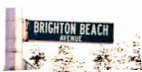
This past Sunday, the (fantastic) City section of The New York Times delved into the smoking habits of the Russians in Brighton Beach (Urban Tactics: Marlboro Men).

While New York has had a ban on smoking in bars and restaurants for a couple years now, the ban has had a hard time among Russian restaurants in Brighton Beach, perhaps because “As the journalist Alexander Grant wrote in Novoye Russkoye Slovo, the city's main Russian-language daily, in 2003, when the city's antismoking law went into effect, cigarette smoke is to the Russian restaurant as steam is to the steam bath.”

Statistics apparently put the number of Russian-American smokers at 30 percent within New York City, above the city average of 18 percent. The Department of Health and Mental Hygiene is trying to bring this figure down, but local Russians don’t seem to be budging.

Conditioned by years of half-baked self-improvement campaigns in the Soviet Union, former Soviets’ here still see such efforts on the part of government agencies with cynical eyes. “But encouraging Russians to stop smoking is like weaning Americans off baseball…,” The Times concludes.

(Photo: Brighton Beach Avenue billboard by Angela Jimenez for
The New York Times)

Tuesday, December 20, 2005

Baryshnikov Arts Center opens

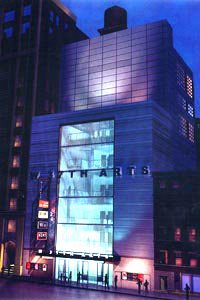
Yesterday, the Novoye Russkoye Slovo’s Baryshnikov has opened his laboratory discussed Mikhail Baryshnikov’s latest project, the Baryshnikov Arts Center (BAC) at the performing arts complex 37 ARTS (450 West 37th Street). The center’s goal is to be a laboratory of creativity and to inspire young, talented people.

The center occupies the top three floors of 37 Arts, a space that cost around seven million dollars, according to the NRS. Around six million has already been raised to cover the costs of the premises. Baryshnikov himself has put up over one million dollars towards the center’s operating expenses, with the remainder coming from donors and other sources.

“Baryshnikov’s name is has currency. His reputation is unusually high in the world of art and he is known by millions. Not only from old videos but also from recent modern dance performances and from Sex and the City. His expressive face has graced ads for very expensive watches which can be seen in magazines and in the programs of prestigious concert halls,” the paper states.

The NRS concludes, “A dancer, a director, an actor, an organizer and once again a dancer, he can at 57 years old still change his course more than once, guided by curiosity, thirsting for knowledge – qualities he believes are absolutely necessary for every creative person to have.”

Monday, December 19, 2005

Astoria's Bohemian Hall

Back in 2000, the New York Times profiled Bohemian Hall in A Beer Garden in Astoria Shelters a Lost Era.

The building features New York's last remaining beer garden, "a grove of about 20 old trees -- maples, sycamores and lindens -- enclosed by a high wall" with "the sheltering feel of an ancient European village, where the townspeople gather for beer and gossip."

Bohemian Hall was built in 1930 as a cultural and community center for local Czechs. They mostly lived in Yorkville in Manhattan at that time, but built the hall in Astoria because there they were able to build big.

The beer garden might be out of season, but Bohemian Hall is hosting a New Year's Eve celebration, with an all-night buffet, open bar and live entertainment. The event runs from 8:00 p.m. to 4:00 a.m. and tickets cost $65.00. Call 718-274-4925 for more information.

Friday, December 16, 2005

ESB Staircase Race: Czechoslovakia v Poland

One of the myriad full-text books available via Google book search is Stuart Goldenberg’s Only in New York: 400 Remarkable Answers to Intriguing, Provocative Questions about New York City, a collection of the author’s answers to readers’ questions about the city published in the New York Times.

Of particular interest to Slavs of New York is page 178, where we find the question “Is it true that Olympic skiers once trained by climbing the stairs of the Empire State Building?”

The answer?

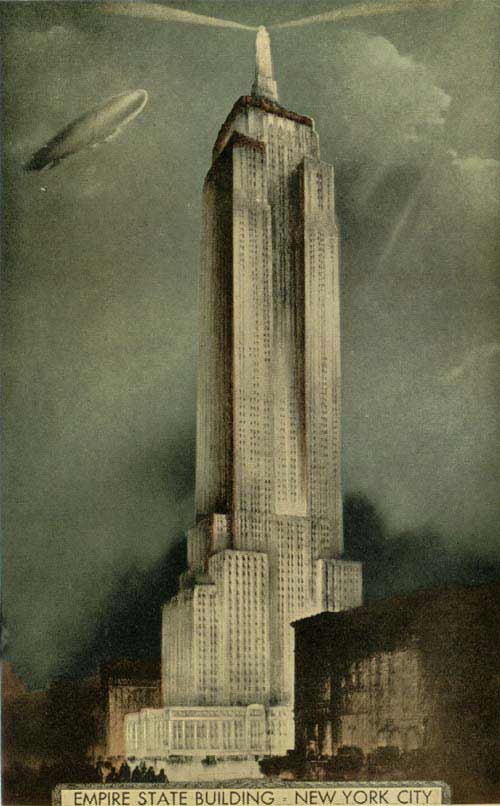
Apparently, the Polish ski team made it from the fifth floor all the way up to the 102nd in just 21 minutes back in 1932 as part of their training for the Olympic 50km cross-country race in Lake Placid.

Once they got there, however, they were greeted by the Czechoslovak team (who beat them by taking the elevator). The Czechoslovak team then challenged the Poles to a race up the stairs, but the 17 February 1932 edition of the Times reports that the building management was "not agreeable on the proposal to use the staircase for international sports."


(Photo: Empire State Building from
New York Architecture Images)

Tuesday, December 13, 2005

Google Book Search

Slavs of New York has just discovered Google Book Search and you should too. A number of Slavic New York gems are pretty much there for the taking. Here’s some selections to get you started:

A useful guidebook to help in the search for Slavic food in the five boroughs is
Nosh New York: The Food Lover's Guide to New York City's Most Delicious Neighborhoods by Myra Alperson.

Also check out
The Spiritual Traveler: The Guide to Sacred Spaces and Peaceful Places by Edward F Bergman, which gives details for many Slavic churches in the city.

Many Slavic communities show up in
The Financial District's Lost Neighborhood by Barbara, Martin Rizek, Joanne Medvecky.

New York figures prominently into
A Passion for Polka: Old-Time Ethnic Music in America by Victor Greene and is mentioned throughout Russians in America by Alison Behnke as well.

New York's Unabomber

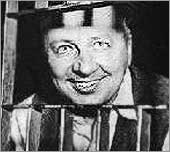
While researching Croatian terrorists in New York recently, Slavs of New York discovered the story of George Metesky, a Polish-American New Yorker. Metesky ran a Unabomber-like campaign of terror in the city in the 1940s and 1950s and was recently featured on HBO in Forensic Features: The Mad Bomber.

In November, 1940, Metesky began his career as a terrorist by placing a bomb on a window ledge at the Consolidated Edison Building on West 64th Street in Manhattan. It was discovered unexploded and police considered it an isolated incident.

A similar bomb was discovered near Con Edison offices on East 19th Street in September 1941, and police received a letter from the would-be bomber that December. The letter stated that the bomber would "cease his activities for the duration of the war, but added, ' I will bring the Con Edison to justice - they will pay for their dastardly deeds." Seventeen similar letters were also sent to newspapers and business including Con Edison itself.

In March 1950, another unexploded bomb was discovered at Grand Central, and in April 1950 another bomb actualy did go off in a phone booth at the New York Public Library. During the next seven years, nearly 40 bombs were discovered around the city and at least twelve did in fact explode. At least ten people were injured by the Mad Bomber, as he came to be known.

Metesky was finally arrested at home in Waterbury, Connecticut. Police discovered a bomb-making workshop in his garage which he made no effort to hide. As it turned out, Metesky's grudge against Con Edison was the result of an accident at a United Electric & Power Company plant where he had worked. He blamed the accident for his later diagnosis of tuberculosis, but his disability claim was denied. United Electric & Power Company was one of the smaller companies later folded into Con Edison.

George Metesky was deemed mentally unfit to stand trial and commmitted to a psychiatric facility. He was released in 1973, and died in 1994 at the age of 90. Check out
George Metesky: New York's Mad Bomber for more details.

Previously on Slavs of New York:
Croatian terrorists...in New York?

Monday, December 12, 2005

Stalinist Architecture via New York?

New York Architecture Images has a fascinating article up about New York's influence on the gems of Stalinist architecture the Seven Sisters buildings in Moscow.

According to the article, none other than the
Municipal Building in the Financial District was the basis for the Seven Sisters and similar monumental public buildings throughout the Soviet Union.

The Municipal Building, built in 1914, itself was based the 16th century Giralda Tower in Seville, Spain, based on the even older Koutoubia Minaret in Morrocco.

Making ends meet for Polish immigrants

The latest issue of Voices That Matter includes “Making ends meet for Polish immigrants,” translated into English from the Polish-language Nowy Dziennik.

The article delves into the question of "what do Polish immigrants spend their money on?" It paints a picture of careful consumers who strive to save as much money as possible.

Alcohol, nevertheless, remains a wide-spread luxury. “A Pole is not a camel, he has to drink,” Marek of Greenpoint told the paper. “I don’t even count how much I spend on beer because it upsets me, but I think it probably would be a lot. I have to be able to have some fun after work.”

Aside from alcohol, rent appears to be the biggest expense, followed by groceries. Education and medical expenses make up another big chunk of many Polish immigrants' budgets, though some in the article admitted to putting of medical care to save the money.

Not everyone is in such dire straights, however. Irena, a tax preparer whose clients are mostly Polish, told Nowy Dziennik that most of her clients declare about $30,000 per year, with more than a quarter making over $40,000 and about ten percent making over $100,000. The more wealthy Polish immigrant, she believes, are younger people with managerial positions and good educations working in US companies. Similarly, business owners and smaller contractors are doing quite well for themselves.

"So maybe Poles simply complain more than they have reason to, as it is a part of their nature. But, they are able to save. Or maybe only some don’t have real reasons to complain; the truth is somewhere in the middle," Nowy Dziennik concludes.

Tuesday, December 06, 2005

Gogol Bordello hits the UK

Last weekend, the BBC Ukrainian Service ran an article about New York-based gypsy punk band Gogol Bordello on Saturday, Ukraine gypsy punk on world stage, as the band is currently playing gigs in the UK.

The article gives a good background on the band and its frontman, Eugene Hutz. "Gypsy punk, a term invented by Eugene himself, is a result of his diverse family roots: as a child he spent a lot of time in Transcarpathia where influences of Ukraine, Hungary, Slovakia and Roma blend to form a unique cultural tradition," the BBC writes.

Hutz commented, "I've spent time looking for what I wanted to express in my music, but now, with the third album out, it's much clearer, it has crystallized - this mix of my cultural inheritance and personal experience."

The article also includes a link to hear the Gogol Bordello song "Start wearing purple."

(Photo: Eugene Hutz (r) stars with Elijah Wood in Everything is Illuminated, from www.bbc.co.uk)

Friday, December 02, 2005

Knizhnyj Magazin № 21

Earlier this month, the Novoye Russkoye Slovo ran a profile of Irina Taic, proprietor of Knizhnyj Magazin № 21, Manhattan’s only Russian bookstore (NRS: Fatal Attraction. To Books).

Born in Kiev, Taic emigrated to the US in the early 1990s. She opened the store on Fifth Avenue near 23rd street about two years ago. Many will remember that long-time Russian bookseller Viktor Kamkin was in the same area but closed several years ago. Tais told NRS that she was running her bookstore a bit smarter: its second-floor space carries a lower rent, and the only employees are her and her daughter.

Another trick up Tais’s sleeve is the fact that she regularly holds events at the store, which helps to make the public aware of the shop’s offerings. “The first one to come was Solomon Volkov,” she told the NRS. “So many people showed up that there was nowhere to stand. The shop wasn’t even finished yet. Books weren’t on the shelves yet. But we brought in several hundred dollars that night anyway.”

Tuesday, November 29, 2005

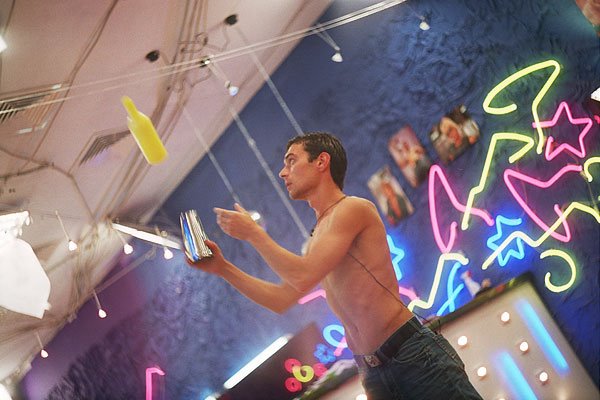
Golod wraps up in Queens

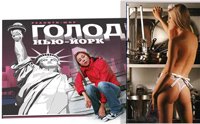
The Russian reality TV show Golod (Hunger) finished its second season in Queens on 20 November with Katja Nemova, a 24 year-old office manager from Samara, Russia, taking home the grand prize of a $2000 monthly “pension” for life.

In an interview after the announcement, Nemova said that the show had led her to discover that she wants to be a photographer and now intends to go to school in that field.

Asked if she would recommend a stint on a reality TV show having experienced it herself, she said, “if there will be a Golod 3, I would drive all of my friends to the casting call myself! Go, go, I would be so happy if you would do it!”

The New York season of Golod began on 7 August, with the contestants living at Silvercup Studios, “where the last season of Sex and the City was filmed. But in Golod, there was no sex, and romantic liaisons quickly broke up,”
NRS commented. Golod ended with Nemova being named the winner on 20 November.

Meanwhile, another Golod contestant, Natal’ja Rubcova made news last week by appearing in the December issue of the Russian edition of Playboy magazine (NRS: Golod – no old maid, a Playboy model). According to Rubcova, age 21. the photo shoot was the fulfillment of a dream from her childhood.

Wednesday, November 23, 2005

Runglish

Back in May, Russian Bazaar took a look at the Russian spoken in Brighton Beach heavily mixed with English, called Runglish or Runglisky (The inevitable birth of Runlgish – When Russian and English merge). The New York Times folowed up in June with Brighton Beach's Runglish-Speaking Immigrants.

Runglish is essentially Russian with a large number of words replaced with Russified English ones. Words for foods rare in Russia but common here are among the most widespread English bits in the Runglish lexicon. So are terms related to technological advances made after the immigrants left their homeland.

Russian Bazaar rightly points out that Runglish is not just taking place in Brighton Beach among the immigrants in America - it is also widespread among Moscow media who use Russified English words like manazher (managers), metroseksualy (metrosexuals), khipstery (hipsters), rekruting (recruiting) and benefiti (benefits).


The Times article also points out that certain Russian words have entered the English language, such as apparatchik, intelligentsia, commissar and samovar. The English influence on Russian among recent immigrants, however, is clearly greater.

Short Runglish lexicon:

Appointments: Appointmyenti
Cross-Bronx Expressway: Cress Bonx Exprezvey
Driving Upstate on the Highways: Draivuyem v Apsteit po Haiveyam
Hamburgers: Hyam-boorgoors
Ice Cream: Ize Cream
Iced Coffee: Ized Cyawfeh

Know-How: Nou-Hau
Potatoes: Potyaytoaz
Sim Cards: Syim Karti

Sliced Cheese: Slaysayushiy Chiz
Turkey: Tyurki

(Photo from http://www.russnet.org/why/p8.html)

Tuesday, November 22, 2005

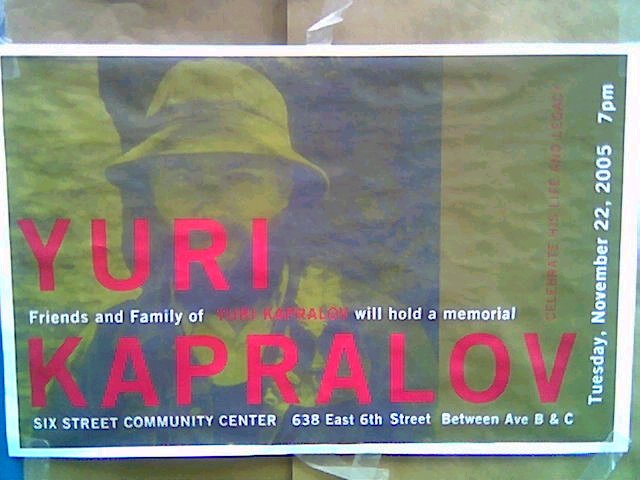
This just in: Kapralov memorial tonight

Friends and family of writer, artist and East Village figure Yuri Kapralov will hold a memorial at Six Street Community Center (638 East 6th Street between Avenues B and C) tonight at 7:00 p.m.

Kapralov died of a stroke on 27 August following a battle with liver disease.

His memoir, Once There Was A Village, focuses on Alphabet City in the late 1960s and offers important insights into the local Polish, Ukrainian, Russian and Carpatho-Russian (Rusyn) communities.

For more on Kapraov, see his obituary from the Villager, "Yuri Kapralov, a 'grandfather' of E.V. counterculture"

Previously on Slavs of New York! Books: Once There Was a Village and Yuri Kapralov dies at 73

Monday, November 21, 2005

Infused Vodka Bar Crawl

New York Magazine recently published an internet-exclusive, Bar Buzz: An Infused Vodka Bar Crawl. The bar crawl in the article is led by a true master, John Rose, author of the Vodka Cookbook. Who better to guide us through the city's best Russian bars?

Rose leads us first to
Uncle Vanya (315 West 54th Street at Eighth Avenue), then to the near-by Russian Vodka Room (265 West 52nd Street between Eighth Avenue and Broadway) and finally to Anyway Cafe (34 East 2nd Street at Second Ave) way down in the East Village.

Though not on the bar crawl, a sidebar points out that something similar to Rose's Spirited Hot Chocolate is served in Greenpoint at
CoC66 (66 Greenpoint Avenue between Franklin and West Streets), and that Savalas (285 Bedford Avenue between Grand and South First Streets) has come up with...Oreo vodka: "Wrap 6 bags of double-stuffed Oreos in a cheesecloth and steep it in 4.5 liters of vodka for four days."

The artice also features a number of Rose's vodka recipies you can try at home:

Friday, November 18, 2005

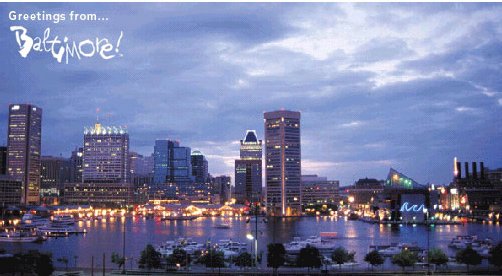
Fieldtrip: Slavic Baltimore

Judging from google searches, the biggest Slavic group in Baltimore would seem to be the Czechs. Major organizations include the Czech and Slovak Heritage Association, the Bohemian National Cemetery and a Sokol.

The Maryland Historical Society also has a special Poles are also well-organized in Baltimore, with the Polish Community of Baltimore and the Archives of Maryland Polonia. And there are a few options for Polish- and Ukrainian-style pierogies ( Citypaper: Where, oh Where are Baltimore's Pierogie?).

The Slovene presence seems to have dwindled down to just the Slovene Center Bowling Lanes & Ballroom, while refugees from elsewhere in the former Yugoslavia are breathing new life into neglected neighborhoods (Citypaper: East Side Story).

Rivaling the Czechs for a Baltimore-based web presence are the Russians (check out Citypaper: Moscow Nights: Getting Down With Baltimore's Burgeoning Eastern Bloc). There is a community site, Russian Baltimore, and there is also the Baltimore Russian Festival. Baltimore is also home to a traditional folk dance troup, Kalinka, and the Crazy Russian strip club (though it isn't clear whether there is actually anything Russian about it).

The main reason for Slavic New Yorkers to make the haul down to Baltimore this winter, though, is
Sacred Arts and City Life: The Glory of Medieval Novgorod, at the Walters Art Museum from 19 November through 12 February 2006.

Novgorod, about 100 miles south of St. Petersburg, is Russia's oldest city, settled as early as 895 A.D. Its soil is particularly good for preserving organic materials, making the entire city a treasure trove for archeologists.

The Walters Art Museum is the only American venue to see this exhibit, featuring art and artifacts culled from the collections of the the State Russian Museum in St. Petersburg and the Novgorod Museum Federation.

Nearly 300 objects are on display, including 35 medieval icons, ecclesiastical objects, carved wood and bone, leather goods, jewelry, musical instruments, and - perhaps the most important artifacts from Novgorod - birchbark documents. There will also be large photograhic murals documenting archeological digs in the city. The exhibit covers the 9th through 16th centuries. More info here.

The Walters Art Museum is organizing events in conjunction with the exhibit, including:

Check out the New York Times review, 'Sacred Arts and City Life.'

Previously on Slavs of New York! New York Times Fall Preview

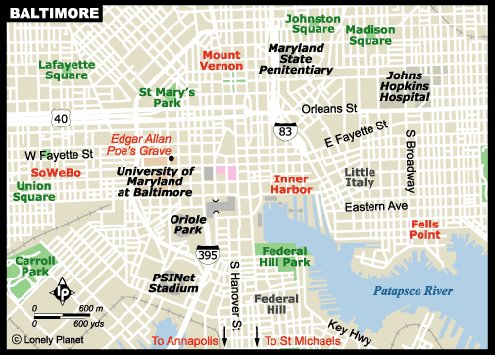
(Map from lonelyplanet.com; Photo (below): St. George and the Dragon," State Russian Museum, St. Petersburg)

Tuesday, November 15, 2005

Montenegrins in New York City

Montenegrins in New York City are hard to pin down. There are definitely some here, though there does not seem to be any sort of organized community. Most seem to associate with the local Serbian community.

Montenegro does have a rather interesting link to New York City, though, via F. Scott Fitzgerald. In the Great Gatsby, Jay Gatsby boasts of having been awarded a Danilo's Cross in Montenegro:

"...I was promoted to be a major, and every Allied government gave me a decoration - even Montenegro, little Montenegro down on the Adriatic Sea!'

Little Montenegro! He lifted up the words and nodded at them - with his smile. The smile comprehended Montenegro’s troubled history and sympathized with the brave struggles of the Montenegrin people. It appreciated fully the chain of national circumstances which had elicited this tribute from Montenegro’s warm little heart. My incredulity was submerged in fascination now; it was like skimming hastily through a dozen magazines.

He reached in his pocket, and a piece of metal, slung on a ribbon, fell into my palm.

"That’s the one from Montenegro."

To my astonishment, the thing had an authentic look.

"Orderi di Danilo," ran the circular legend, "Montenegro, Nicolas Rex."

"Turn it."

"Major Jay Gatsby," I read, "For Valour Extraordinary."


The Danilo's Cross is named after a Montenegrin leader from the Njegos dynasty. At the time of the writing of the Great Gatsby, F. Scott and Zelda were frequent visitors to both Paris and Antibes, where the Montenegrin royal family was living in exile. However, there is no evidence they did (or did not) meet.

For more concrete information about Montenegrins in New York, check out Plav.Net, a website by Muslims from the Plav-Gusinje region of Montenegro, many of whom live in the metro area. In SoHo, there is also Crna Gora Film and Television, but the website seems to be down and no more information is available. Raccoon is also active with local Montenegrins. And even though it serves Italian food, Amici Amore (29-35 Newtown Avenue at 30th Street) in Astoria is owned by a Montenegrin, Dino Redzic.

Monday, November 14, 2005

Croatian terrorists...in New York?

A couple weeks ago, Slavs of New York ran the post Slovenes in the East Village, which caught the eye of Glory of Carniola. To be mentioned on such a fantastic blog was great, but what was even better was the comments by DarkoV.

Apparently, back in the 1970s and 1980s New York City had its very own Croatian nationalist terror attacks. Who knew?

The group was called the Croatian National Resistance, or Otpor (or Odpor) for short. It was founded by Vjekoslav “Maks” Luburic, a leader of Croatia’s World War II-era Ustasha government.

Aside from New York City, the group was also active in Chicago and Los Angeles, with other members also in Cleveland, San Francisco and Toronto as well as in South America and in Europe.

Their primary goal was to secure the independence of Croatia from the Socialist Federative Republic of Yugoslavia but their activities mostly consisted of attacks on pro-Yugoslav or moderate Croats in the US and elsewhere.

Among the incidents:

29 December 1975 –
LaGuardia Airport attack. Croatian Nationals at LaGuardia Airport kill 11 and injure 75 after detonating a bomb with the force of 20 sticks of dynamite in a coin operated locker at the TWA terminal. The force of the explosion turned locker doors and metal pieces from baggage carousels into deadly shrapnel.

10 September 1976 – TWA hijacking. Terrorist Zvonko Busic, his wife and three other Croatian terrorists, as a result of concerns about the plight of Croatia within then communist Yugoslavia, hijack a TWA jetliner from LaGuardia Airport, bound for Chicago and re-routed to Paris, seizing 86 passengers. There were no weapons aboard the plane, but genuine explosives were left behind in a Grand Central Station baggage locker in order to create the impression that there were weapons on the plane. Bomb Squad Officer Brian Murray tragically lost his life attempting to deactivate the bomb. Another Glory of Carniola reader adds, that was the flight where Vesna Vulović secured the most terrifying world record of all: surviving the highest fall without a parachute. And apparently Vesna landed straight into a folk song, “Vesna stuardesa” (check out Aviation Security International, How to Survive a Bombing at 33,00 Feet)

1977 - Assasination attempt on Radomir Medic at United Nation mission.

1978 - Two killed. Yugoslav immigrants Ante Cikoja and Krizan Brkic were killed in New York City and Los Angeles, resp.


1978 - Two critically wounded. Another two Yugoslav immigrants critically wounded in an attack in New York City.


2 July 1982 –
Landmark sentencing of six Otpor activists on racketeering charges, including two planned murders.

6 July 1982 – Bombings in New York. Four New York Yugoslav sites bombed by Otpor in retaliation.

25 January 1983 -
The First Otpor RICO Trial in New York City. Decision handed down in the case of USA vs. Franjo Ivic Nedjelko Sovulj, Ivan Cale and Stipe Ivkosic. All four Otpor members were convicted on various charges; Cale was sentenced to 35 years, Ivic to 30, Ivkosic and Sovulj both to 20.

14 April 1983 -
The Second Otpor RICO Trial in New York City. Thirteen-week trail results in the conviction of six more Otpor activists. Defense lawyers accused the prosecution of being in bed with UDBA, the Yugoslav secret police, and alleged their clients were victims of the communist Yugoslav government, which influenced the US government to bring forward the charges.

The group was the subject of an episode of the FBI Files on the Discovery Channel which aired about this time last year.


DarkoV concludes: It was not a pleasant time to be an American of Croatian birth, who had no interest in any violent overthrow. Luckily, the main organizers were arrested or they disappeared, so life returned to normalcy again, namely, back to the times when most Americans didn't know who or what a Croatian was.

Thanks for the info, DarkoV!

Previously on Slavs of New York: Slovenes in the East Village and Manhattan's Croats

Thursday, November 10, 2005

Golod: Berlin vs. New York

RussianNY has also cast its gaze on the reality TV series Golod (Hunger): Survivor - extremely Russian!

Summarizing the show, RussianNY says, “the participants must share the fate of many Russian immigrants thrown into the fire of the Big Apple: not knowing three words of English, the young people must not die of hunger and get what they need to survive in any way they can on the unforgiving streets of Queens!”

“To the credit of the involuntary immigrants,” the article continues, “they have demonstrated exceptional ingenuity, each in turn justifying the moral of the saying “golj na vydumku khitra (the poor are clever in ideas).”

The article also compares this season to last year’s Golod, set in Berlin:


Last year, the organizers threw the group of guinea pigs in Berlin without any knowledge of German… and even did not tell them where they were being taken, which almost ended in an international scandal when the police intervened after receiving numerous reports about strange Russians ready to do anything to earn a bit of crumbs. This year, organizers decided to soften the conditions – on the insistence of the Ministry of Internal Affairs, which was not pleased that the contestants were being taken around the world like little more than prisoners of 21st century slave traders. And beyond that, the show’s organizers have guaranteed the Office of Film, Theater and Television of the Office of the Mayor of New York that none of the participants will suffer or die of malnutrition during filming.

In November 2003, Reuters featured the Berlin show ("Hungry" Russians Stranded On TV Game Show in Berlin), after the daily Bild reported that "Russian TV lets young women starve in a Berlin container." In the Reuters article, TNT producer Dmitry Troitsky responded to accusations that the contestants would turn to crime or prostitution, saying that "the contestants are sent into the city with camera teams, so there is no question of them resorting to crime."

Tuesday, November 08, 2005

Hunger in Queens

Via Gothamist, Slavs of New York has discovered that the Russian reality TV show Golod (Hunger) is going on right now in New York. The show started on 7 August after a successful first season set in Berlin.

From the website: "13 blindfolded people were taken from Russia. They must survive 146 days in a foreign city - with no money, no food and not knowing the language. Help is waiting for them, but they must fight for it: the winner of the show will receive $2000 each month for the rest of their life."

The website also lists the rules: "Each week two participants will go out into the city to get food and money. They can do anything to get it and they can return to the house whenever they want. But while they are out looking for food, no one else will be allowed out of the house. Every other week, two participants will fly to Moscow. Here, on live TV, they will fight a verbal duel. From the results of viewers' voting, one of them will leave the show and the other returns to the house."

Gothamist: Going Hungry for Russian Reality TV

For more on reality TV in Russia, check out
As the novelty of “Big Brother” and “Dom-2” wears off... in the St. Petersburg Times.

Monday, November 07, 2005

Slav of New York: Leon Trotsky

And while we're on the Revolution Day theme, don't forget that Leon Trotsky, one of the leaders of the revolution, lived in New York for a couple months in 1917. Trotsky was born in Yankova, Ukraine, in 1879 and after being expelled from France and Spain he ended up in New York in January 1917. Together with his wife and two sons, he lived at 1522 Vyse Avenue in the Bronx.

Trotsky was active in the New York Russian expatriate community, and particularly in the communist movement. He wrote for the newspaper Novyi Mir (The New World), then based at 77 St. Mark's Place in the East Village, and also lectured at the East Village's Russian Free University on East Seventh Street.

He left New York March 1917 to return to Russia to join the other leaders of the revolution. At the time, the Bronx Home News ran the headline "Bronx Man Leads Russian Revolution."

Trotsy is remembered in the city at
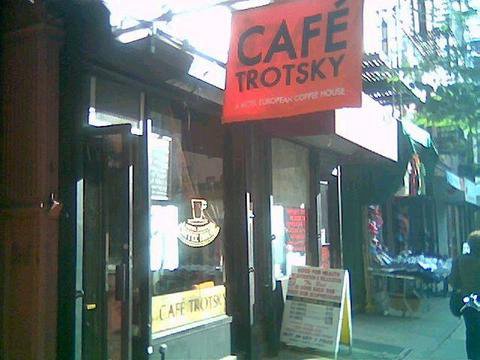
Cafe Trotsky (192 Orchard at Houston), a Viennese coffee house on the Lower East Side.

Read Leon Trotsky's
My Life, chapter 22, "New York."

Friday, October 28, 2005

Slavic Staten Island

The Staten Island Ferry is celebrating 100 years of service with a number of events this weekend as part of the annual Ferry Fest.

Of interest to Slavic New Yorkers are the performances on the ferrys and in the terminals this weekend, since Russians will be among the performers. Performances will be held between noon and 9:00 p.m. on Saturday and between 11:00 a.m. and 7:00 p.m. on Sunday.

In recent years, Staten Island has seen such a large influx of Russians that it raised a bit of xenophobia. The construction industry in particular resented the newcomers, since many of the Russians worked in that field. The Russian American Council of Staten Island was formed in 2003 in large part to help combat xenophobia and prejudice against Russians in the area. There are around 50,000 Russian-speaking immigrants in Staten Island today (Staten Island speaks Russian, from Voices that Must Be Heard).

Russians have their own community website, Russian Staten Island, and a publication called Our Home - Staten Island, published in Russian. There are also several restaurants, including Cafe Shinok (2230 Hylan Boulevard) and Atlantis (2066 Hylan Boulevard).

The Polish community is also well represented. The first-ever Polish Festival in Staten Island (from Nowy Dziennik) was held in 2002 and has since become an annual event.

Among the prominent Polish landmarks in Staten Island is the Church of St. Stanislaw Kostka (109 York Avenue), which since 1994 has maintained the Polish School of John Paul II. There is also at least one restaurant, The Polish Place (19 Corson Avenue, check out the Village Voice review).

Finally, Ukrainians have at least one church, Holy Trinity Ukrainian Catholic Church (288 Vanderbilt Avenue). The parish begain 1949, but the current building was built between 1957 and 1966.

(Photo: Whitehall Terminal with Ferryboat and skyline March 2005. Photo by Henryk J. Behnke. Staten Island Museum.)

Thursday, October 27, 2005

New York City's Balkan music scene

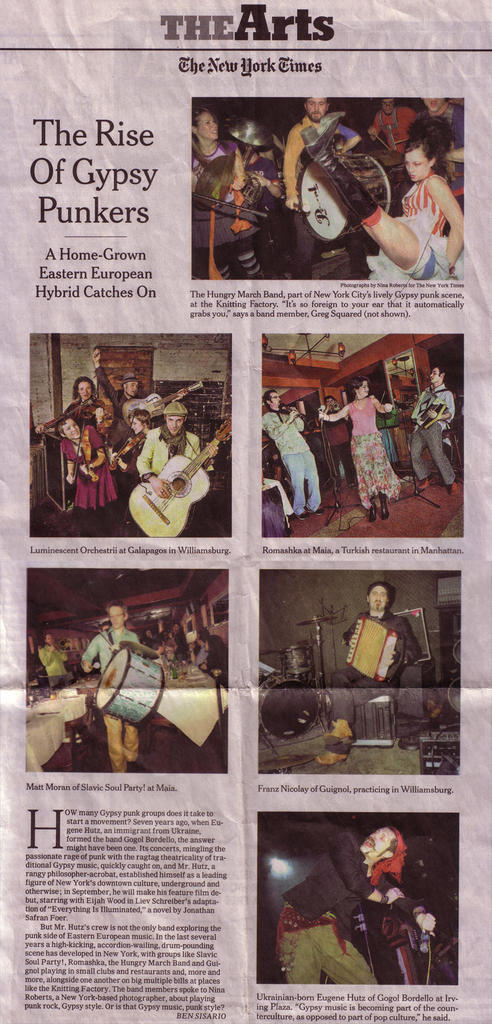
One of the least-expected waves to hit New York City is the current Balkan gypsy music fad, led by Gogol Bordello and its illuminated frontman Eugene Hütz.

The scene started slowly at Mehanata, on the second floor of an unassuming building on the corner of Broadway and Canal Street in Chinatown. Hütz started out there as a DJ and quickly built a following. Gogol Bordello quickly followed, forming in 2000. The band performs what it calls "punk cabaret" music, influenced by Hutsul, Ukrainian, Romanian and Gypsy music. Hütz's rise recently culminated in a starring role in the movie Everything is Illuminated.

There are easily a dozen bands in the five boroughs playing one sort of Balkan music or another. Among the current favorites are Zagnut Cirkus Orkestar, Romashka, Hungry March Band and Luminescent Orchestrii. The most established are Zlatne Uste and Slavic Soul Party!, and one old favorite we'd love to see make a comeback is Pectopah.

You can catch these bands at shows all over town, particularly at Mehanata, Hungarian House, Barbes and Maia Meyhane. Other venues that frequently feature these bands include the Knitting Factory, Nublu and Satalla.


For anyone interested in learning the traditional dances that accompany the music, there's NYC Folk Dance. Each year, they schedule two seasons of low-key dance lessons as part of their Folk Dance Fridays, Family Dance and Balkan Cafe series at Hungarian House on the Upper East Side. They also run a Wednesday night Balkan dance class in Chelsea.

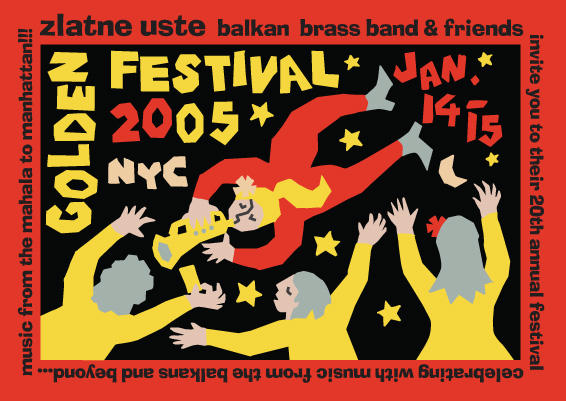
The high point of the Balkan music year in the city is definitely the Golden Festival, which next takes place on 13 and 14 January 2006. In its 21st year, the annual gathering is organized by Zlatne Uste and features countless performers on multiple stages, Balkan and Middle Eastern delicacies and art vendors.

But before that comes the first New York Gypsy Festival, which opens on Saturday and runs through 6 November. The festival, like most of the bands and events, does not feature music from Slavic lands exclusively, but covers a wider cultural area that includes Romania, Turkey and the Middle East. The highlight will be an eight-hour marathon of performances on 6 November at the Roxy.

And if you can't attend any of the events, or just want a souvenier, check out the new double CD produced by Mehanata. Tracks were provided by many bands that have performed at Mehanata, including Balkan Beat Box, the Dolomites, Gogol Bordello, Guignol, the Hungry March Band, J.U.F., Luminescent Orchestrii, Romashka, Shaat’nez, Slavic Soul Party!, Yuri Yunakov and Zagnut Cirkus Orkestar.

But why the sudden craze? Inna Barmash, the singer of Romashka, told the Times of London in May that “There is something about gypsy music that people just respond to, whether it’s flamenco, Hungarian gypsy or Russian gypsy — it catches people’s souls in a very immediate way. People seem to know how to dance to it intuitively” (check out The Gypsies pitch up in the New York Times). Matt Moran of Slavic Soul Party! told the Times that he thinks part of the reason is the opening up of the Eastern Bloc and the floods of new immigrants and refugees from Eastern Europe and the Balkans. But the music and the passion behind it are the real pull - who could resist it?

Off to Siberia!

The old Siberia, in the 1/9 subway station at 50th Street was renowned for being the only bar in the city located in the subway, and was also known as a hangout for journalist-types. When it was evicted several years ago, it seemed like that was that. However, it quietly reopened near Times Square and is once again a hotspot.

The bar took its name from the fact that the old site was a KGB drop-off point in the 1950s. The new bar keeps the tradition as well as the kitchy Soviet decoration. Outside, there is no sign - the door is marked by a single violet light bulb. According to the owner, Tracy Westmoreland, "If you can't find the place, you aren't smart enough to be here."

The bar also featured into a 2001 low-budget documentary, which deals with the owner's fighting to save the old bar from eviction. Among his ploys ws to chain himself to a toilet in front of the landlord's offices in Japan. Check out the film,
Siberia and the American Dream, here.

And also check out the
New York Times review, and Sipping the Gloom, With Hank on the Jukebox, as well as New York Hangover.

Siberia is located at 356 West 40th Street.

For more Soviet kitch/chic in Manhattan, check out
Pravda and KGB.

Wednesday, October 26, 2005

Okeanos spa opens

Midtown saw the opening of Okeanos spa earlier this month. The spa is an updating of the traditional Russian banya experience, though more in the tradition of the Tsars than that of the average Russian (for that, check out the Russian and Turkish Baths, 268 East 10th St).

All visitors arrive a special Russian-style welcome, "a heated buckwheat wrap scented with rich, exotic Russian spices" placed on your shoulders. Afterwards, there is a wide array of treatments to choose from.

Key treatments involve the banya, the traditional Russian steam room. This is to be followed up by platza, the traditional where you are beaten with birch branches... though the website describes it as "the revitalizing experience of bundled birch leaves brushed against sauna-warmed skin." Platza treatments, according to the website start at $50.00, or $35.00 in combination with a massage.

Another interesting treatment is the Siberian Hot Stone (90 minutes, $210.00). "Powerful penetrating heat therapy heals the body with warm river stones placed along the back, hands and feet. Deep massage calms, soothes and restores."

Heidsick & Co. Monopole champagne - the personal favorite of Nicholas II - as well as ZYR Vodka and Petrossian caviar are also available.

See also From Russia with Banya.


Okeanos is located at 211 East 51st Street. For more information, call 212-223-6773.

RIP: Leshko's and Kiev

As more and more Slavs move out of the East Village, their presence is being felt less and less. Two major landmarks recently disappered: Leshko's and Kiev.

Of course, both are still standing. It's just that both have been renovated, reimagined and reopened, losing much (if not all) of their Ukrainian flavor along the way.

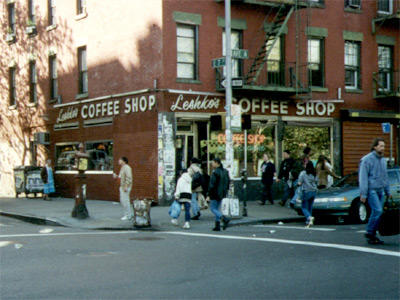
First to go was Leshko's (111 Avenue A at 7th Street), which opened in 1957. New owners closed down the old-school favorite in 1999 and turned it into something that ended up in an issue of Wallpaper* not long after. The menu lost almost all of its Slavic dishes, with the exception of pierogies. But they were reworked almost beyond recognition - mushroom and leek pierogies?

That state of affairs lasted until the fall of 2003, when it changed hands again and things went from bad to worse as far as the Slavic state of the place was concerned (check out ‘New Leshko’s’ closes; end of pierogis from the Villager).
It is now a pan-Latin restaurant called Yuca, bar and cocina Latina.

Now, the iconic Kiev (117 Second Avenue at 7th Street) is gone too. Opened sometime in the 1970s, the restaurant opened its doors after two years of renovations in February of 2004. The change was dramatic, as far as the interior design was concerned. And as far as the menu was concerned. Kiev became... an Asian restaurant. An Asian restaurant that serveed fish and shrimp pierogies, beet ginger blintzes and potato pancakes made from parsnips... Now, even that incarnation of Kiev is history. As of late September, the restaurant has "For Rent" signs in the window (check out The Anti-Plywood: Taqueria de Mexico, Fluff, Kiev at Eater).


But, all is not lost - the East Village does still boast a number of authentic Ukrainian restaurants: Odessa, the Ukrainian East Village Restaurant and Veselka, at least. Enjoy them while you still can...

(Photo: (above) Before, from http://www.dyske.com/index.php?view_id=356, and (middle) After, from http://www.palateking.com/l.html and (below) http://blogs.yahoo.co.jp/yuccactus0704/4476072.html)

Tuesday, October 25, 2005

Chagall Peace Window rededicated

The Chagall Peace Window returned to the Visitors’ lobby of the United Nations yesterday with a dedication ceremony timed to coincide with UN Day and the 60th anniversary of the organization’s founding.

The window was originally installed at the site in 1964, in honor of former UN Secretary-General Dag Hammarskjöld and all those who have lost their lives in the pursuit of peace. It is a free-standing piece of stained glass.

Its creator, Mark Chagall, was a Jew born in Viciebsk, Belarus. His work is important not only to Jewish culture but to Belarusian culture overall. Over the years, the work began to show its age. The restoration was undertaken by the Maecenas World Patrimony Foundation (MWPF). Though the restoration was actually finished in the summer of 2001, the dedication ceremony slated for UN Day that year was postponed due to the 11 September attacks in New York. The Visitors’ Lobby of the UN building is open to the public.

Monday, October 24, 2005

Slavic diplomatic buildings in New York City

A number of diplomatic missions from Slavic countries occupy landmark buildings in Manhattan. From the AIA Guide to New York City:

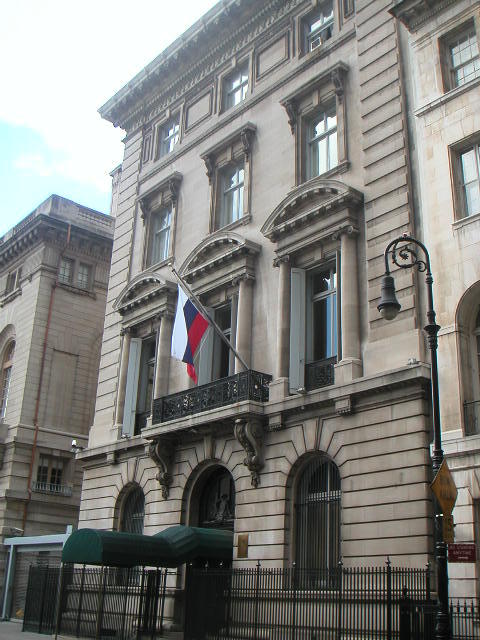
The Permanent Mission of the Russian Federation to the UN (136 East 67 Street) did not make the cut for the AIA Guide, but the Consulate of the Russian Federation (9 and 11 East 91st Street) did.

Built in 1902-1903 as the John Henry and Emily Vanderbilt Sloane Hammond House and the John B. and Caroline Trevor House, the Soviet Union purchased the building to open a consulate in 1975.

However, when the USSR invaded Afghanistan, President Carter forbade the opening of the Consulate. The building sat vacant from 1979 until 1992, and deteriorated. After extensive rennovation it opened as the Russian Consulate in 1995 (p. 429, and STREETSCAPES: 9 East 91st Street; A Soviet Palazzo Off Fifth Ave).

The Russian Mission also maintains a diplomatic residence in the Bronx (355 West 255th Street at Mosholu Avenue). The 19-storey apartment building was constructed in 1975 (p. 611).

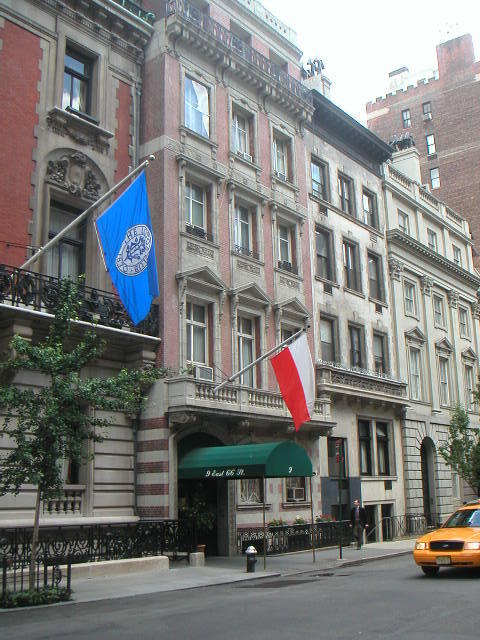
The Permanent Mission of the Republic of Poland to the UN (9 East 66th Street) was built in 1909-1912 as the Charles and Louise Flagg Scribner, Jr. House. The building's architect, Ernest Flagg, was also responsible for many others in the city, including the Singer Building in SoHo and the rectory of St. Mark's in the Bowery Church in the East Village as well as several buildings for Scribner (p. 395).

The Polish Consulate General (233 Madison Avenue at 37th Street) also made the guide. Built in 1905-1906 as the Joseph R. DeLamar House, the building also once housed the National Democratic Club (p. 242-243).

The Permanent Mission of Serbia and Montenegro to the UN (formerly the mission of the SFR Yugoslavia, 854 Fifth Avenue between 66th and 67th Street), was built between 1903 and 1905 as the R. Livingston and Eleanor T. Beckman House (p. 394).

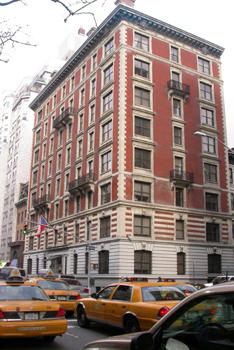
Somehow, the beautiful building of the Permanent Mission of the Czech Republic to the UN (1109-1111 Madison Avenue) did not make it into the AIA Guide...hopefully the ediors will include it in the next edition. The building also houses the Consulate General and the Czech Center.

(Photos: Russian Consulate and Polish Mission, from NY Architecture Images; Czech Mission from www.czechcenter.com)

Wednesday, October 19, 2005

Orphans from Slovakia visit the East Village

A group of kids from an orphanage in Medzilaborce, Slovakia, is in town and staying at St. Nicholas Carpatho-Russian Orthodox Church on East 10th Street and Avenue A in the East Village.

The trip was organized by Mike Kundrat of Binghamton, NY, and was funded by Bishop Nicholas of the American Carpatho-Russian Orthodox Diocese with additional contributions by parishioners of St. Nicholas.

The children arrived earlier this month, spending a few days in Manhattan and then travelling to Homestead, Pennsylvania. They returned to New York Sunday evening and will return to Slovakia on Thursday. The church is hosting an early Thanksgiving dinner in honor of the children tonight. Tickets are still available.

Slavic WIlliamsburg & Greenpoint

The most densely Slavic part of New York City is easily Greenpoint, in Brooklyn. The bulk of the neighborhood is clearly Polish, with the first Polish immigrants arriving around 1890 and founding the monumental St. Stanislaus Kostka Church (607 Humboldt Street at Driggs) in 1896. The building dates from 1903.

The local Polish community – and the church – are so important to the area that Humboldt Street in front of the church is known as Lech Walesa Place, and Driggs Street is called Pope John Paul II Plaza. Another nearby Polish-named landmark is the Kosciuszko Bridge, joining Brooklyn and Queens. Formerly the Meeker Avenue Bridge, it was renamed in honor of Polish patriot Tadeusz Kosciuszko in 1940.

Other Slavic landmarks include the Greek Catholic Church of St. Elias (149 Kent Street between Manhattan Avenue and Franklin Street), and the Polish National Home, better known to local hipsters as the
Warsaw (261 Driggs Avenue).

The nicest Polish bookstore in the area by far is
Ksiegarnia Literacka (161 Java Street). Polish restaurants include Old Poland Bakery and Restaurant (192 Nassau Street), Pod Wierchami (119 Nassau Street), Lomzynianka (646 Manhattan Avenue), Stylowa (694 Manhattan Avenue), Christina's (853 Manhattan Avenue), Polish and Slavic Credit Union (175 Kent Street) and Little Poland (136 Greenpoint Avenue)

On the border of Greenpoint and Williamsburg is one of the most impressive buildings in either neighborhood: the
Russian Orthodox Cathedral of the Transfiguration of Our Lord (228 N.12th Street at Driggs). The church is easily recognizable thanks to its five large copper domes (currently being restored). The church was built between 1916 and 1921, and was modeled after the Moscow Kremlin’s Cathedral of the Dormition. The iconostas within features icons painted by monks from Kiev’s famous Monastery of the Caves. The congregation is largely Carpatho-Rusyn, and the parish priest, Very Rev. Wiaczeslaw Krawczuk, is Belarusian.

Williamsburg, just south of Greenpoint, is also not lacking in Slavic sites. The most important is easily the Holy Trinity Church of the Ukrainian Autocephalic Orthodox Church in Exile (117-185 S.5th Street at New Street), which occupies a landmark building built in 1906 as the main branch of the Williamsburg Trust Company. It served in that capacity just a few years, until 1911, and then was abandoned until 1928 when it became a courthouse. The Ukrainians took it over in the 1960s.

Sources of information about Poles in Greenpoint include
Search for Polonia by Kari Levinson and Sally Valentin and If You're Thinking of Living In/Greenpoint; An Inviting Area, Once You Get There by Dulcie Leimbach in the New York Times. For information about the small Polish presence in Queens, try Polish In Queens:Never Afraid To Work Hard For Their Dreams by Tamara Hartman.

For info on Transfiguration Cathedral, check out
At Russian Orthodox Church in Williamsburg; Restoring the Cupolas Of a Landmark Cathedral in the New York Times, From Russia With Love - The story of Brooklyn's most beautiful cathedral from billburg.com and the church’s listing in the OCA directory of parishes.

(Photo: (top) St. Stanislaus from Forgotten New York; (bottom) Transfiguration Cathedral by Jason Kempin, from
billburg.com)

Monday, October 17, 2005

Slovenes in the East Village

According to Edward Kasinec in the Encyclopedia of New York, Slovenes began coming to New York City from the Austro-Hungarian Empire at the end of the 19th century and initially found work in the straw-hat industry. Throughout the 1920s and 1930s, the community built on early success and fostered a number of entrepreneurs in various businesses, from groceries to shipping companies.

The centerpiece of the Slovene community throughout its history in the city has been St. Cyril Catholic Church, the city's only Slovene parish, founded in July 1916. A 3 September 2002 article from the Slovene daily Večer, Košček Slovenije sredi New Yorka (A Bit of Slovenia in the Middle of New York), said that the community and the parish have been changing for quite some time. "Decades ago, hundreds of people gathered for Mass, but in the past 30 years, Slovene families - like many others - began moving out of Manhattan. Some because of the high cost of housing, some because of the crime which had been a huge problem, according to [parish priest] Fr. Cimerman, even just a few years ago. Lately, conditions have improved, but people have already left and do not return to the center of New York just for Sunday Mass."

All is not lost, however. The article continues: "Those who remained come every Sunday. Not just because of the word of God, but also for socializing, because here they can speak in their native language, because after the Mass - which is conducted entirely in Slovene - everyone has a cup of coffee together. Most have been in the United States for decades and their Slovene is intermixed with English. The youngest and 'newest' among them is Karmen Katz, from Bohinjska Bela in the Gorenjska region, who married an American two years ago and moved to Manhattan. 'I came the first week I was here, and now I can hardly wait for Sunday, so I can speak Slovene,' she says. St. Cyril is the only contact many other Slovenes living in New York have with their homeland. '"

A number of community organizations, such as the mutual-assistance organization the League of Slovenian Americans and numerous singing and dancing groups have come and gone. Similarly, the Society for Slovene Studies was founded at Columbia University in 1973, though is no longer based in the area. The American Slovene Congress was founded in 1994, but does not seem to be currrently active. In the past few years, the Slovene Consulate in New York and the Slovenian Women's Union of America have been actively organizing events, frequently at the basement of St. Cyril Church which as been rechristened the Slovenian Cultural Center.

Much more information on Slovenes in the area can be found in John Arnez's Slovenci v New Yorku, published by Studia Slovenica in 1966.