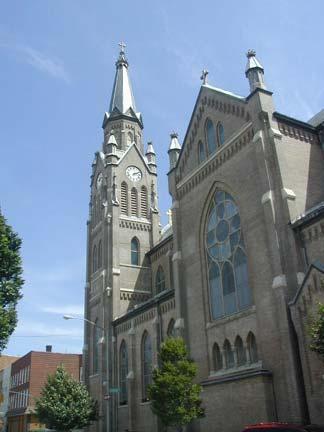
The most densely Slavic part of New York City is easily Greenpoint, in Brooklyn. The bulk of the neighborhood is clearly Polish, with the first Polish immigrants arriving around 1890 and founding the monumental St. Stanislaus Kostka Church (607 Humboldt Street at Driggs) in 1896. The building dates from 1903.
The local Polish community – and the church – are so important to the area that Humboldt Street in front of the church is known as Lech Walesa Place, and Driggs Street is called Pope John Paul II Plaza. Another nearby Polish-named landmark is the Kosciuszko Bridge, joining Brooklyn and Queens. Formerly the Meeker Avenue Bridge, it was renamed in honor of Polish patriot Tadeusz Kosciuszko in 1940.
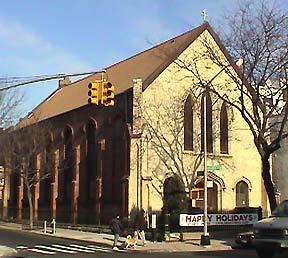
Other Slavic landmarks include the Greek Catholic Church of St. Elias (149 Kent Street between Manhattan Avenue and Franklin Street), and the Polish National Home, better known to local hipsters as the Warsaw (261 Driggs Avenue).
The nicest Polish bookstore in the area by far is Ksiegarnia Literacka (161 Java Street). Polish restaurants include Old Poland Bakery and Restaurant (192 Nassau Street), Pod Wierchami (119 Nassau Street), Lomzynianka (646 Manhattan Avenue), Stylowa (694 Manhattan Avenue), Christina's (853 Manhattan Avenue), Polish and Slavic Credit Union (175 Kent Street) and Little Poland (136 Greenpoint Avenue)
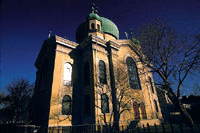
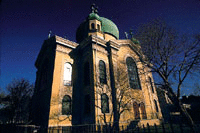 On the border of Greenpoint and Williamsburg is one of the most impressive buildings in either neighborhood: the Russian Orthodox Cathedral of the Transfiguration of Our Lord (228 N.12th Street at Driggs). The church is easily recognizable thanks to its five large copper domes (currently being restored). The church was built between 1916 and 1921, and was modeled after the Moscow Kremlin’s Cathedral of the Dormition. The iconostas within features icons painted by monks from Kiev’s famous Monastery of the Caves. The congregation is largely Carpatho-Rusyn, and the parish priest, Very Rev. Wiaczeslaw Krawczuk, is Belarusian.
Williamsburg, just south of Greenpoint, is also not lacking in Slavic sites. The most important is easily the Holy Trinity Church of the Ukrainian Autocephalic Orthodox Church in Exile (117-185 S.5th Street at New Street), which occupies a landmark building built in 1906 as the main branch of the Williamsburg Trust Company. It served in that capacity just a few years, until 1911, and then was abandoned until 1928 when it became a courthouse. The Ukrainians took it over in the 1960s.
Sources of information about Poles in Greenpoint include Search for Polonia by Kari Levinson and Sally Valentin and If You're Thinking of Living In/Greenpoint; An Inviting Area, Once You Get There by Dulcie Leimbach in the New York Times. For information about the small Polish presence in Queens, try Polish In Queens:Never Afraid To Work Hard For Their Dreams by Tamara Hartman.
For info on Transfiguration Cathedral, check out At Russian Orthodox Church in Williamsburg; Restoring the Cupolas Of a Landmark Cathedral in the New York Times, From Russia With Love - The story of Brooklyn's most beautiful cathedral from billburg.com and the church’s listing in the OCA directory of parishes.
(Photo: (top) St. Stanislaus from Forgotten New York; (bottom) Transfiguration Cathedral by Jason Kempin, from billburg.com)

 The Forum's members are: Belarus, Bosnia and Herzegovina, Bulgaria, Croatia, Macedonia, Montenegro, Poland, the Russian Federation, Serbia, Slovakia, Slovenia and Ukraine, with The Czech Republic as an observer status. Attention is also paid to Slavic minorities in non-Slavic countries, including the Lusatian Sorbs in Germany.
 The Forum's members are: Belarus, Bosnia and Herzegovina, Bulgaria, Croatia, Macedonia, Montenegro, Poland, the Russian Federation, Serbia, Slovakia, Slovenia and Ukraine, with The Czech Republic as an observer status. Attention is also paid to Slavic minorities in non-Slavic countries, including the Lusatian Sorbs in Germany.