Saturday, January 09, 2010
Czechs and Slovaks in New York
Sunday, March 02, 2008
Local reactions to Kosovo independence
On 19 February, Columbia University's Morningside Post ran Jackie Carpenter's "Independence Day for Kosovars in New York," documenting the celebrations in Times Square in support of the move.
The flip side showed up a few days later. The New York Times on 24 February ran an article, "Upheaval Over Kosovo’s Independence Echoes in a New York Enclave" by Anthony Ramierez, which features reactions by Serbs in the Ridgewood neighborhood of Queens.
Down the Jersey Shore, the Press of Atlantic City ran Amy Kuperinsky's "Independent Kosovo splits expatriates living in area" on 2 March.
And video from WNBC 4 of local Serbs (and Bosnians) at Stari Most in Astoria can be seen on the restaurant's website.
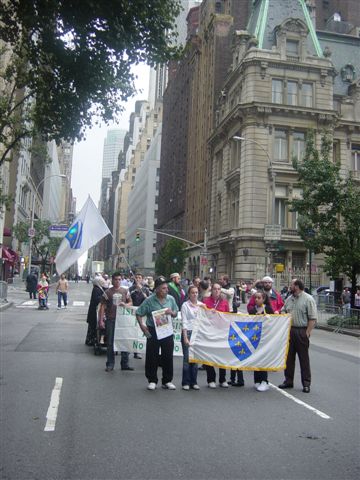
Below are photos from Sunday's protest near the United Nations.
Monday, October 08, 2007
Czechoslovak Independence Day Weekend
Once again, Sunday’s City Section of the New York Times featured a bit of Slavic New York – Bohemian Hall and Beer Garden in Astoria (Joseph V. Tirella’s Welcome. But Don’t Call Them German). Last week, the Times featured the perseverance of a group of Ukrainian women in the East Village struggling to keep their luncheonette going. Formerly home to significant communities of Poles, Ukrainians and Carpatho-Rusyns, the East Village in recent years has been shedding more and more of its Slavic character.
In Astoria, however, the problem is similar but very different. Bohemian Hall is one of the city’s oldest and most impressive Slavic sites, but is lately becoming a victim of its own success. As the beer hall gets more and more popular among New Yorkers at large, few are aware of its Czech (and Slovak) character. Many, such as one of the people quoted in the article, are under the impression that if it is a beer hall, it must be German.
Bohemian Hall is full of Czech and Czechoslovak memorabilia, Czech beers, Czech food, and a large Czech flag flies above the front door. If people are not aware of its role in the local Czech and Slovak communities, it is not for lack of trying.
The management is trying to play up its pedigree by hosting cultural events – this summer’s Czech film series, for example. Some, though think it won’t matter and the public will continue to overlook Bohemian Hall’s Czech and Slovak character. One Czech patron concluded, “They don’t know because they don’t care.”
Meanwhile, Saturday was the annual Czech Street Festival on 83rd Street between Park and Madison. The festival celebrates the independence of Czechoslovakia in 1918, and even though it is primarily a Czech event today, it also features New York’s Slovak and Carpatho-Rusyn communities who also made up Czechoslovakia at that time.
Erik Sunguryan sent some photos from the event:


Tuesday, April 24, 2007
Bulgarians (and Romanians) in the 5 Boroughs
Seth Kugel writes that there are 22,000 Romanian (not Slavic) and 4,000 Bulgarian (Slavic) immigrants in the five boroughs. The most obvious center of Bulgarian life in the city is Mehanata, (113 Ludlow Street) well known as a bar/disco but less so for its food (which isn’t bad at all). The Times prefers the menu at Bulgara (37-10 11th Street, Long Island City) instead.
The article also points out a couple Bulgarian happenings, including the Bulgarian Film Festival at Scandinavian House (58 Park Avenue). Three screenings are left, all on Friday, 27 April: - 7:00 p.m., Sparrows in October (Vrabci prez oktomvri, Henry Koulev, Bulgaria 2006, 100")
- 9:00 p.m., George and the Butterflies (Georgi i peperydite, Andrey Paounov, Bulgaria 2006, 56")
- 10:00 p.m., The North Side of the Sunflower (Severnata strana na slunchogleda, Ivan Mladenov, Bulgaria 2006, 51")
And finally, Eleanor Gilpatrick will be showing her painted landscapes of Bulgaria at the Jadite Gallery (413 West 50th. Street) starting on 1 May.
More on the Bulgarians of New York on Slavs of New York.
Photo: Bulgara, by Robert Caplin for The New York Times
Tuesday, December 19, 2006
Burek!
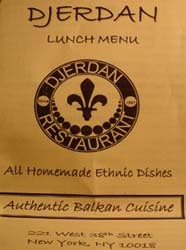
Last week, Gridskipper ran a feature on Burek in New York. Djerdan 34-04A 31st Avenue between 35th and 34th Streets in Astoria; 23-01 65th Street at 23rd Avenue in Brooklyn; and 221 West 38th Street between Seventh and Eighth Avenues in Manhattan) topped the list.Cevabdzinica Sarajevo (37-18 34th Avenue in Astoria) was there too. A few non-Slavic places were there as well, and just might be worth checking out:
- Zerza (Moroccan, 304 East 6th Street between First and Second Avenues in Manhattan)
- Café Roma (Kosher, 175 West 91st Street at Amsterdam Avenue in Manhattan)
- Tony & Tina's Pizzeria (Albanian, 2483 Arthur Avenue in the Bronx)
- House of Pita (Middle Eastern, 32 West 48th Street in Manhattan)
- Tasty Shawarmy (Middle Eastern, 71 7th Avenue South at Bleecker Street in Manhattan)
- Aroma (Israeli, 160 Wooster Street at Houston in Manhattan)
Previously on Slavs of New York: Another Cevapdzinica opens in Queens, Bosnian Grocery Shopping and Cravings takes on Bosnian and Polish cuisine
Wednesday, July 05, 2006
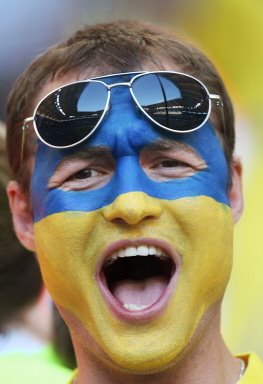
Slavs out of World Cup
The World Cup semifinals have started, but all five Slavic teams have been eliminated.The kids over at Jaunted covered Friday's Italy/Ukraine match that saw the Ukrainian team get pummelled 3-0. Jaunted caught the match at the Ukrainian Sports Club on Second Avenue, which had a full house.
"The Club itself offers a viewing experience similar to that at an Elks Club or a Boy Scout meeting; there's plenty of linoleum, fake wood paneling and brown carpeting to go around. Chairs were parked around big-screen TV, and fans were crowded behind the seats.
Team Jerseys were even available for purchase, and we would have been tempted if we could have gotten a discount after Italy's first goal in the sixth minute. Before that quick strike, the room was all nervous anticipation and excitement, filling with chants of "U-kray-ee-na!" whenever the Ukranians touched the ball."Jaunted also treked out to Bohemian Hall a couple weekends ago to catch the Ghana/Czech Republic match. "Bohemian Hall was ready for early bird fans--they were open by 10 and were selling muffins and coffee for bleary-eyed supporters arriving for the noon match. Of course, they were selling pitchers of beer as well, and most of the true Czech fans were going for the authentic, breakfast beer route. By the start of the match, the line for beer was out the door and around the corner, and the line for food at halftime was long enough that we saw several fans with pitchers of beer and glasses to sustain themselves during the wait. Bohemian Hall serves authentic grilled klobasy and sauerkraut, and it's worth the wait for the tasty sausage."
The Times Ledger posted a report on the Argentina/Serbia game at the Serbian Club in Glendale, which described slightly less World Cup fever than the scenes at the Ukrainian Sports Club and Bohemian Hall. About 40 people showed up to watch Serbia's first two games, but by the time last week's game rolled around, disappointed fans largely stayed away.The semifinals kicked off tomorrow with with Italy defeating Germany 2-0, and continue today with Portugal v France.
Previously on Slavs of New York: Slavs at the World Cup
(Photos from http://fifaworldcup.yahoo.com/06/en/)
Tuesday, June 20, 2006
Bosnian Grocery Shopping
Back in March, the New York Times published Alan Flippen’s The Tastes of Bosnia Follow Those Who Fled, about the arrival of foodstuffs from Bosnia and the former Yugoslavia to grocery store shelves in New York.According to the article, products such as suho meso (smoked beef), ajvar (a sort of relish), pekmez od sljiva (a fruit spread), Travnik feta cheese and traditional Bosnian Turkish coffee started showing up in New York, primarily in Queens, along with refugees from the war in Bosnia in the early 1990s. The ensuing three-fold increase in the city’s Bosnian population has kept sales of the food products going.
Though there are numerous places around to get former Yugo ingredients, the article points to Euromarket (30-42 31st Street near 30th Avenue, Astoria) and Grand Prix Trading Corporation in Ridgewood.
Previously on Slavs of New York: Another Cevapdzinica opens in Queens
Thursday, June 08, 2006
Slavs at the World Cup
We've gotten a few emails lately about where to watch the five Slavic teams compete at the World Cup, and so we figured we should blog it. Games begin on Friday, and not all bars will show all of the games so call ahead to figure out where's best to go. In no particular order, here's the list: - Czech Republic: Bohemian Hall (29-19 24th Avenue, Astoria, 718-274-4925). You can't go wrong with this big giant beer garden behind the historic Czech cultural center in Astoria. Aside from Czech beers, they're also having BBQs.
- Croatia: Scorpio (3515 Broadway at 35th Street. Astoria, 718-956-8233). We're not 100% sure they're playing the games, but if anyone is rooting for Croatia, it's Scorpio. Be sure to try the bijela kava (like a latee), certainly the best in the city.
- Serbia and Montenegro: Serbian Club (72-65 65th Place, Glendale, 718-821-9875). The mothership for Serbian fans. We've never been, but we hear it's well worth a visit. They've got cold beer, Balkan food and a big-screen TV. Can't go wrong.
Fans of Croatia and Serbia and Montenegro can also check out Zum Stammtisch (69-46 Myrtle Avenue between 69th and 70th Streets, Glendale, 718-386-3014), which of course caters to Germans, but is also frequented by the x-YU communities in the area.
- Ukraine: Ukrainian Sports Club (122 Second Avenue between 7th and 8th Streets, East Village, 212-475-1340). If you're a Ukraine fan, there's no other place to be. Aside from the full bar with Ukrainian beer, there's a five-foot projection screen TV. The game schedule is on the front door, pass by and check it out.
- Poland: Smolen Bar and Grill (708 Fifth Avenue, Park Slope, 718-788-9729). There must be a stack of places rooting for Poland, but we came up with nothing. Sage, a Slavs of New York reader, came to the rescue by pointing out Smolen, a neighborhood bar frequented by Russians and Poles serving up Polish beer.
And Cafe Blue Light (30th Street & 35th Avenue, Astoria) also has a live feed on a plasma TV, as well as Balkan food and $3.50 beer.
Monday, May 22, 2006
Counter Culture: Feta Blizzard
We should've noted this earlier, but better late than never, right? Last weeks Village Voice featured Counter Culture: Feta Blizzard, about Bulgara (31-10 11th Street) in Long Island City, Queens.This is one of just two Bulgarian restaurants left in the city (togeter with Tricolorii in Sunnyside), with the closure of Chinatown's Mehanata back in March.
Though Bulgara "is located in a rat's ass of a neighborhood in Long Island City," the food is deemed more than satisfactory, if the ambience is not. Be forewarned: this is no Mehanata. But if you're hankering for solid Bulgarian fare, you won't go wrong here.
(Photo: Kate Lacey for the Village Voice)
Thursday, March 09, 2006
Serbs in New York City
In the Encyclopedia of New York City, Marc Ferris writes that Serbs first came to the United States in the late nineteenth century as economic refugees. They primarliy settled further west, but many ended up in the Serb, Croat and Slovene community in Midtown West, along Ninth and Tenth Avenues between 21ts and 40th Streets. By 1914, the community was organized in to the Srpska Narodna Odbrana (Serbian National Defense) organization, and between 1911 and 1932 they had a daily newspaper, Srbski Dnevnik.
The most famous Serbian New Yorker is certainly Nikola Tesla, the prominent scientist and inventor. He lived here for almost 60 years, and died at the Hotel New Yorker at 40th Street and 6th Avenue in Manhattan. The hotel now bears a memorial plaque in his honor.Today, the strength of the Serbian community in New York is estimated at around 40,000, with the largest concentrations in Ridgewood and Astoria. The community's institutions inclulde the Jasenovac Research Institute and the Tesla Memorial Society of New York, and many recently-arrived refugees are active with Raccoon, whose focuses on all former Yugoslav groups.
Though it is now dispersed around the city, the center of the community remains Serbian Orthodox Cathedral of St. Sava (20 West 26th Street between 6th Avenue and Broadway), the most striking architectural landmark in town. The Permanent Mission of Serbia and Montenegro to the UN (854 Fifth Avenue between 66th and 67th Street) is another architectural gem.
(Top Photo: Interior of St. Sava Cathedral from New York Architectural Images; Below: memorial plaque at Hotel New Yorker from http://teslasociety.com)
Wednesday, February 01, 2006
Bosnians in Astoria
New York is home to many Bosnians, who are split into Serbs, Croats and Bosnian Muslims (Bosniaks). Bosnian Serbs tend to associate with local Serbs, and Bosnian Croats likewise associate with the local Croatian community. Bosnian Muslims have cultivated a distinct community which has its own contacts with local Muslims from the former Yugoslavia (Kosovo, Sandzak) as well as with other Muslims in the area. Regardless of whether they are Serb, Croat or Muslim, most Bosnians arrived in New York city during or shortly after the war in Bosnia (from 1992 to 1995) and settled in Astoria.
The Bosnian Muslims are well organized around religious and social organizations. They are the primary audience of at least two Islamic centers, the Bosnian Hercegovinian Islamic Center (25-17 Astoria Boulevard, Astoria) and the Islamic Unity and Cultural Center of Plav-Gusinje (Bosnian Muslim Community of New York, 31-33 12th Street, Astoria). They are also the primary community served by the Ali Pasha Mosque in Astoria.
The Bosnian American Association Of New York (26-40 18th Street, Astoria) is the community's central social organization, and was recently featured at Ethnic Communities.org. The BAA was initiated in 1997 to help meet the needs of newly arrived Bosnians and to help them acclimate themselves to New York, and to the United States. The Bosnian American Association was finally formed in 1999 in Astoria with 300 members.
Its membership is currently around 1000, and it focuses on five areas: English language instruction, computer training, elderly assistance, translation services and naturalization and citizenship classes. Mrkanovic and Elezovic told ethniccommunities.org that the biggest challenge facing the group now is funding, as it would like to expand its program offerings.
“We hope to add additional sporting events to help organize the young people in our community, as well as movie nights that focus on post-conflict and development issues in Bosnia,” he told the website. Other ideas include micro-enterprise instruction and advanced English and citizenship classes, as well as branching out to non-Bosnian refugees in the area.Aside from the Bosnian American Association, Bosnia and Bosnians are also the focus of the New York-based Academy of Bosnia and Herzegovina and America Bosnia Cultural Foundation. They are also active within Raccoon, which strives for reconcilation among all of the peoples of the former Yugoslavia.
Among Bosnian media locally is the newspaper Sabah, the web magazine Bosnjaci.net, Radio Muslimanski Glas (Radio Muslim Voice), and Radio Voice of Bosnia and Herzegovina.
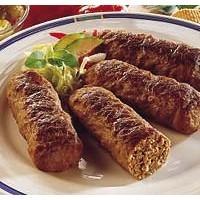
One of the most prominent features of the Bosnian community is the Cevabdzinica, the traditional Bosnian restaurant featuring the sausage-like cevapci (or cevapcici). Of the many if the five boroughs are Bosna Express (Astoria), Cevabdzinica Sarajevo (Astoria) and Djerdan (Astoria, Manhattan, Brooklyn).
Another Bosnian cultural institution popular with New Yorkers is the Bosnian-Herzegovinian Film Festival, now in its third year. The next festival will be from 19 to 21 May.
(Photo: Ali Pashna Mosque from Dzemati.com, and Bosnians at the 2003 Muslim Parade in New York, from Radio Muslimanski Glas)
Wednesday, January 04, 2006
Bulgarians in New York City
New York has been home to a Bulgarian community since at least 1900, according to the Encyclopedia of New York City. The original immigrants settled in today's Alphabet City, around Avenues B and C at 3rd and 4th Streets.The city was also home to the first Bulgarian association in the country, the Bulgarian American Mutual Aid Society, founded in 1906. Several other organizations aimed at the newly-arrived immigrants followed. Political emigration after World War Two saw the creation of a number of political groups in the city, such as the Bulgarian National Committee (1946-) and the Bulgarian National Front (1947-1968).
As the early immigrants moved up in society, they, like other immigrant groups, moved out of the Lower East Side. Many Bulgarians ended up the Tremont Avenue and Fordham Road sections of the Bronx, as well as in other parts of Manhattan and in the suburbs.
By the end of the 20th century, there were between 1500 and 2000 Bulgarians in New York, according to the Encyclopedia. Religious centers include Ss. Kirill and Methody Cathedral (552 West 50th Street) and St. Andrew in the Bronx.
The Bulgarian community is connected through the weekly newspaper Nedelnik, and many congregate at the city's Bulgarian restaurants, such as Bulgara in Astoria, Tricolorii in Sunnyside and Mehanata in Manhattan.In large part building on the popularity of Mehanata, the Bulgarian community has stumbled into the cultural spotight in recent years, helping to launch a local Balkan music scene, and a Gypsy music festival.
Monday, December 19, 2005
Astoria's Bohemian Hall
Back in 2000, the New York Times profiled Bohemian Hall in A Beer Garden in Astoria Shelters a Lost Era. The building features New York's last remaining beer garden, "a grove of about 20 old trees -- maples, sycamores and lindens -- enclosed by a high wall" with "the sheltering feel of an ancient European village, where the townspeople gather for beer and gossip."
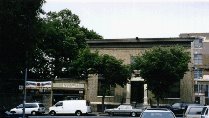
Bohemian Hall was built in 1930 as a cultural and community center for local Czechs. They mostly lived in Yorkville in Manhattan at that time, but built the hall in Astoria because there they were able to build big.
The beer garden might be out of season, but Bohemian Hall is hosting a New Year's Eve celebration, with an all-night buffet, open bar and live entertainment. The event runs from 8:00 p.m. to 4:00 a.m. and tickets cost $65.00. Call 718-274-4925 for more information.
Tuesday, November 15, 2005
Montenegrins in New York City
Montenegrins in New York City are hard to pin down. There are definitely some here, though there does not seem to be any sort of organized community. Most seem to associate with the local Serbian community.Montenegro does have a rather interesting link to New York City, though, via F. Scott Fitzgerald. In the Great Gatsby, Jay Gatsby boasts of having been awarded a Danilo's Cross in Montenegro:
"...I was promoted to be a major, and every Allied government gave me a decoration - even Montenegro, little Montenegro down on the Adriatic Sea!' Little Montenegro! He lifted up the words and nodded at them - with his smile. The smile comprehended Montenegro’s troubled history and sympathized with the brave struggles of the Montenegrin people. It appreciated fully the chain of national circumstances which had elicited this tribute from Montenegro’s warm little heart. My incredulity was submerged in fascination now; it was like skimming hastily through a dozen magazines.
He reached in his pocket, and a piece of metal, slung on a ribbon, fell into my palm.
"That’s the one from Montenegro."
To my astonishment, the thing had an authentic look.
"Orderi di Danilo," ran the circular legend, "Montenegro, Nicolas Rex."
"Turn it."
"Major Jay Gatsby," I read, "For Valour Extraordinary."
The Danilo's Cross is named after a Montenegrin leader from the Njegos dynasty. At the time of the writing of the Great Gatsby, F. Scott and Zelda were frequent visitors to both Paris and Antibes, where the Montenegrin royal family was living in exile. However, there is no evidence they did (or did not) meet.
For more concrete information about Montenegrins in New York, check out Plav.Net, a website by Muslims from the Plav-Gusinje region of Montenegro, many of whom live in the metro area. In SoHo, there is also Crna Gora Film and Television, but the website seems to be down and no more information is available. Raccoon is also active with local Montenegrins. And even though it serves Italian food, Amici Amore (29-35 Newtown Avenue at 30th Street) in Astoria is owned by a Montenegrin, Dino Redzic.
Wednesday, August 10, 2005
Another Cevapdzinica opens in Queens
The Village Voice recently reviewed Bosna Express, a new cevapdzinica in Long Island city. A cevapdzinica is a restaurant that serves Balkan food, but focuses on cevapci, a traditional sausage plate.Read Robert Seitsema's "Leapin' Lepinja" at http://www.villagevoice.com/nyclife/0531,sietsema,66401,19.html
- Bosna Express31-29 12th St., Long Island City, Qns718-932-5577
- Cevabdzinica Sarajevo Restaurant 37-18 34th Ave., Astoria718-752-9528
- Djerdan221 W. 38th St.between Seventh and Eighth Aves., Manhattan212-921-1183
- Djerdan23-01 65th St., at 23rd Ave., Brooklyn 718-336-9880
- Djerdan 34-04A 31st Ave.between 35th and 34th Sts., Astoria718-721-2694