Showing posts with label long island city. Show all posts

Tuesday, April 24, 2007

Bulgarians (and Romanians) in the 5 Boroughs

Sunday’s Travel Section of the New York Times included the article “Weekend in New York Romanian and Bulgarian Culture: Danube (Both Sides) on Hudson” featuring Bulgarian restaurants on the Lower East Side of Manhattan and in Astoria, Queens.

Seth Kugel writes that there are 22,000 Romanian (not Slavic) and 4,000 Bulgarian (Slavic) immigrants in the five boroughs. The most obvious center of Bulgarian life in the city is
Mehanata, (113 Ludlow Street) well known as a bar/disco but less so for its food (which isn’t bad at all). The Times prefers the menu at Bulgara (37-10 11th Street, Long Island City) instead.

The article also points out a couple Bulgarian happenings, including the Bulgarian Film Festival at Scandinavian House (58 Park Avenue). Three screenings are left, all on Friday, 27 April:
  • 7:00 p.m., Sparrows in October (Vrabci prez oktomvri, Henry Koulev, Bulgaria 2006, 100")
  • 9:00 p.m., George and the Butterflies (Georgi i peperydite, Andrey Paounov, Bulgaria 2006, 56")
  • 10:00 p.m., The North Side of the Sunflower (Severnata strana na slunchogleda, Ivan Mladenov, Bulgaria 2006, 51")
The Bulgarian Virtuosi will also perform at Carnegie Hall Weill Recital Hall (154 West 57th Street) on Sunday, 29 April at 2:00 p.m. Performers include the Bulgarian Virtuosi Chamber Orchestra, Stefan Linev, Music Director and Conductor, violinist David Bowlin, cellist Kalin Ivanov and clarinetist Todd Brunel. The program features three 20th and 21st century works from Bulgarian composers. Tickets are $30 and $20 for students and seniors. The Bulgarian Consulate (121 East 62nd Street) also regularly hosts free concert evenings with Bulgarian performers.

And finally,
Eleanor Gilpatrick will be showing her painted landscapes of Bulgaria at the Jadite Gallery (413 West 50th. Street) starting on 1 May.

More on the Bulgarians of New York on
Slavs of New York.

Photo: Bulgara, by Robert Caplin for The New York Times

Monday, May 22, 2006

Counter Culture: Feta Blizzard

We should've noted this earlier, but better late than never, right? Last weeks Village Voice featured Counter Culture: Feta Blizzard, about Bulgara (31-10 11th Street) in Long Island City, Queens.

This is one of just two Bulgarian restaurants left in the city (togeter with
Tricolorii in Sunnyside), with the closure of Chinatown's Mehanata back in March.

Though Bulgara "is located in a rat's ass of a neighborhood in Long Island City," the food is deemed more than satisfactory, if the ambience is not. Be forewarned: this is no Mehanata. But if you're hankering for solid Bulgarian fare, you won't go wrong here.

(Photo: Kate Lacey for the Village Voice)

Wednesday, February 01, 2006

Bosnians in Astoria

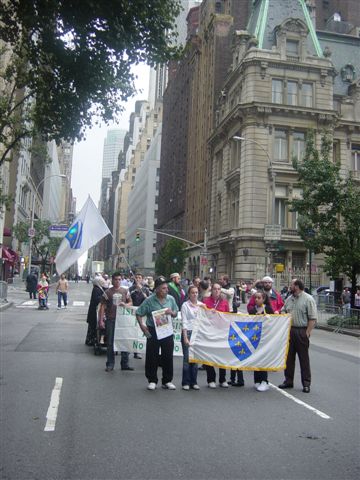
New York is home to many Bosnians, who are split into Serbs, Croats and Bosnian Muslims (Bosniaks). Bosnian Serbs tend to associate with local Serbs, and Bosnian Croats likewise associate with the local Croatian community. Bosnian Muslims have cultivated a distinct community which has its own contacts with local Muslims from the former Yugoslavia (Kosovo, Sandzak) as well as with other Muslims in the area.

Regardless of whether they are Serb, Croat or Muslim, most Bosnians arrived in New York city during or shortly after the war in Bosnia (from 1992 to 1995) and settled in Astoria.

The Bosnian Muslims are well organized around religious and social organizations. They are the primary audience of at least two Islamic centers, the
Bosnian Hercegovinian Islamic Center (25-17 Astoria Boulevard, Astoria) and the Islamic Unity and Cultural Center of Plav-Gusinje (Bosnian Muslim Community of New York, 31-33 12th Street, Astoria). They are also the primary community served by the Ali Pasha Mosque in Astoria.

The Bosnian American Association Of New York (26-40 18th Street, Astoria) is the community's central social organization, and was recently featured at
Ethnic Communities.org. The BAA was initiated in 1997 to help meet the needs of newly arrived Bosnians and to help them acclimate themselves to New York, and to the United States. The Bosnian American Association was finally formed in 1999 in Astoria with 300 members.

Its membership is currently around 1000, and it focuses on five areas: English language instruction, computer training, elderly assistance, translation services and naturalization and citizenship classes. Mrkanovic and Elezovic told ethniccommunities.org that the biggest challenge facing the group now is funding, as it would like to expand its program offerings.

We hope to add additional sporting events to help organize the young people in our community, as well as movie nights that focus on post-conflict and development issues in Bosnia,” he told the website. Other ideas include micro-enterprise instruction and advanced English and citizenship classes, as well as branching out to non-Bosnian refugees in the area.

Aside from the Bosnian American Association, Bosnia and Bosnians are also the focus of the New York-based
Academy of Bosnia and Herzegovina and America Bosnia Cultural Foundation. They are also active within Raccoon, which strives for reconcilation among all of the peoples of the former Yugoslavia.

Among Bosnian media locally is the newspaper
Sabah, the web magazine Bosnjaci.net, Radio Muslimanski Glas (Radio Muslim Voice), and Radio Voice of Bosnia and Herzegovina.

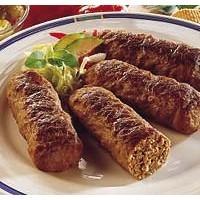
One of the most prominent features of the Bosnian community is the Cevabdzinica, the traditional Bosnian restaurant featuring the sausage-like cevapci (or cevapcici). Of the many if the five boroughs are
Bosna Express (Astoria), Cevabdzinica Sarajevo (Astoria) and Djerdan (Astoria, Manhattan, Brooklyn).

Another Bosnian cultural institution popular with New Yorkers is the
Bosnian-Herzegovinian Film Festival, now in its third year. The next festival will be from 19 to 21 May.

(Photo: Ali Pashna Mosque from
Dzemati.com, and Bosnians at the 2003 Muslim Parade in New York, from Radio Muslimanski Glas)

Tuesday, November 29, 2005

Golod wraps up in Queens

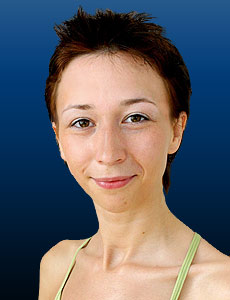
The Russian reality TV show Golod (Hunger) finished its second season in Queens on 20 November with Katja Nemova, a 24 year-old office manager from Samara, Russia, taking home the grand prize of a $2000 monthly “pension” for life.

In an interview after the announcement, Nemova said that the show had led her to discover that she wants to be a photographer and now intends to go to school in that field.

Asked if she would recommend a stint on a reality TV show having experienced it herself, she said, “if there will be a Golod 3, I would drive all of my friends to the casting call myself! Go, go, I would be so happy if you would do it!”

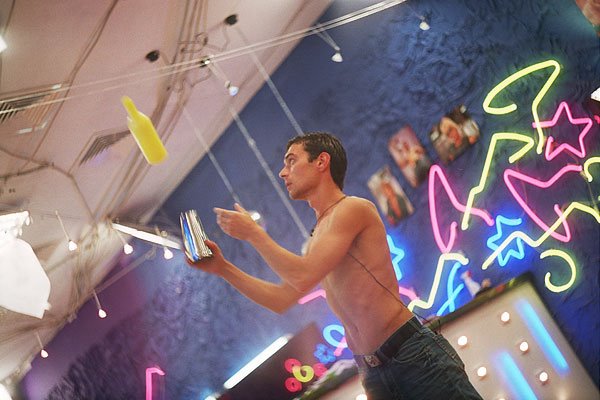
The New York season of Golod began on 7 August, with the contestants living at Silvercup Studios, “where the last season of Sex and the City was filmed. But in Golod, there was no sex, and romantic liaisons quickly broke up,”
NRS commented. Golod ended with Nemova being named the winner on 20 November.

Meanwhile, another Golod contestant, Natal’ja Rubcova made news last week by appearing in the December issue of the Russian edition of Playboy magazine (NRS: Golod – no old maid, a Playboy model). According to Rubcova, age 21. the photo shoot was the fulfillment of a dream from her childhood.

Thursday, November 10, 2005

Golod: Berlin vs. New York

RussianNY has also cast its gaze on the reality TV series Golod (Hunger): Survivor - extremely Russian!

Summarizing the show, RussianNY says, “the participants must share the fate of many Russian immigrants thrown into the fire of the Big Apple: not knowing three words of English, the young people must not die of hunger and get what they need to survive in any way they can on the unforgiving streets of Queens!”

“To the credit of the involuntary immigrants,” the article continues, “they have demonstrated exceptional ingenuity, each in turn justifying the moral of the saying “golj na vydumku khitra (the poor are clever in ideas).”

The article also compares this season to last year’s Golod, set in Berlin:


Last year, the organizers threw the group of guinea pigs in Berlin without any knowledge of German… and even did not tell them where they were being taken, which almost ended in an international scandal when the police intervened after receiving numerous reports about strange Russians ready to do anything to earn a bit of crumbs. This year, organizers decided to soften the conditions – on the insistence of the Ministry of Internal Affairs, which was not pleased that the contestants were being taken around the world like little more than prisoners of 21st century slave traders. And beyond that, the show’s organizers have guaranteed the Office of Film, Theater and Television of the Office of the Mayor of New York that none of the participants will suffer or die of malnutrition during filming.

In November 2003, Reuters featured the Berlin show ("Hungry" Russians Stranded On TV Game Show in Berlin), after the daily Bild reported that "Russian TV lets young women starve in a Berlin container." In the Reuters article, TNT producer Dmitry Troitsky responded to accusations that the contestants would turn to crime or prostitution, saying that "the contestants are sent into the city with camera teams, so there is no question of them resorting to crime."

Tuesday, November 08, 2005

Hunger in Queens

Via Gothamist, Slavs of New York has discovered that the Russian reality TV show Golod (Hunger) is going on right now in New York. The show started on 7 August after a successful first season set in Berlin.

From the website: "13 blindfolded people were taken from Russia. They must survive 146 days in a foreign city - with no money, no food and not knowing the language. Help is waiting for them, but they must fight for it: the winner of the show will receive $2000 each month for the rest of their life."

The website also lists the rules: "Each week two participants will go out into the city to get food and money. They can do anything to get it and they can return to the house whenever they want. But while they are out looking for food, no one else will be allowed out of the house. Every other week, two participants will fly to Moscow. Here, on live TV, they will fight a verbal duel. From the results of viewers' voting, one of them will leave the show and the other returns to the house."

Gothamist: Going Hungry for Russian Reality TV

For more on reality TV in Russia, check out
As the novelty of “Big Brother” and “Dom-2” wears off... in the St. Petersburg Times.

Monday, November 07, 2005

Slav of New York: Leon Trotsky

And while we're on the Revolution Day theme, don't forget that Leon Trotsky, one of the leaders of the revolution, lived in New York for a couple months in 1917. Trotsky was born in Yankova, Ukraine, in 1879 and after being expelled from France and Spain he ended up in New York in January 1917. Together with his wife and two sons, he lived at 1522 Vyse Avenue in the Bronx.

Trotsky was active in the New York Russian expatriate community, and particularly in the communist movement. He wrote for the newspaper Novyi Mir (The New World), then based at 77 St. Mark's Place in the East Village, and also lectured at the East Village's Russian Free University on East Seventh Street.

He left New York March 1917 to return to Russia to join the other leaders of the revolution. At the time, the Bronx Home News ran the headline "Bronx Man Leads Russian Revolution."

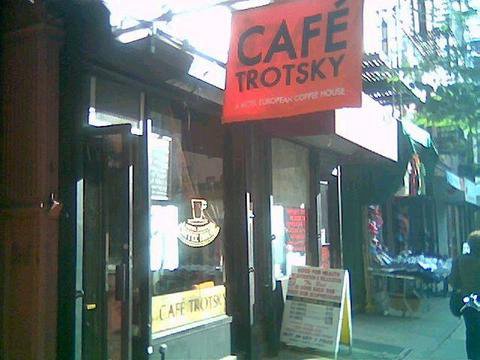
Trotsy is remembered in the city at
Cafe Trotsky (192 Orchard at Houston), a Viennese coffee house on the Lower East Side.

Read Leon Trotsky's
My Life, chapter 22, "New York."

Wednesday, August 10, 2005

Another Cevapdzinica opens in Queens

The Village Voice recently reviewed Bosna Express, a new cevapdzinica in Long Island city. A cevapdzinica is a restaurant that serves Balkan food, but focuses on cevapci, a traditional sausage plate.


Read Robert Seitsema's "Leapin' Lepinja" at http://www.villagevoice.com/nyclife/0531,sietsema,66401,19.html

  • Bosna Express31-29 12th St., Long Island City, Qns718-932-5577
Also check out:
  • Cevabdzinica Sarajevo Restaurant 37-18 34th Ave., Astoria718-752-9528
  • Djerdan221 W. 38th St.between Seventh and Eighth Aves., Manhattan212-921-1183
  • Djerdan23-01 65th St., at 23rd Ave., Brooklyn 718-336-9880
  • Djerdan 34-04A 31st Ave.between 35th and 34th Sts., Astoria718-721-2694