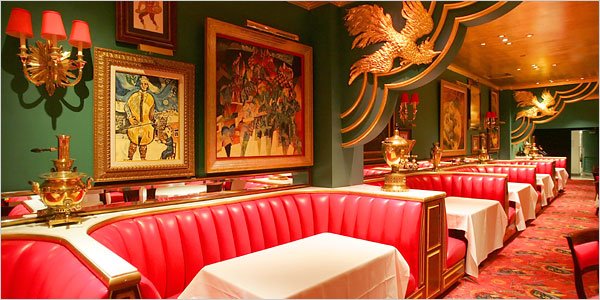
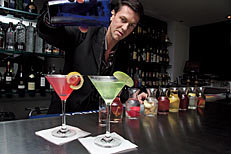
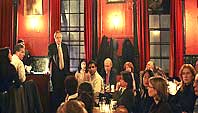
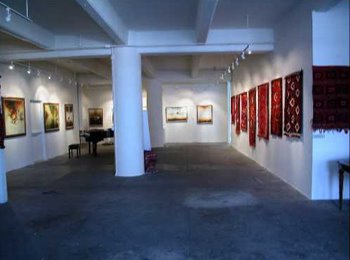
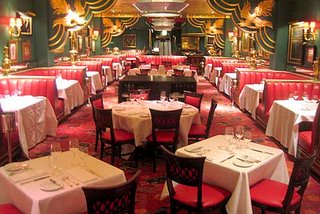
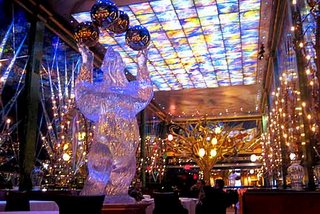
 New York Magazine's food blog Grub Street (First Look Inside the Russian Tea Room) has come up with the first photos of the Russian Tea Room (150 West 57th Street between 6th and 7th Avenues), just ahead of its reopening Wednesday morning.
The restaurant will be open from 7:30 a.m. to midnight on weekdays, 10:30 to midnight on Saturday and 10:30 a.m. to 10:30 p.m. on Sunday, with a menu ranging from breakfast to tea to elaborate dinners.
 Reservations are being accepted from Friday on – Restaurant Girl already snagged hers, but gave no clue as to what the number is but the New York Magazine review says it’s 212-974-2111.
Previously on Slavs of New York: Russian Tea Room Reopening
(Photos: Jed Egan for New York Magazine)
 Sunday’s New York Times featured a bit of background on the soon-to-reopen Russian Tea Room, Recreating the Sizzle, Going Easy on the Butter.
The Manhattan classic will reopen on 1 November at its old digs at 150 West 57 between Sixth and Seventh Avenues after a four year lapse. Former members of the Russian Imperial Ballet opened the original Russian Tea Room opened in 1926 at the same location.
Florence Fabricant’s Tea Room Coming Back from the 4 October issue of The New York Times has all the details of the new owners.
“When the Russian Tea Room closed four years ago, diners may have wondered if they would ever again see the restaurant’s over-the-top décor, the 15-foot acrylic juggling bear that doubled as an aquarium, the gold-hued Fabergé egg, the red banquettes.” Turns out they will. Most of the familiar details have been restored.
What will be a bit different is the menu, courtesy of Gary Robins (formerly of Chelsea’s Biltmore Room). Much of the menu will be lighter reinterpretations of traditional Russian fare.
Previously on Slavs of New York: The Russian Tea Room
(Photo: Ruby Washington for The New York Times)
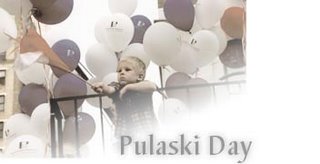 This weekend marks Pulaski Day, honoring Casimir Pulaski (1745-1779), a Polish nobleman who fought in the US War for Independence.
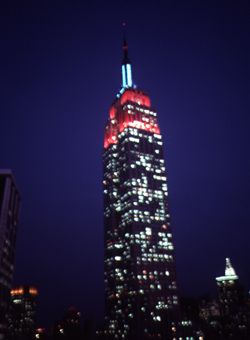
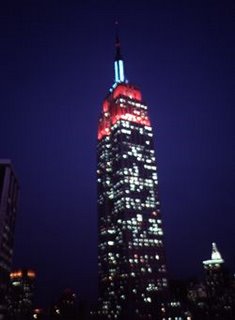
For the occassion, the Empire State Building will be lit up in the Polish national colors, red and white, from Friday through Sunday.
 Sunday is also the 69th annual Pulaski Parade, a celebration of Poles in New York.This year's theme is Honoring all Our Polish Immigrants for their contributions to the United States.
Prior to the parade, there will be a special mass at St. Patrick's Cathedral followed by a special breakfast at the Marriott Marquis ($45.00, contact Penny Donach at 718-389-4150 or email).
The parade runs up Fifth Avenue from 31st Street to 53rd Street, beginning at 12:30 p.m.
Sunday is also the 69th annual Pulaski Parade, a celebration of Poles in New York.This year's theme is Honoring all Our Polish Immigrants for their contributions to the United States.
Prior to the parade, there will be a special mass at St. Patrick's Cathedral followed by a special breakfast at the Marriott Marquis ($45.00, contact Penny Donach at 718-389-4150 or email).
The parade runs up Fifth Avenue from 31st Street to 53rd Street, beginning at 12:30 p.m.
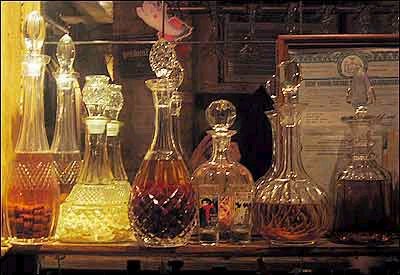
 The kids over Gridskipper have embarked on the “Trans-Siberian express to obliteration,” a crawl through all of New York’s Russian bars. First up was Uncle Vanya (315 West 54th Street), which they seemed to enjoy (doubly so once they hit the house infused vodka collection).
Next up was Anyway Сafe (34 East 2nd Street, and 2nd Avenue). Like Uncle Vanya this one is more a restaurant than a bar, but also like Uncle Vanya it has more than enough liquor to go around. Apparently there was a male stripper on hand back in March (any clue what was going on there??), but when Gridskipper visited there was only a solitary bard singing chanson.
 Yesterday’s news of Veselka’s anti-Rusyn gaffe reminded us that news broke recently that the final location of Andy Warhol’s Factory is about to go condo. Plans call for the four-story building to be converted into 22 stories with 50 luxury loft units.
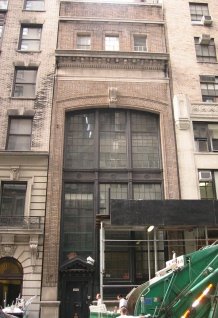
The building, a former ConEd substation at 19 East 32nd Street, 158 Madison Avenue and 22 East 33rd Street, actually still bears a bit of Warhol-era graffiti reading “I never wanted to be a painter, I wanted to be a tap-dancer.” The graffiti is visible below a second-floor balcony in the 33rd street entrance lobby.
Back in March 1998, the New York Times profiled the building in “Warhol's Old Factory: A Restaurant and Offices; 15 Minutes of Pasta?” when the condo plans were first floated. This time, though, it seems the plans will go forward.
Warhol bought the building in 1981 and turned it into the fourth location of The Factory. Upon his death in 1987, the building became the headquarters of The Andy Warhol Foundation for the Visual Arts, which is now located on Bleecker Street. The first Factory was on the fifth floor of 231 East 47th Street from 1964-1968, then 33 Union Square West until 1974 when it moved to 860 Broadway and was rechristened The Office.
Check out Warhol condo coverage at Gothamist (Clips from The Factory), Towleroad (Andy Warhol Factory Going Condo) and Triple Mint (Warhol Factory Condos)
(Photo: Triple Mint)
 This week's Time Out New York highlights Vlada Lounge (331 West 51st Street between Eighth and Ninth Avenues), a new bar by Vlada von Shats, owner of the Russian Samovar.
Like Eastern Bloc (505 East Sixth Street at Avenue A), which opened last December, Vlada Lounge also features a Soviet theme. Unlike Eastern Bloc, it is authentic. The drink list features no less than 15 sorts of infused vodka, sure to be a crowd pleaser.
Previously on Slavs of New York: GLBT Slavs of New York
This week's Time Out New York highlights Vlada Lounge (331 West 51st Street between Eighth and Ninth Avenues), a new bar by Vlada von Shats, owner of the Russian Samovar.
Like Eastern Bloc (505 East Sixth Street at Avenue A), which opened last December, Vlada Lounge also features a Soviet theme. Unlike Eastern Bloc, it is authentic. The drink list features no less than 15 sorts of infused vodka, sure to be a crowd pleaser.
Previously on Slavs of New York: GLBT Slavs of New York
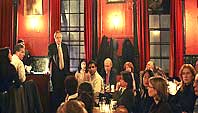 Various Slavs of New York featured heavily in this week’s New York magazine roundup of lit-bars, “Bookish Boozing.” At the top of the list was Barbes (376 9th Street at Sixth Avenue, Park Slope), not exactly a Slavic spot, but home to Slavic Soul Party each Tuesday evening.
Similarly, number two on the list, Bowery Poetry Club (308 Bowery, between Bleecker and Houston) regularly hosts Slavic readings, particularly the Project Gorod series.
More directly, both KGB Bar (85 East 4th Street between Second and Third Avenues) and the Russian Samovar (256 West 52nd Street between Eighth Avenue and Broadway) fly the Slavic flag proudly.
On KGB Bar, New York writes: “Sundays bring fiction, Mondays poetry, and Tuesdays non-fiction. From Wednesday to Friday, you’ll hear everything from sci-fi to prize-winning journalism. The monthly ‘Drunken! Careening! Writers!’ limits each participating novelist/poet/hack to fifteen minutes and insists each work must have ‘at least one thing that makes people laugh.’”
And on the Samovar, “Sporadic readings take place in the upstairs room, where listeners gather around a large table and knock back exotically infused vodkas.”
Also on the list? Half King (505 West 23rd Street), Happy Ending (302 Broome Street), Mo Pitkin's House of Satisfaction (34 Avenue A), Pete’s Candy Store (709 Lorimer Street), and Rocky Sullivan’s (129 Lexington Avenue).
(Photo: UN Secretary of Staff, Mr. Mark Malloch Brown at KGB, by Julia Calfee for New York)
 In the Encyclopedia of New York City, Marc Ferris writes that Serbs first came to the United States in the late nineteenth century as economic refugees. They primarliy settled further west, but many ended up in the Serb, Croat and Slovene community in Midtown West, along Ninth and Tenth Avenues between 21ts and 40th Streets. By 1914, the community was organized in to the Srpska Narodna Odbrana (Serbian National Defense) organization, and between 1911 and 1932 they had a daily newspaper, Srbski Dnevnik.
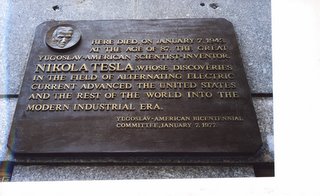 The most famous Serbian New Yorker is certainly Nikola Tesla, the prominent scientist and inventor. He lived here for almost 60 years, and died at the Hotel New Yorker at 40th Street and 6th Avenue in Manhattan. The hotel now bears a memorial plaque in his honor.
Today, the strength of the Serbian community in New York is estimated at around 40,000, with the largest concentrations in Ridgewood and Astoria. The community's institutions inclulde the Jasenovac Research Institute and the Tesla Memorial Society of New York, and many recently-arrived refugees are active with Raccoon, whose focuses on all former Yugoslav groups.
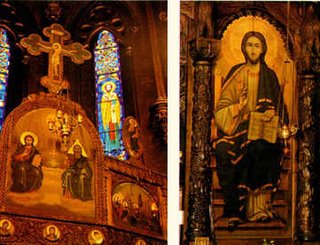
Though it is now dispersed around the city, the center of the community remains Serbian Orthodox Cathedral of St. Sava (20 West 26th Street between 6th Avenue and Broadway), the most striking architectural landmark in town. The Permanent Mission of Serbia and Montenegro to the UN (854 Fifth Avenue between 66th and 67th Street) is another architectural gem.
(Top Photo: Interior of St. Sava Cathedral from New York Architectural Images; Below: memorial plaque at Hotel New Yorker from http://teslasociety.com)
The most famous Serbian New Yorker is certainly Nikola Tesla, the prominent scientist and inventor. He lived here for almost 60 years, and died at the Hotel New Yorker at 40th Street and 6th Avenue in Manhattan. The hotel now bears a memorial plaque in his honor.
Today, the strength of the Serbian community in New York is estimated at around 40,000, with the largest concentrations in Ridgewood and Astoria. The community's institutions inclulde the Jasenovac Research Institute and the Tesla Memorial Society of New York, and many recently-arrived refugees are active with Raccoon, whose focuses on all former Yugoslav groups.
Though it is now dispersed around the city, the center of the community remains Serbian Orthodox Cathedral of St. Sava (20 West 26th Street between 6th Avenue and Broadway), the most striking architectural landmark in town. The Permanent Mission of Serbia and Montenegro to the UN (854 Fifth Avenue between 66th and 67th Street) is another architectural gem.
(Top Photo: Interior of St. Sava Cathedral from New York Architectural Images; Below: memorial plaque at Hotel New Yorker from http://teslasociety.com)
 Macedonians began arriving with other groups from the former Yugoslavia in the early years of the twentieth century but they were never a strong presence in New York City. Today there are about 100,000 Macedonians in the country, with the largest concentration in Detroit.
The New York City area is home to only about 1500 with another 1500 in New Jersey but the group has made great strides in recent years and is becoming more and more vibrant.
In 2002, the Macedonian community opened its first local church, the Macedonian Orthodox Church of Saint Clement of Ohrid (20-05 124th Street, Flushing, Queens). There are several parishes in New Jersey, but local Macedonians wanted their own. It took nearly ten years to raise the money, but it paid off when the church was finally finished.
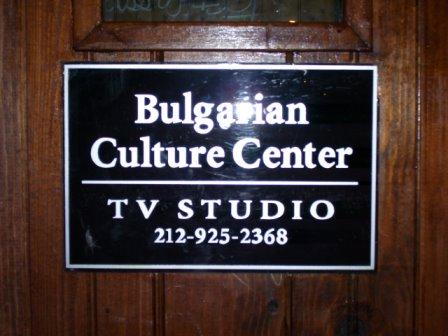
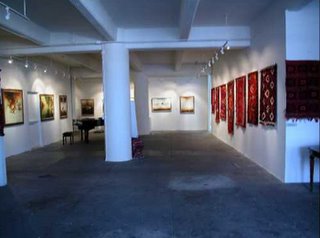 There is also a Macedonia Community Youth Center (37-22 Union Street) in Flushing. The Macedonian Cultural Center (549 West 52nd Street, 8th Floor) in Manhattan, home to Gallery MC, opened in 2004. Macedonians are also active with Raccoon.
Read: Macedonian Community To Open Church In Queens
 Amy over at Newyorkology recently investigated the rumour that Josep Stalin had visited New York City and used the secret train platform beneath the Waldorf-Astoria hotel.
The 7 February "Waldorf-Astoria's private rail platform forever closed" not only reported that the platform is closed but so is the case on the Stalin rumour: Josep Stalin never visited New York City, and therefore he could never have used the platform. His successor, Nikita Krushchev, did visit New York and stayed at the Waldorf-Astoria, "but arrived by motorcade."
Previously on Slavs of New York: Stalinist Architecture via New York?
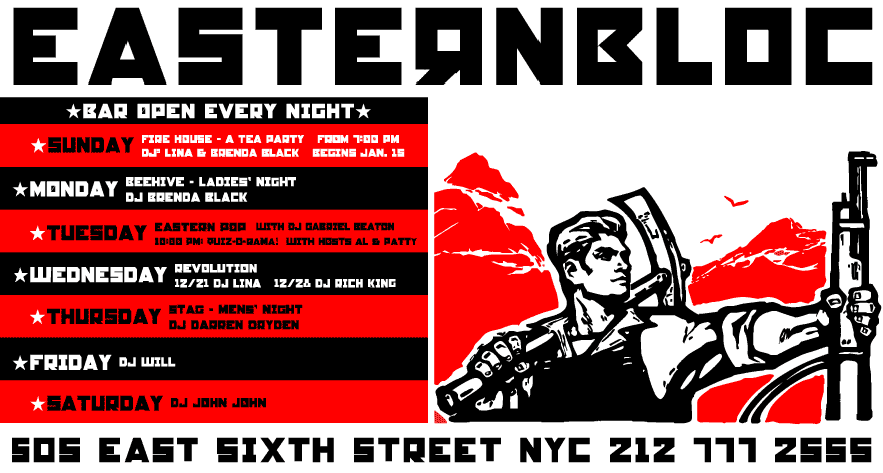
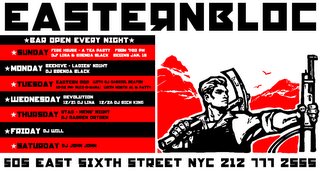 The East Village, Manhattan's Slavic heartland, is now home to the city's first official Slavic gay bar (sort of). Back in December, Eastern Bloc (505 East Sixth Street at Avenue A) opened for business with a decidely SocArt theme. The clientel might not be Slavic, but the decor is ochen' Soviet.
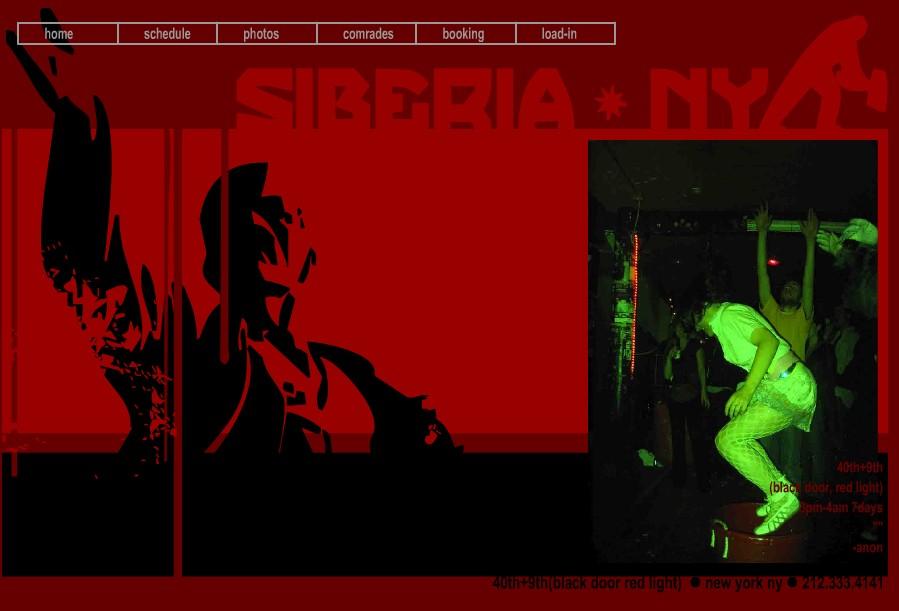
Meanwhile, Siberia (356 West 40th Street) has recently started up a Saturday night GLBT party called Cruising. Cover is $5.00 before midnight, $10.00 after. And the 23-29 November 2005 issue of the NY Press
The East Village, Manhattan's Slavic heartland, is now home to the city's first official Slavic gay bar (sort of). Back in December, Eastern Bloc (505 East Sixth Street at Avenue A) opened for business with a decidely SocArt theme. The clientel might not be Slavic, but the decor is ochen' Soviet.
Meanwhile, Siberia (356 West 40th Street) has recently started up a Saturday night GLBT party called Cruising. Cover is $5.00 before midnight, $10.00 after. And the 23-29 November 2005 issue of the NY Press mentions S
ecrets (1321 Avenue Z between East 13th and East 14th Streets) out in Sheepshead Bay, Brooklyn, near the Russian enclave of Brighton Beach. Though it is surrounded by Russian bars, the Press does not indicate that this bar is itself frequented by Russians.
GLBTs from the former Yugoslavia aren't quite left out in the cold, either. Though it (so far) only has a website and a message list, Queer Ex-YU Diaspora is doing its job to link like-minded people from the Balkans, many of whom are in the five boroughs. There is also apparently a Polish organization in the city as well, called Razem (email razem@juno.com), but it does not seem to be active at this time. Email Slavs of New York if you have any additional information.
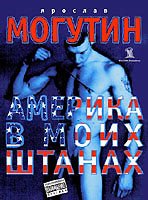
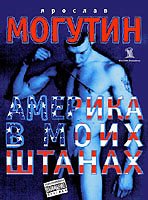 And for the sake of being comprehensive, it also stands to point out that New York has seen its share of prominent GLBT Slavs of New York, first among whom is surely the Carpatho-Rusyn Andy Warhol. Another is the Russian artist Yaroslav Mogutin, a.k.a. Slava Mogutin. Born in 1974 in Siberia, he became the first Russian to be granted asylum in the US on the grounds of sexual orientation in 1995 and settled in New York. Since then, his celebrity as a poet and photographer has grown so much that he is now able to split his time between New York and Moscow, where he has also found an audience. Check out this interview from a 2002 issue of Index.
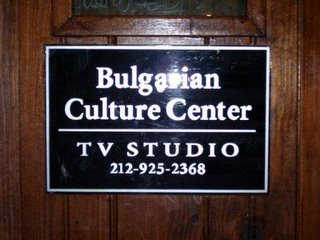 New York has been home to a Bulgarian community since at least 1900, according to the Encyclopedia of New York City. The original immigrants settled in today's Alphabet City, around Avenues B and C at 3rd and 4th Streets.
The city was also home to the first Bulgarian association in the country, the Bulgarian American Mutual Aid Society, founded in 1906. Several other organizations aimed at the newly-arrived immigrants followed. Political emigration after World War Two saw the creation of a number of political groups in the city, such as the Bulgarian National Committee (1946-) and the Bulgarian National Front (1947-1968).
As the early immigrants moved up in society, they, like other immigrant groups, moved out of the Lower East Side. Many Bulgarians ended up the Tremont Avenue and Fordham Road sections of the Bronx, as well as in other parts of Manhattan and in the suburbs.
By the end of the 20th century, there were between 1500 and 2000 Bulgarians in New York, according to the Encyclopedia. Religious centers include Ss. Kirill and Methody Cathedral (552 West 50th Street) and St. Andrew in the Bronx.  The Bulgarian community is connected through the weekly newspaper Nedelnik, and many congregate at the city's Bulgarian restaurants, such as Bulgara in Astoria, Tricolorii in Sunnyside and Mehanata in Manhattan.
In large part building on the popularity of Mehanata, the Bulgarian community has stumbled into the cultural spotight in recent years, helping to launch a local Balkan music scene, and a Gypsy music festival.
The Bulgarian community is connected through the weekly newspaper Nedelnik, and many congregate at the city's Bulgarian restaurants, such as Bulgara in Astoria, Tricolorii in Sunnyside and Mehanata in Manhattan.
In large part building on the popularity of Mehanata, the Bulgarian community has stumbled into the cultural spotight in recent years, helping to launch a local Balkan music scene, and a Gypsy music festival.
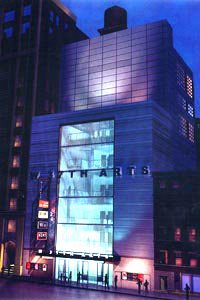
 Yesterday, the Novoye Russkoye Slovo’s Baryshnikov has opened his laboratory discussed Mikhail Baryshnikov’s latest project, the Baryshnikov Arts Center (BAC) at the performing arts complex 37 ARTS (450 West 37th Street). The center’s goal is to be a laboratory of creativity and to inspire young, talented people.
The center occupies the top three floors of 37 Arts, a space that cost around seven million dollars, according to the NRS. Around six million has already been raised to cover the costs of the premises. Baryshnikov himself has put up over one million dollars towards the center’s operating expenses, with the remainder coming from donors and other sources.
“Baryshnikov’s name is has currency. His reputation is unusually high in the world of art and he is known by millions. Not only from old videos but also from recent modern dance performances and from Sex and the City. His expressive face has graced ads for very expensive watches which can be seen in magazines and in the programs of prestigious concert halls,” the paper states.
The NRS concludes, “A dancer, a director, an actor, an organizer and once again a dancer, he can at 57 years old still change his course more than once, guided by curiosity, thirsting for knowledge – qualities he believes are absolutely necessary for every creative person to have.”
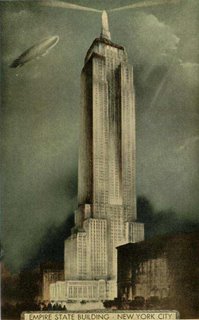 One of the myriad full-text books available via Google book search is Stuart Goldenberg’s Only in New York: 400 Remarkable Answers to Intriguing, Provocative Questions about New York City, a collection of the author’s answers to readers’ questions about the city published in the New York Times.
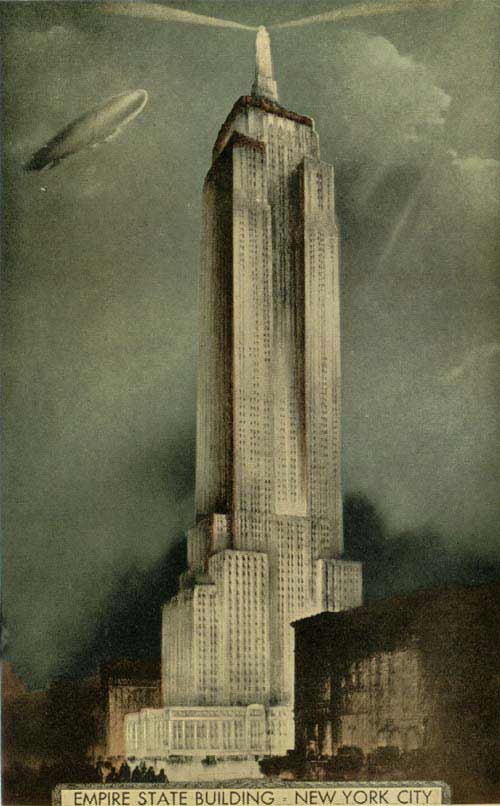
Of particular interest to Slavs of New York is page 178, where we find the question “Is it true that Olympic skiers once trained by climbing the stairs of the Empire State Building?”
The answer?
Apparently, the Polish ski team made it from the fifth floor all the way up to the 102nd in just 21 minutes back in 1932 as part of their training for the Olympic 50km cross-country race in Lake Placid.
Once they got there, however, they were greeted by the Czechoslovak team (who beat them by taking the elevator). The Czechoslovak team then challenged the Poles to a race up the stairs, but the 17 February 1932 edition of the Times reports that the building management was "not agreeable on the proposal to use the staircase for international sports."
(Photo: Empire State Building from New York Architecture Images)
 While researching Croatian terrorists in New York recently, Slavs of New York discovered the story of George Metesky, a Polish-American New Yorker. Metesky ran a Unabomber-like campaign of terror in the city in the 1940s and 1950s and was recently featured on HBO in Forensic Features: The Mad Bomber.
In November, 1940, Metesky began his career as a terrorist by placing a bomb on a window ledge at the Consolidated Edison Building on West 64th Street in Manhattan. It was discovered unexploded and police considered it an isolated incident.
A similar bomb was discovered near Con Edison offices on East 19th Street in September 1941, and police received a letter from the would-be bomber that December. The letter stated that the bomber would "cease his activities for the duration of the war, but added, ' I will bring the Con Edison to justice - they will pay for their dastardly deeds." Seventeen similar letters were also sent to newspapers and business including Con Edison itself.
In March 1950, another unexploded bomb was discovered at Grand Central, and in April 1950 another bomb actualy did go off in a phone booth at the New York Public Library. During the next seven years, nearly 40 bombs were discovered around the city and at least twelve did in fact explode. At least ten people were injured by the Mad Bomber, as he came to be known.
Metesky was finally arrested at home in Waterbury, Connecticut. Police discovered a bomb-making workshop in his garage which he made no effort to hide. As it turned out, Metesky's grudge against Con Edison was the result of an accident at a United Electric & Power Company plant where he had worked. He blamed the accident for his later diagnosis of tuberculosis, but his disability claim was denied. United Electric & Power Company was one of the smaller companies later folded into Con Edison.
George Metesky was deemed mentally unfit to stand trial and commmitted to a psychiatric facility. He was released in 1973, and died in 1994 at the age of 90. Check out George Metesky: New York's Mad Bomber for more details.
Previously on Slavs of New York: Croatian terrorists...in New York?
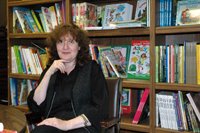 Earlier this month, the Novoye Russkoye Slovo ran a profile of Irina Taic, proprietor of Knizhnyj Magazin № 21, Manhattan’s only Russian bookstore (NRS: Fatal Attraction. To Books).
Born in Kiev, Taic emigrated to the US in the early 1990s. She opened the store on Fifth Avenue near 23rd street about two years ago. Many will remember that long-time Russian bookseller Viktor Kamkin was in the same area but closed several years ago. Tais told NRS that she was running her bookstore a bit smarter: its second-floor space carries a lower rent, and the only employees are her and her daughter.
Another trick up Tais’s sleeve is the fact that she regularly holds events at the store, which helps to make the public aware of the shop’s offerings. “The first one to come was Solomon Volkov,” she told the NRS. “So many people showed up that there was nowhere to stand. The shop wasn’t even finished yet. Books weren’t on the shelves yet. But we brought in several hundred dollars that night anyway.”
 New York Magazine recently published an internet-exclusive, Bar Buzz: An Infused Vodka Bar Crawl. The bar crawl in the article is led by a true master, John Rose, author of the Vodka Cookbook. Who better to guide us through the city's best Russian bars?
Rose leads us first to Uncle Vanya (315 West 54th Street at Eighth Avenue), then to the near-by Russian Vodka Room (265 West 52nd Street between Eighth Avenue and Broadway) and finally to Anyway Cafe (34 East 2nd Street at Second Ave) way down in the East Village.
Though not on the bar crawl, a sidebar points out that something similar to Rose's Spirited Hot Chocolate is served in Greenpoint at CoC66 (66 Greenpoint Avenue between Franklin and West Streets), and that Savalas (285 Bedford Avenue between Grand and South First Streets) has come up with...Oreo vodka: "Wrap 6 bags of double-stuffed Oreos in a cheesecloth and steep it in 4.5 liters of vodka for four days."
The artice also features a number of Rose's vodka recipies you can try at home:
 The old Siberia, in the 1/9 subway station at 50th Street was renowned for being the only bar in the city located in the subway, and was also known as a hangout for journalist-types. When it was evicted several years ago, it seemed like that was that. However, it quietly reopened near Times Square and is once again a hotspot.
The bar took its name from the fact that the old site was a KGB drop-off point in the 1950s. The new bar keeps the tradition as well as the kitchy Soviet decoration. Outside, there is no sign - the door is marked by a single violet light bulb. According to the owner, Tracy Westmoreland, "If you can't find the place, you aren't smart enough to be here."
The bar also featured into a 2001 low-budget documentary, which deals with the owner's fighting to save the old bar from eviction. Among his ploys ws to chain himself to a toilet in front of the landlord's offices in Japan. Check out the film, Siberia and the American Dream, here.
And also check out the New York Times review, and Sipping the Gloom, With Hank on the Jukebox, as well as New York Hangover.
Siberia is located at 356 West 40th Street.
For more Soviet kitch/chic in Manhattan, check out Pravda and KGB.
 Midtown saw the opening of Okeanos spa earlier this month. The spa is an updating of the traditional Russian banya experience, though more in the tradition of the Tsars than that of the average Russian (for that, check out the Russian and Turkish Baths, 268 East 10th St).
All visitors arrive a special Russian-style welcome, "a heated buckwheat wrap scented with rich, exotic Russian spices" placed on your shoulders. Afterwards, there is a wide array of treatments to choose from.
Key treatments involve the banya, the traditional Russian steam room. This is to be followed up by platza, the traditional where you are beaten with birch branches... though the website describes it as "the revitalizing experience of bundled birch leaves brushed against sauna-warmed skin." Platza treatments, according to the website start at $50.00, or $35.00 in combination with a massage.
Another interesting treatment is the Siberian Hot Stone (90 minutes, $210.00). "Powerful penetrating heat therapy heals the body with warm river stones placed along the back, hands and feet. Deep massage calms, soothes and restores."
Heidsick & Co. Monopole champagne - the personal favorite of Nicholas II - as well as ZYR Vodka and Petrossian caviar are also available.
See also From Russia with Banya.
Okeanos is located at 211 East 51st Street. For more information, call 212-223-6773.
 A number of diplomatic missions from Slavic countries occupy landmark buildings in Manhattan. From the AIA Guide to New York City:
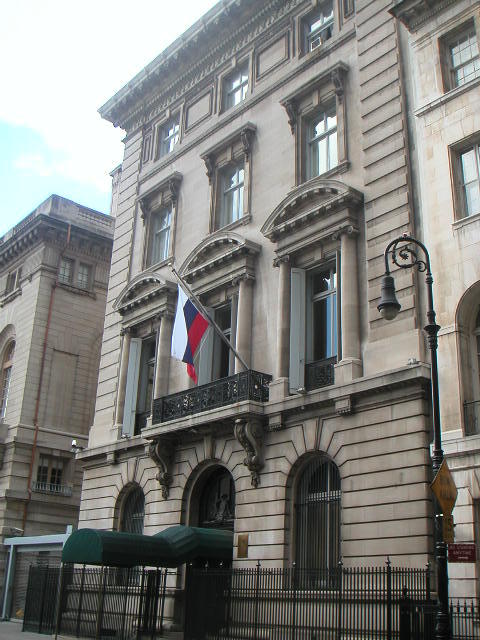
The Permanent Mission of the Russian Federation to the UN (136 East 67 Street) did not make the cut for the AIA Guide, but the Consulate of the Russian Federation (9 and 11 East 91st Street) did.
Built in 1902-1903 as the John Henry and Emily Vanderbilt Sloane Hammond House and the John B. and Caroline Trevor House, the Soviet Union purchased the building to open a consulate in 1975.
A number of diplomatic missions from Slavic countries occupy landmark buildings in Manhattan. From the AIA Guide to New York City:
The Permanent Mission of the Russian Federation to the UN (136 East 67 Street) did not make the cut for the AIA Guide, but the Consulate of the Russian Federation (9 and 11 East 91st Street) did.
Built in 1902-1903 as the John Henry and Emily Vanderbilt Sloane Hammond House and the John B. and Caroline Trevor House, the Soviet Union purchased the building to open a consulate in 1975.
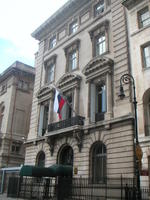 However, when the USSR invaded Afghanistan, President Carter forbade the opening of the Consulate. The building sat vacant from 1979 until 1992, and deteriorated. After extensive rennovation it opened as the Russian Consulate in 1995 (p. 429, and STREETSCAPES: 9 East 91st Street; A Soviet Palazzo Off Fifth Ave).
The Russian Mission also maintains a diplomatic residence in the Bronx (355 West 255th Street at Mosholu Avenue). The 19-storey apartment building was constructed in 1975 (p. 611).
However, when the USSR invaded Afghanistan, President Carter forbade the opening of the Consulate. The building sat vacant from 1979 until 1992, and deteriorated. After extensive rennovation it opened as the Russian Consulate in 1995 (p. 429, and STREETSCAPES: 9 East 91st Street; A Soviet Palazzo Off Fifth Ave).
The Russian Mission also maintains a diplomatic residence in the Bronx (355 West 255th Street at Mosholu Avenue). The 19-storey apartment building was constructed in 1975 (p. 611).
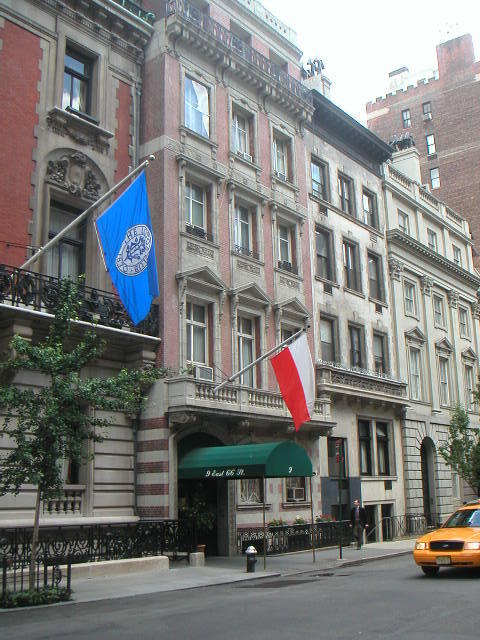
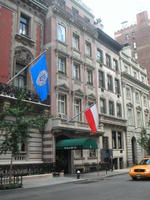 The Permanent Mission of the Republic of Poland to the UN (9 East 66th Street) was built in 1909-1912 as the Charles and Louise Flagg Scribner, Jr. House. The building's architect, Ernest Flagg, was also responsible for many others in the city, including the Singer Building in SoHo and the rectory of St. Mark's in the Bowery Church in the East Village as well as several buildings for Scribner (p. 395).
The Polish Consulate General (233 Madison Avenue at 37th Street) also made the guide. Built in 1905-1906 as the Joseph R. DeLamar House, the building also once housed the National Democratic Club (p. 242-243).
The Permanent Mission of Serbia and Montenegro to the UN (formerly the mission of the SFR Yugoslavia, 854 Fifth Avenue between 66th and 67th Street), was built between 1903 and 1905 as the R. Livingston and Eleanor T. Beckman House (p. 394).
The Permanent Mission of the Republic of Poland to the UN (9 East 66th Street) was built in 1909-1912 as the Charles and Louise Flagg Scribner, Jr. House. The building's architect, Ernest Flagg, was also responsible for many others in the city, including the Singer Building in SoHo and the rectory of St. Mark's in the Bowery Church in the East Village as well as several buildings for Scribner (p. 395).
The Polish Consulate General (233 Madison Avenue at 37th Street) also made the guide. Built in 1905-1906 as the Joseph R. DeLamar House, the building also once housed the National Democratic Club (p. 242-243).
The Permanent Mission of Serbia and Montenegro to the UN (formerly the mission of the SFR Yugoslavia, 854 Fifth Avenue between 66th and 67th Street), was built between 1903 and 1905 as the R. Livingston and Eleanor T. Beckman House (p. 394).
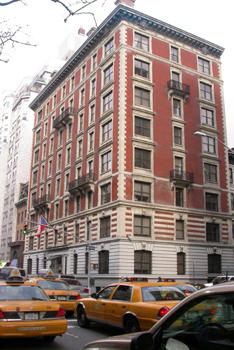
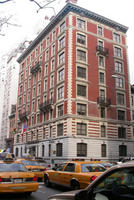 Somehow, the beautiful building of the Permanent Mission of the Czech Republic to the UN (1109-1111 Madison Avenue) did not make it into the AIA Guide...hopefully the ediors will include it in the next edition. The building also houses the Consulate General and the Czech Center.
(Photos: Russian Consulate and Polish Mission, from NY Architecture Images; Czech Mission from www.czechcenter.com)
Somehow, the beautiful building of the Permanent Mission of the Czech Republic to the UN (1109-1111 Madison Avenue) did not make it into the AIA Guide...hopefully the ediors will include it in the next edition. The building also houses the Consulate General and the Czech Center.
(Photos: Russian Consulate and Polish Mission, from NY Architecture Images; Czech Mission from www.czechcenter.com)
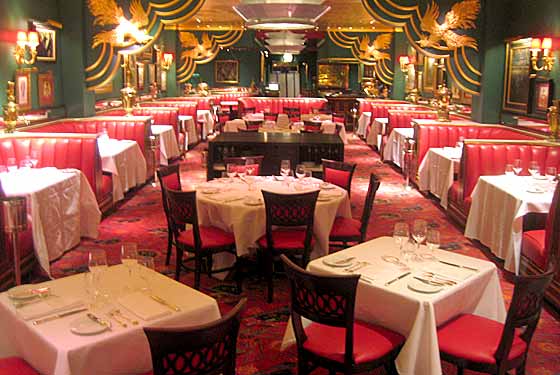 New York Magazine's food blog Grub Street (First Look Inside the Russian Tea Room) has come up with the first photos of the Russian Tea Room (150 West 57th Street between 6th and 7th Avenues), just ahead of its reopening Wednesday morning.
 Reservations are being accepted from Friday on – Restaurant Girl already snagged hers, but gave no clue as to what the number is but the New York Magazine review says it’s 212-974-2111.