Showing posts with label serbs. Show all posts

Saturday, January 17, 2009

Walking Tour: Ridgewood

Ridgewood is perhaps a bit out of the way for the average New Yorker, but the effort to get there is well worthwhile. Historically, this is a German neighborhood but today it is as diverse as anywhere else in Queens – and is home to a major Polish enclave (mainly along Fresh Pond Road), and a smattering of former Yugoslavs, among many other groups.

The neighborhood is home to a major historic district, focused on its fantastically preserved early 20th century residential buildings. When the historic district was declared in 1983, it was the largest in the country, with nearly 3000 buildings included. Even beyond the Slavic sites here, the historic architecture makes Ridgewood a nice place to spend an afternoon.

Though there are several transportation options, Slavs of New York came from Manhattan on the L line to Myrtle-Wyckoff Avenue, and walked across Myrtle Avenue (though there is also a connection to the M line that runs straight through Ridgewood).

The Balkan presence is quickly felt on Myrtle Avenue. Walking across, you’ll first hit the Bulgarian grocery Parrot Coffee Grocery (58-22 Myrtle Avenue). Nearby is the Serbian-owned European Music & Video Store (59-13 71st Avenue), then Muncan Meat Market (60-86 Myrtle Avenue).

A bit further down, the deli Balkan Express (64-02 Myrtle Avenue), featuring a Socialist Federative Republic of Yugoslavia flag on its awning has unfortunately closed, though the awning (and the flag) remain for now. From here, it’s a quick walk over to the next neighborhood in Queens, Glendale, home of the Serbian Club (72-65 65th Place).
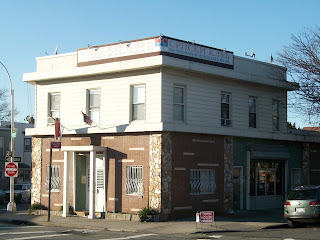


An outpost of the Greenpoint-based Polish & Slavic Federal Credit Union (60-95 Myrtle Avenue) on the corner with Fresh Pond Road is the gateway to a Polish enclave second only to Greenpoint itself. Walking up Fresh Pond Road, you’ll first hit Bona Restaurant (71-24 Fresh Pond Road).

The road has a string of Polish delis, too numerous to list here. They include Teddy's Market Polskie Delikatesy (71-08 Fresh Pond Road), Wawel Meats (68-33 Fresh Pond Road), Pulaski Deli (67-12 Fresh Pond Road) and Okruszek Polish Bakery (67-10 Fresh Pond Road). Just around the corner, down Putnam Road, is a Polish bookstore.
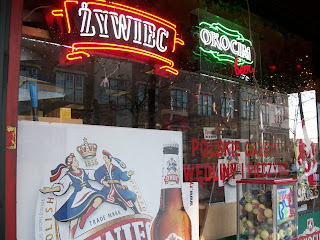


After a couple more delis, including Jantar (66-66 Fresh Pond Road) and Starowiejski (66-51 Fresh Pond Road), there are two excellent Polish restaurants: Kredens (66-36 Fresh Pond Road) and Krolewskie Jadlo (66-21 Fresh Pond Road). Either is a good place for lunch or dinner.

Further up, you’ll find many more Polish delis, as well as Video Random (66-02 Fresh Pond Road) and Aga Book Store (65-18 Fresh Pond Road).

A short walk down Linden Street from Fresh Pond Road will take you to
Gottscheer Hall (657 Fairview Avenue), which is worth poking your head into. The well-preserved deco lobby is impressive, as is the beer-hall on the first floor.


Along with the early German presence came the Gottscheer Germans, a group from what is today Kočevje, in Slovenia. Very few Gottscheer Germans remain in Slovenia because of post-World War II repression of German culture in Yugoslavia, and so their presence in Ridgewood is rather unique. The Gottscheer community here has a number of institutions – most visibly Gotscheer Hall, but also a dance group, a hunting club, a women’s chorus and more.

Down Fairview, the excellent restaurant Bosna Express (7-91 Fairview Avenue) sits next door to the Albanian Café Tirana, a sight possible perhaps only in Queens. Also nearby are even more Polish delis, joined now by a few Balkan ones. Check out Old World Bakery (66-91 Forest Avenue), Europa Grocery (99 Forest Avenue), Korona Deli & Grocery (66-65 Forest Avenue), and Burek's (68-55 Forest Avenue). Also nearby is St. Matthias Roman Catholic Church (58-15 Catalpa Avenue), a German parish that now serves the Polish enclave.

And from here, you will be within striking distance of the Myrtle-Wyckoff Avenue L train.

Thursday, November 27, 2008

Slavs at the 1939 World's Fair in Queens

The other week, Slavs of New York was lucky enough to join the Municipal Arts Society’s walking tour of Bohemian National and the Sokol Halls, led by Joe Svehlak. Everyone is encouraged to visit Bohemian National Hall, but Sokol Hall is a bit less of a public space so getting inside was a treat.

Just inside the door is a small pub, and among the decorations are five large medallions – one each for Bohemia, Moravia, Silesia, Slovakia and Subcarpathian Rus (Ruthenia), the five parts of Czechoslovakia from 1918 to 1939. The guide said they were originally from the Czechoslovak pavilion from the 1939-1940 World’s Fair in Flushing Meadows, Queens.


The Munich Agreement was in September 1938, and Hitler invaded on 14 March 1939. Slovakia declared independence on 14 March, and Ruthenia on 15 March (the latter was then occupied by Hungary just about 24 hours later). The rest of Czechoslovakia was reorganized as the Nazi Protectorate of Bohemia and Moravia. Czechoslovakia would not reemerge until the close of World War II.


So how was there a World’s Fair pavilion for a state that did not exist?

Turns out, the contract with the fair organizers was signed in 1938, and at the time of the Nazi invasion the following March the building was already about half-done.
The plans were scaled down, but preparations went forward.

Mayor Fiorello La Guardia emerged as a leading proponent of Czechoslovak independence, quickly meeting with Czechoslovak representatives and assuring that so long as the United States did not recognize the German moves the Czechoslovak envoys would keep their titles and authority. When Nazi Germany (the only major country not participating in the fair) tried to keep the Czechoslovak pavilion from opening, La Guardia set up a “citizens’ committee” to raise funds to help complete the pavilion and its exhibits.

The pavilion became a
symbol of Czechoslovak resistance to Nazi domination. Former Czechoslovak president Edvard Benes spoke at the dedication of the pavilion on 31 May, highlighting the struggle of the Czechs, Slovaks and Carpatho-Russians (Rusyns) in Europe and thanking La Guardia, noting that “This pavilion, ladies and gentlemen, is the free and independent Czecho-Slovakia of the near past and the free and independent Czecho-Slovakia of the near future.”

The Czechoslovak pavilion stood
between the pavilions of the Soviet Union and Japan. Here’s a description of the finished pavilion from the New York Times on 30 April 1939:

The progress of the country during its twenty-year existence is the central theme, and the products and resources of the land and people are represented and demonstrated – such products as iron, steel, textiles, shoes, beer, hams, Glass blowing and etching are shown. A restaurant and open-air beer garden are included in the project.

Yugoslav pavilion featured a large, illuminated map of the country, as well as a model of the oldest pharmacy in the world, from Dubrovnik. Also highlighted were Yugoslavs who have made contributions to the United States, such as Nikola Tesla and Michael Pupin.
Mayor La Guardia spoke in Croatian, a language he learnt while stationed in the United States Consular Service in Fiume (Rijeka), at the opening of the Yugoslav pavilion in May. Among his comments:

The people of Yugoslavia are generous, kindly and peace-loving. Whenever there is trouble in the Balkans, look for the reason, and it will be found to come from without and not from within. Let the strong and big nations leave the Balkans alone and peace will prevail there.
Among the 60 states participating at the 1939 World’s Fair were three more Slavic states: Yugoslavia, Poland and the Soviet Union.

The

The Polish pavilion was built around the 348th anniversary of the first Polish Constitution, and included – among a wide variety of exhibits – the Jagellonian globe, which is believed to be the first to show the name “America.”


The statue of King Jagiello by Stanisław K. Ostrowski, originally placed in front of the Polish pavilion, is one of the rare artifacts of the 1939-1940 World’s Fair still publicly displayed in New York. The statue now sits in Manhattan’s Central Park, near the Turtle Pond.


The Soviet Pavilion was universally acclaimed as a major highlight of the fair. The building was the tallest on the fairgrounds, other than the iconic Trylon structure. Estimates for its cost ranged from $4 to 6 million, by far the most of any World’s Fair structure. Among the materials used in its construction were nine different sorts of marble brought over specially from the USSR.

The building was topped by a 79-foot-tall worker holding aloft an illuminated red star, nick named Big Joe. After complaints, Fair officials had to put a US flag atop the Parachute Jump (which was later relocated to Coney Island) to ensure it flew higher than the Soviet star.

Exhibits inside included a map of the Soviet Union covered in precious stones, two cinemas, a restaurant, and even a full-scale replica of a portion of Moscow’s Mayakovsky metro station (the station was brand new, having just been completed in 1938).

At the end of the 1939 season, the
Soviet Union pulled out of the fair, and its building was taken apart and shipped back to Moscow.


On 3 January 1940, the New York Times ran a story about the dismantling of Big Joe entitled “Soviet Worker at Fair is ‘Purged’” commenting tongue-in-cheek that “Stalin’s extended his purge to the United States yesterday and ‘Big Joe’… was decapitated by a derrick.”

Initially, there were plans to reassemble the pavilion at
Gorky Park in Moscow, but this was never done and the final fate of Big Joe and the rest of the exhibits remain a mystery.

Monday, August 04, 2008

The Return of the Slavs

Kurowycky Meat Products used to be at 124 First Avenue between 7th and 8th Street, but it closed after 52 years on 2 June 2007.

Today, Jeremiah's Vanishing New York reports on what is happening to the building. Apparently there was interest in opening the space as a restaurant, but the local community board turned down the liquor license application and the interested restaurateurs backed out.

So now rumor has it that it will be turned into a porn store. Jeremiah comments, “When a high-end restaurant is passed over for porn, maybe it’s time to say welcome back, bad old East Village!” But it seems there is still a chance that a liquor license will be approved, and the space will open as a restaurant.

The loss of Kurowycky Meat Products followed hot on the heels of
the final demise of Kiev diner, a major landmark for the local Ukrainians, the latest in a long string of Slavic establishments closing up shop in the face of gentrification.

Lately, though, the gentrification of the neighborhood has taken a new twist: the return of the Slavs.

First up was the Klimat (77 East 7th Street), near the unreconstructed Blue & Gold bar and the gentrified Café 81 (pregentrification: Verchovyna Tavern). Klimat is officially Polish, but has a beer menu and a wine list that covers most of Eastern Europe. The menu also includes pierogies, kielbasa and other Slavic East Village soul food.

And just last month, the Serbs set up an outpost in Alphabet City: Kafana (116 Avenue C, between 7th and 8th Streets). The most detailed review seems to be in the Village Voice. The menu is extensive, the food is excellent. And the Slavs are back in town.

Addendum: New York Magazine has just annouced that Veselka (144 Second Ave. and Ninth Street) is going ahead with the creation of a new location - Veselka Bowery - on East First Street, to be open next summer. Meanwhile, the original location is continuing with its planned expansion into a neighboring space on East Ninth Street.

Photos: Kurowycky from Jeremiah's Vanishing New York; Klimat from New York Magazine.

Saturday, July 19, 2008

Croatian Hijacker to be Paroled

Sunday’s New York Times noted the parole of Zvone Busic, a Croat involved in a hijacking of a TWA flight in 1976 designed to draw attention to the Croatian independence movement (Croatian Leader of 1976 Hijacking Is Granted Parole, but Faces Deportation).

When Croatian hijackers took over TWA Flight 355 not long after its departure from La Guardia on 10 September 1976, they announced they had put five bombs on the plane and a sixth in Grand Central. As it turned out, there were none onboard, but the one in Grand Central was real – and one New York City police officer, Brian J. Murray, was killed trying to defuse it. Another officer was blinded in one eye and two more were injured.

Busic, now 62 years old, served more than 30 years, and was granted parole on Friday but will not be allowed to remain in the United States.

About a week after the hijacking, the Times ran the story,
New York’s Croatians: Close-Knit and Fiery, which describes the community at that time. The article states that up to 35 percent of the 60,000 Croats in the city in the late 1970s arrived after World War II and were very politically active; they tended “to think of themselves as exiles rather than immigrants…” Many fled following the 1971 of the “Croatian Spring” reform movement in Yugoslavia, which was quickly extinguished by the Communist authorities.

Yugoslav Communist leader Josip Broz Tito died on 4 May 1980, but already on 23 March the Times published
Violent Acts in U.S. Feared on Tito’s Death, which predicted “Croatian separatists, Serbian nationalists and Yugoslav security police officers” in the US and elsewhere would see Tito’s death as an opportunity to advance their causes. Croats and Serbs in New York, Chicago and elsewhere often alleged that Yugoslav security services had executed terrorist attacks to tarnish their names, complicating the situation.

An earlier hijacking by Croatian nationalists, that of JAT Flight 367, saw the plane explode above Srbska Kamenica, Czechoslovakia. Of the 28 people on board, only stewardess Vesna Vulovaic survived – having fallen 33,300 feet.

She ended up in the Guinness Book of World Records (highest fall without a parachute) and in the New York Times again in April (
Serbia’s Most Famous Survivor Fears That Recent History Will Repeat Itself) in the run-up to the recent elections in Serbia.

Monday, March 03, 2008

Forum of Slavic Cultures finally online!


Founded in 1994, the Forum of Slavic Cultures has only recently debuted on the internet. The international cultural organization unites representatives from all 13 Slavic countries to join forces to promote Slavic cultures at home and abroad. The organization is based in Ljubljana, Slovenia.

The Forum's members are: Belarus, Bosnia and Herzegovina, Bulgaria, Croatia, Macedonia, Montenegro, Poland, the Russian Federation, Serbia, Slovakia, Slovenia and Ukraine, with The Czech Republic as an observer status. Attention is also paid to Slavic minorities in non-Slavic countries, including the Lusatian Sorbs in Germany.

While the Forum has a variety of projects, among the most pressing right now are those designed to highlight Slavic cultures in Brussels in honor of Slovenia's current stint as the first Slavic president of the European Union.

So far, no activities have been planned for New York, but Slavs of New York is nevertheless very proud to be among the Forum's links!

Sunday, March 02, 2008

Local reactions to Kosovo independence

The declaration of independence by Kosovo on 17 February has sparked interest and concern on the part of many Slavs of New York, not the least of which local Serbs.

On 19 February, Columbia University's Morningside Post ran Jackie Carpenter's "Independence Day for Kosovars in New York," documenting the celebrations in Times Square in support of the move.

The flip side showed up a few days later. The New York Times on 24 February ran an article, "Upheaval Over Kosovo’s Independence Echoes in a New York Enclave" by Anthony Ramierez, which features reactions by Serbs in the Ridgewood neighborhood of Queens.

Down the Jersey Shore, the Press of Atlantic City ran Amy Kuperinsky's "
Independent Kosovo splits expatriates living in area" on 2 March.

And video from WNBC 4 of local Serbs (and Bosnians) at Stari Most in Astoria can be seen on the
restaurant's website.

Below are photos from Sunday's protest near the United Nations.

Wednesday, September 19, 2007

Serbs shine in Brooklyn water polo team

Earlier this week, the New York Times highlighted the water polo team of St. Francis College in Brooklyn Heights, made up of three Americans, one Israeli, three Hungarians and eight Serbs.

The team has been wildly successful despite the fact that its Hungarians and Serbs were recruited without ever having met the coaches before showing up at JFK.

Stepan Gencic, a freshman from Belgrade, told the Times, “Everybody knows ‘that college which has eight Serbians,’ Most of them don’t know the name of the college; they just know that there is a good water polo team.”

Nemanja Pucarevic, a senior from Belgrade pointed out that Serbs may have had a rough time of it in recent years, but can take pride in sports. "Someone like Novak Djokovic, who played at the U.S. Open, he makes the country proud.”

Photo: Joshua Robinson for the New York Times

Tuesday, December 19, 2006

Burek!

Last week, Gridskipper ran a feature on Burek in New York. Djerdan 34-04A 31st Avenue between 35th and 34th Streets in Astoria; 23-01 65th Street at 23rd Avenue in Brooklyn; and 221 West 38th Street between Seventh and Eighth Avenues in Manhattan) topped the list.

Cevabdzinica Sarajevo (37-18 34th Avenue in Astoria) was there too. A few non-Slavic places were there as well, and just might be worth checking out:
  • Zerza (Moroccan, 304 East 6th Street between First and Second Avenues in Manhattan)
  • Café Roma (Kosher, 175 West 91st Street at Amsterdam Avenue in Manhattan)
  • Tony & Tina's Pizzeria (Albanian, 2483 Arthur Avenue in the Bronx)
  • House of Pita (Middle Eastern, 32 West 48th Street in Manhattan)
  • Tasty Shawarmy (Middle Eastern, 71 7th Avenue South at Bleecker Street in Manhattan)
  • Aroma (Israeli, 160 Wooster Street at Houston in Manhattan)
And don’t forget Bosna Express (31-29 12th Street in Astoria), which somehow failed to make the list at all.

Previously on Slavs of New York:
Another Cevapdzinica opens in Queens, Bosnian Grocery Shopping and Cravings takes on Bosnian and Polish cuisine

Wednesday, July 05, 2006

Slavs out of World Cup

The World Cup semifinals have started, but all five Slavic teams have been eliminated.

The kids over at
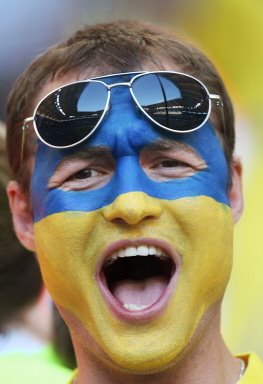
Jaunted covered Friday's Italy/Ukraine match that saw the Ukrainian team get pummelled 3-0. Jaunted caught the match at the Ukrainian Sports Club on Second Avenue, which had a full house.

"The Club itself offers a viewing experience similar to that at an Elks Club or a Boy Scout meeting; there's plenty of linoleum, fake wood paneling and brown carpeting to go around. Chairs were parked around big-screen TV, and fans were crowded behind the seats. Team Jerseys were even available for purchase, and we would have been tempted if we could have gotten a discount after Italy's first goal in the sixth minute. Before that quick strike, the room was all nervous anticipation and excitement, filling with chants of "U-kray-ee-na!" whenever the Ukranians touched the ball."

Jaunted also treked out to Bohemian Hall a couple weekends ago to catch the Ghana/Czech Republic match. "Bohemian Hall was ready for early bird fans--they were open by 10 and were selling muffins and coffee for bleary-eyed supporters arriving for the noon match. Of course, they were selling pitchers of beer as well, and most of the true Czech fans were going for the authentic, breakfast beer route. By the start of the match, the line for beer was out the door and around the corner, and the line for food at halftime was long enough that we saw several fans with pitchers of beer and glasses to sustain themselves during the wait. Bohemian Hall serves authentic grilled klobasy and sauerkraut, and it's worth the wait for the tasty sausage."

The Times Ledger posted a report on the Argentina/Serbia game at the Serbian Club in Glendale, which described slightly less World Cup fever than the scenes at the Ukrainian Sports Club and Bohemian Hall. About 40 people showed up to watch Serbia's first two games, but by the time last week's game rolled around, disappointed fans largely stayed away.

The semifinals kicked off tomorrow with with Italy defeating Germany 2-0, and continue today with Portugal v France.

Previously on Slavs of New York:
Slavs at the World Cup

(Photos from http://fifaworldcup.yahoo.com/06/en/)

Thursday, June 08, 2006

Slavs at the World Cup

We've gotten a few emails lately about where to watch the five Slavic teams compete at the World Cup, and so we figured we should blog it. Games begin on Friday, and not all bars will show all of the games so call ahead to figure out where's best to go. In no particular order, here's the list:
  • Czech Republic: Bohemian Hall (29-19 24th Avenue, Astoria, 718-274-4925). You can't go wrong with this big giant beer garden behind the historic Czech cultural center in Astoria. Aside from Czech beers, they're also having BBQs.

  • Croatia: Scorpio (3515 Broadway at 35th Street. Astoria, 718-956-8233). We're not 100% sure they're playing the games, but if anyone is rooting for Croatia, it's Scorpio. Be sure to try the bijela kava (like a latee), certainly the best in the city.

  • Serbia and Montenegro: Serbian Club (72-65 65th Place, Glendale, 718-821-9875). The mothership for Serbian fans. We've never been, but we hear it's well worth a visit. They've got cold beer, Balkan food and a big-screen TV. Can't go wrong.

    Fans of Croatia and Serbia and Montenegro can also check out
    Zum Stammtisch (69-46 Myrtle Avenue between 69th and 70th Streets, Glendale, 718-386-3014), which of course caters to Germans, but is also frequented by the x-YU communities in the area.

  • Ukraine: Ukrainian Sports Club (122 Second Avenue between 7th and 8th Streets, East Village, 212-475-1340). If you're a Ukraine fan, there's no other place to be. Aside from the full bar with Ukrainian beer, there's a five-foot projection screen TV. The game schedule is on the front door, pass by and check it out.

  • Poland: Smolen Bar and Grill (708 Fifth Avenue, Park Slope, 718-788-9729). There must be a stack of places rooting for Poland, but we came up with nothing. Sage, a Slavs of New York reader, came to the rescue by pointing out Smolen, a neighborhood bar frequented by Russians and Poles serving up Polish beer.
UPDATE: Croatia's games will also be shown at the Croatian Center (502 West 41st Street, 212-563-3395) in Manhattan, open to the public and free admission. Croatia v Brazil (13 June at 2:55 p.m.), Croatia v Japan (18 June at 9:00 a.m.) and Croatia v Australia (22 June at 2:55 p.m.).
And Cafe Blue Light (30th Street & 35th Avenue, Astoria) also has a live feed on a plasma TV, as well as Balkan food and $3.50 beer.

Friday, April 07, 2006

Slavic Sheepshead Bay

Earlier this week, Forgotten NY spotlighted Sheepshead Bay, Brooklyn, home to a couple of thought-provoking Slavic sites.


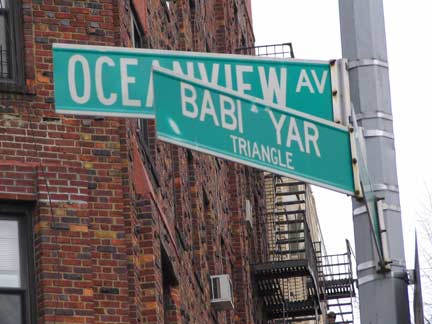
First up, check out Babi Yar Triangle (Corbin Place and Brighton 15th Street), a park named after a 1941 pogrom led by Nazi Einsatzgruppe soldiers and Ukrainan militiamen at Babi Yar, near Kyiv. Nearly 34,000 Jews were killed in just two days, and over the course of the 778 days of Nazi rule in Ukraine a ravine in Babi Yar became the final resting place for over 100,000 people - Jews, Roma, handicapped people, Soviet POWs homosexuals and others. This park was dedicated in 1989.


Sheepshead Bay is also home to the only Holocaust memorial park in New York City, dedicated in 1985.

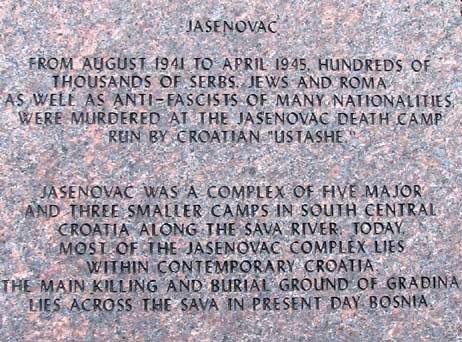
The monument in the park also commemorates the mass killings at Jasenovac, a concentration camp run by the Croatian Ustase from 1941 to 1945. Hundreds of thousands of Serbs, as well as Jews, Roma, anti-fascists and others were put to death there, and Jasenovac has been a wedge between the Serbs and Croats ever since.
The neighborhood is also home to the Bethel Russian Baptist Fellowship (2310 Voorhies Avenue), and the (gay?) bar Secrets (1321 Avenue Z between East 13th & East 14th Streets). And in nearby Gravesend Neck you'll find the Russian restaurants Elrisha (2364 McDonald Ave between Gravesend Neck Road & Villa) and Anyway Cafe (1602 Gravesend Neck Road), as well as the Russian Baths of NY (1200 Gravesend Neck Road, Gravesend Neck).

Thursday, March 09, 2006

Serbs in New York City

In the Encyclopedia of New York City, Marc Ferris writes that Serbs first came to the United States in the late nineteenth century as economic refugees. They primarliy settled further west, but many ended up in the Serb, Croat and Slovene community in Midtown West, along Ninth and Tenth Avenues between 21ts and 40th Streets. By 1914, the community was organized in to the Srpska Narodna Odbrana (Serbian National Defense) organization, and between 1911 and 1932 they had a daily newspaper, Srbski Dnevnik.


The most famous Serbian New Yorker is certainly Nikola Tesla, the prominent scientist and inventor. He lived here for almost 60 years, and died at the Hotel New Yorker at 40th Street and 6th Avenue in Manhattan. The hotel now bears a memorial plaque in his honor.


Today, the strength of the Serbian community in New York is estimated at around 40,000, with the largest concentrations in Ridgewood and Astoria. The community's institutions inclulde the Jasenovac Research Institute and the Tesla Memorial Society of New York, and many recently-arrived refugees are active with Raccoon, whose focuses on all former Yugoslav groups.


Though it is now dispersed around the city, the center of the community remains Serbian Orthodox Cathedral of St. Sava (20 West 26th Street between 6th Avenue and Broadway), the most striking architectural landmark in town. The Permanent Mission of Serbia and Montenegro to the UN (854 Fifth Avenue between 66th and 67th Street) is another architectural gem.
(Top Photo: Interior of St. Sava Cathedral from New York Architectural Images; Below: memorial plaque at Hotel New Yorker from http://teslasociety.com)

Friday, February 03, 2006

GLBT Slavs of New York

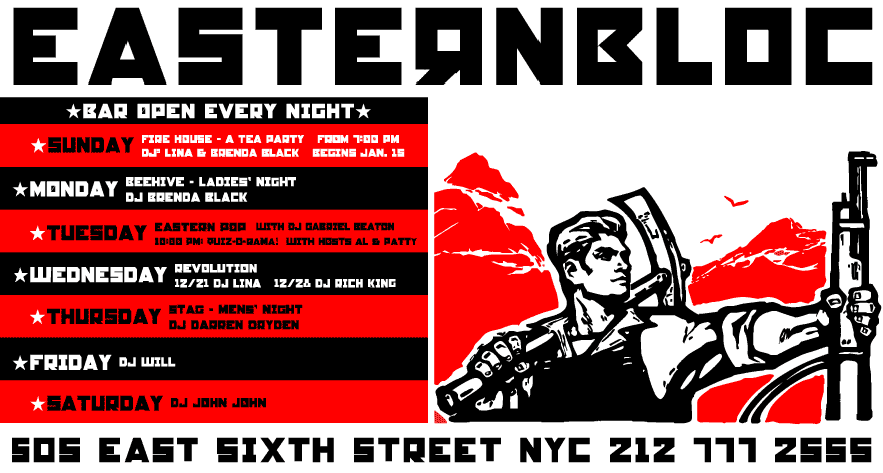
The East Village, Manhattan's Slavic heartland, is now home to the city's first official Slavic gay bar (sort of). Back in December, Eastern Bloc (505 East Sixth Street at Avenue A) opened for business with a decidely SocArt theme. The clientel might not be Slavic, but the decor is ochen' Soviet.

Meanwhile, Siberia (356 West 40th Street) has recently started up a Saturday night GLBT party called Cruising. Cover is $5.00 before midnight, $10.00 after. And the 23-29 November 2005 issue of the NY Press mentions Secrets (1321 Avenue Z between East 13th and East 14th Streets) out in Sheepshead Bay, Brooklyn, near the Russian enclave of Brighton Beach. Though it is surrounded by Russian bars, the Press does not indicate that this bar is itself frequented by Russians.

GLBTs from the former Yugoslavia aren't quite left out in the cold, either. Though it (so far) only has a website and a message list, Queer Ex-YU Diaspora is doing its job to link like-minded people from the Balkans, many of whom are in the five boroughs. There is also apparently a Polish organization in the city as well, called Razem (email razem@juno.com), but it does not seem to be active at this time. Email Slavs of New York if you have any additional information.

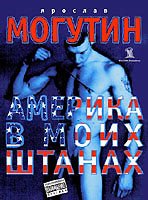
And for the sake of being comprehensive, it also stands to point out that New York has seen its share of prominent GLBT Slavs of New York, first among whom is surely the Carpatho-Rusyn Andy Warhol. Another is the Russian artist Yaroslav Mogutin, a.k.a. Slava Mogutin. Born in 1974 in Siberia, he became the first Russian to be granted asylum in the US on the grounds of sexual orientation in 1995 and settled in New York. Since then, his celebrity as a poet and photographer has grown so much that he is now able to split his time between New York and Moscow, where he has also found an audience. Check out this interview from a 2002 issue of Index.

Monday, November 14, 2005

Croatian terrorists...in New York?

A couple weeks ago, Slavs of New York ran the post Slovenes in the East Village, which caught the eye of Glory of Carniola. To be mentioned on such a fantastic blog was great, but what was even better was the comments by DarkoV.

Apparently, back in the 1970s and 1980s New York City had its very own Croatian nationalist terror attacks. Who knew?

The group was called the Croatian National Resistance, or Otpor (or Odpor) for short. It was founded by Vjekoslav “Maks” Luburic, a leader of Croatia’s World War II-era Ustasha government.

Aside from New York City, the group was also active in Chicago and Los Angeles, with other members also in Cleveland, San Francisco and Toronto as well as in South America and in Europe.

Their primary goal was to secure the independence of Croatia from the Socialist Federative Republic of Yugoslavia but their activities mostly consisted of attacks on pro-Yugoslav or moderate Croats in the US and elsewhere.

Among the incidents:

29 December 1975 –
LaGuardia Airport attack. Croatian Nationals at LaGuardia Airport kill 11 and injure 75 after detonating a bomb with the force of 20 sticks of dynamite in a coin operated locker at the TWA terminal. The force of the explosion turned locker doors and metal pieces from baggage carousels into deadly shrapnel.

10 September 1976 – TWA hijacking. Terrorist Zvonko Busic, his wife and three other Croatian terrorists, as a result of concerns about the plight of Croatia within then communist Yugoslavia, hijack a TWA jetliner from LaGuardia Airport, bound for Chicago and re-routed to Paris, seizing 86 passengers. There were no weapons aboard the plane, but genuine explosives were left behind in a Grand Central Station baggage locker in order to create the impression that there were weapons on the plane. Bomb Squad Officer Brian Murray tragically lost his life attempting to deactivate the bomb. Another Glory of Carniola reader adds, that was the flight where Vesna Vulović secured the most terrifying world record of all: surviving the highest fall without a parachute. And apparently Vesna landed straight into a folk song, “Vesna stuardesa” (check out Aviation Security International, How to Survive a Bombing at 33,00 Feet)

1977 - Assasination attempt on Radomir Medic at United Nation mission.

1978 - Two killed. Yugoslav immigrants Ante Cikoja and Krizan Brkic were killed in New York City and Los Angeles, resp.


1978 - Two critically wounded. Another two Yugoslav immigrants critically wounded in an attack in New York City.


2 July 1982 –
Landmark sentencing of six Otpor activists on racketeering charges, including two planned murders.

6 July 1982 – Bombings in New York. Four New York Yugoslav sites bombed by Otpor in retaliation.

25 January 1983 -
The First Otpor RICO Trial in New York City. Decision handed down in the case of USA vs. Franjo Ivic Nedjelko Sovulj, Ivan Cale and Stipe Ivkosic. All four Otpor members were convicted on various charges; Cale was sentenced to 35 years, Ivic to 30, Ivkosic and Sovulj both to 20.

14 April 1983 -
The Second Otpor RICO Trial in New York City. Thirteen-week trail results in the conviction of six more Otpor activists. Defense lawyers accused the prosecution of being in bed with UDBA, the Yugoslav secret police, and alleged their clients were victims of the communist Yugoslav government, which influenced the US government to bring forward the charges.

The group was the subject of an episode of the FBI Files on the Discovery Channel which aired about this time last year.


DarkoV concludes: It was not a pleasant time to be an American of Croatian birth, who had no interest in any violent overthrow. Luckily, the main organizers were arrested or they disappeared, so life returned to normalcy again, namely, back to the times when most Americans didn't know who or what a Croatian was.

Thanks for the info, DarkoV!

Previously on Slavs of New York: Slovenes in the East Village and Manhattan's Croats

Thursday, October 27, 2005

New York City's Balkan music scene

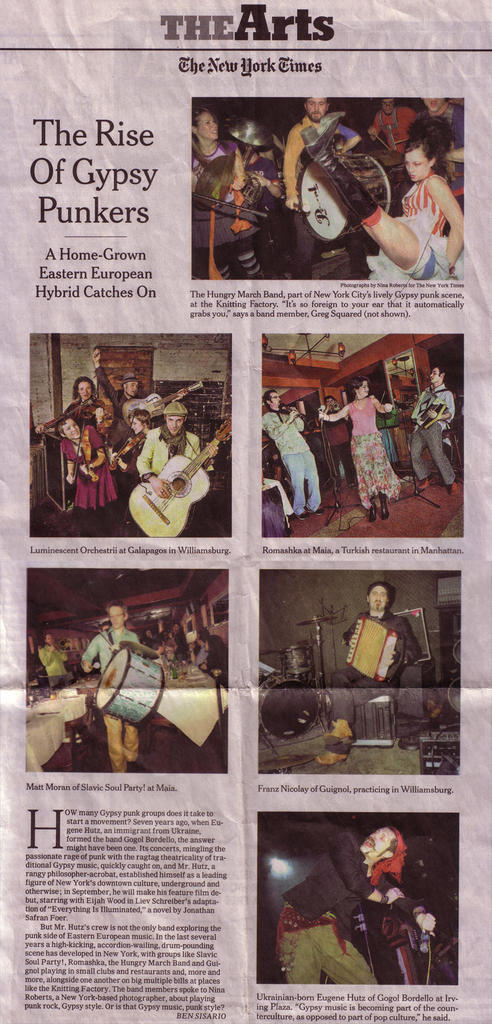
One of the least-expected waves to hit New York City is the current Balkan gypsy music fad, led by Gogol Bordello and its illuminated frontman Eugene Hütz.

The scene started slowly at Mehanata, on the second floor of an unassuming building on the corner of Broadway and Canal Street in Chinatown. Hütz started out there as a DJ and quickly built a following. Gogol Bordello quickly followed, forming in 2000. The band performs what it calls "punk cabaret" music, influenced by Hutsul, Ukrainian, Romanian and Gypsy music. Hütz's rise recently culminated in a starring role in the movie Everything is Illuminated.


There are easily a dozen bands in the five boroughs playing one sort of Balkan music or another. Among the current favorites are Zagnut Cirkus Orkestar, Romashka, Hungry March Band and Luminescent Orchestrii. The most established are Zlatne Uste and Slavic Soul Party!, and one old favorite we'd love to see make a comeback is Pectopah.

You can catch these bands at shows all over town, particularly at Mehanata, Hungarian House, Barbes and Maia Meyhane. Other venues that frequently feature these bands include the Knitting Factory, Nublu and Satalla.


For anyone interested in learning the traditional dances that accompany the music, there's NYC Folk Dance. Each year, they schedule two seasons of low-key dance lessons as part of their Folk Dance Fridays, Family Dance and Balkan Cafe series at Hungarian House on the Upper East Side. They also run a Wednesday night Balkan dance class in Chelsea.

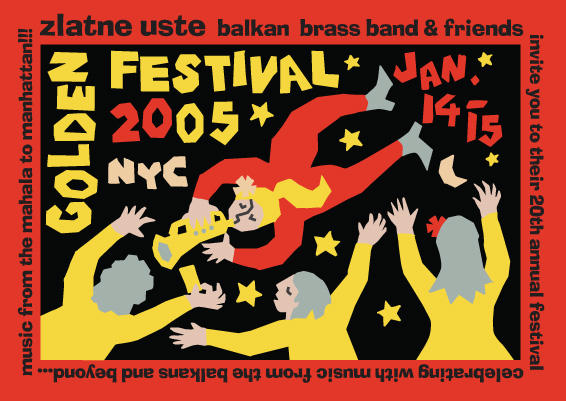
The high point of the Balkan music year in the city is definitely the Golden Festival, which next takes place on 13 and 14 January 2006. In its 21st year, the annual gathering is organized by Zlatne Uste and features countless performers on multiple stages, Balkan and Middle Eastern delicacies and art vendors.

But before that comes the first New York Gypsy Festival, which opens on Saturday and runs through 6 November. The festival, like most of the bands and events, does not feature music from Slavic lands exclusively, but covers a wider cultural area that includes Romania, Turkey and the Middle East. The highlight will be an eight-hour marathon of performances on 6 November at the Roxy.

And if you can't attend any of the events, or just want a souvenier, check out the new double CD produced by Mehanata. Tracks were provided by many bands that have performed at Mehanata, including Balkan Beat Box, the Dolomites, Gogol Bordello, Guignol, the Hungry March Band, J.U.F., Luminescent Orchestrii, Romashka, Shaat’nez, Slavic Soul Party!, Yuri Yunakov and Zagnut Cirkus Orkestar.

But why the sudden craze? Inna Barmash, the singer of Romashka, told the Times of London in May that “There is something about gypsy music that people just respond to, whether it’s flamenco, Hungarian gypsy or Russian gypsy — it catches people’s souls in a very immediate way. People seem to know how to dance to it intuitively” (check out The Gypsies pitch up in the New York Times). Matt Moran of Slavic Soul Party! told the Times that he thinks part of the reason is the opening up of the Eastern Bloc and the floods of new immigrants and refugees from Eastern Europe and the Balkans. But the music and the passion behind it are the real pull - who could resist it?