Showing posts with label greenpoint. Show all posts

Wednesday, September 24, 2008

Walking Tour: Slavs of Greenpoint

Greenpoint is the preeminent Polish enclave in New York – and one of the largest outside of Poland itself. According to the 2000 Census, New York had the second-largest Polish community in the country after Chicago, and the majority seem to live in Greenpoint.

The Polish presence is so strong that even though you downloaded that
Polish-language primer from GreenPunkt as a joke, it turned out to be pretty useful in the end. Kirk Semple wrote recently in The New York Times that the booming economy in Poland is luring more Poles home and may leave Polish Greenpoint a part of history. But for now, there’s still much to see – even if gentrification is an ever-increasing force in the neighborhood and the promise of a better life now has many local Poles rethinking life in their homeland.

Since they’re close, this walk actually starts in
Williamsburg, at the Bedford Avenue L station. Walk Up Bedford Avenue and you’ll immediately pass both Raymond's Place (124 Bedford Avenue) and Kasia’s Restaurant (146 Bedford Avenue). Turn right along North 12th Street, walk to Driggs Avenue and you cannot miss the landmark Russian Orthodox Cathedral of the Transfiguration of Our Lord (228 N.12th Street at Driggs).

From here, go back out to Bedford Avenue, keep walking north and you’ll hit Father Jerzy Popieluszko Square. Popieluszko was a priest martyred by Poland's Communist government in 1984 for supporting the emergent Solidarity movement. The monument was erected here just six years later, in 1990.

At the fork, keep right and walk along Nassau Avenue (passing the Nassau Avenue G station), and you should see a number of Polish
milkbars and restaurants, including Lomzynianka (646 Manhattan Avenue), Pod Wierchami (119 Nassau Avenue) and Pyza (118 Nassau Avenue).

At Eckford Stret, turn right and walk down to Driggs Avenue to the
Polish National Home (a.k.a. the Warsaw) (261 Driggs Avenue). This former ethnic social club in recent years has recast itself as a major club venue.

From here, walk down Driggs to Humbolt, where you’ll see Walesa-Solidarity Square (a.k.a. Humbolt Street) and Pope John Paul II Plaza (Driggs Street) near the center of Greenpoint’s Polish community,
St. Stanislaus Kostka Church (607 Humboldt Street at Driggs).

Turn right and walk up Humbolt St. back to Nassau Avenue, where you’ll find Old Poland Bakery and Restaurant (192 Nassau Avenue). Have a snack, or continue on to Manhattan Avenue and turn right. Near Norman Avenue is Krolewskie Jadlo (694 Manhattan Ave), guarded over by a Polish knight.
At the next intersection (Manhattan and Meserole), you’ll find Club Europa (98 Meserole Avenue) to the left, and the fantastic Wedel chocolate shop (772 Manhattan Avenue) on corner to the right. If you can, make SURE to check this place out around Christmas time!

Further along Manhattan on the next block is yet another Polish restaurant,
Christina's (853 Manhattan Avenue), and Polonia Bookstore (882 Manhattan Ave) where you can get books in Polish as well as books to learn Polish. If you turn right onto Greenpoint Avenue, Club Exit (149 Greenpoint Avenue, check out Clubbing in Greenpoint) is just off Manhattan Avenue.

The next intersection is with Kent Street, and just past Manhattan Avenue to the left is the former Carpatho-Rusyn
Greek Catholic Church of St. Elias (149 Kent Street (Manhattan Avenue & Franklin Street) and to the right, the Polish and Slavic Center (177 Kent Street and the Polish and Slavic Credit Union (175 Kent Street), two major local institutions.

And at the next intersection, turn right on Kent Street and you’ll find
Ksiegarnia Literacka (161 Java Street). This one is the classiest of Greenpoint's Polish bookstores, and even if you don't read the language it's well worth dropping in just to take a look. It's also the end of the tour - unless you're feeling adventurous and want to check out the Pulaski Bridge (keep waking up Manhattan Avenue to the end and turn right on Ash Street and hike out to McGuiness Boulevard).

When you're done, you can walk back to the Bedford Avenue L train or the Nassau Avenue G, but the closest will be the Greenpoint Avenue G station at the intersection of Greenpoint and Manhattan Avenues.

Monday, August 04, 2008

Spoke too soon: Greenpoint church to become condos

No sooner do we note a resurgence of Slavic life in the East Village in the face of gentrification than we discover a new loss in Greenpoint: the Byzantine (Ruthenian) Catholic Church of Saint Elias (143-149 Kent Street) is to be converted into condos.

The church was built in 1870 and bought by the Byzantine Catholic Eparchy of Passaic in 1943. The congregation (originally at least) was primarily Carpatho-Rusyn. The congregation has since dispersed, and the building has sat vacant for a few years.

Curbed reported today that the building is being handled by “voracious real estate machine” Massey Knakal. The exterior has landmark status and cannot be altered, but the idea seems to be to turn the inside into condos.

Back in March, the
New York Sun reported the asking price as $4.2 million. The Brooklyn Paper says that “close to 40 units” will be created in the building, at a cost of $7 million.

The Brooklyn Paper also noted that
the stained glass windows and Byzantine crosses on the roof are being removed “in hopes of not scaring away potential tenants.”

Tuesday, October 10, 2006

Cravings takes on Bosnian and Polish cuisine

Local foodie website Cravings recently published a feature on ethnic restaurants in the five boroughs, and singled out Bosnian and Polish cuisine for special attention.

They declared Burek of course as the highlight of Bosnian cuisine, after a visit to Djerdan (221 West 38th Street between 7th and 8th Avenues). Slavs of New York would go a bit further and also recommend the cevapci.

As for Polish cuisine, the star at Polam International Market (952 Manhattan Avenue between India and Java Street, Greenpoint) was the stuffed cabbage – at about 70¢ each!

Meanwhile, Cravings enjoyed the smoked bacon spread at Damis (931 Manhattan Avenue between India and Java Street, Greenpoint). The food at this jungle-themed restaurant apparently wasn’t up to snuff, but the meal was saved by this bacon spread which came free with the basket of bread before dinner was even served.

Wednesday, June 21, 2006

Clubbing in Greenpoint

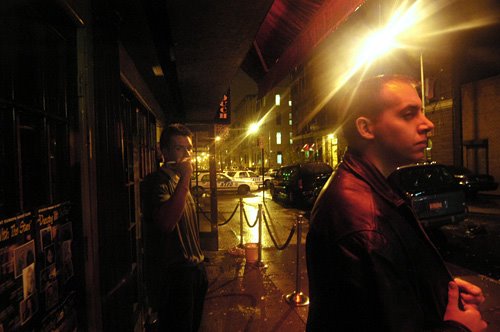
Last week’s Village Voice featured Daphne Carr’s Love and Warsaw: Two thriving Greenpoint dance clubs vie for Polish nightlife supremacy, about the Polish club scene in Brooklyn.

The article focused on the rivalry between
Club Europa (98-104 Meserole Avenue at Manhattan Avenue, Greenpoint) and Club Exit (149 Greenpoint Avenue), long favorites of Brooklyn’s Poles and other Slavs. Now, they’re gaining more and more prominence as gentrification pushes hipsters out of Williamsburg and into Greenpoint.

Europa’s owner Zibby Chalecki told the Voice that he sees the club as a “cultural embassy of Poland: ‘It’s not just a discotheque, it’s an arts center.’” He seems to be disappointed that the local Polish community is beginning to move on, but also eager to reach out to the wider community to ensure his business continues to thrive.

Exit is also starting to reach out. Though Saturdays are still Slav-apalooza, Fridays are mostly run by outside promoters who bring in their own audiences (though Slavic bands do come by from time to time).

The Voice website also featured a slideshow, Hot Like That:Scenes from the Polish/New York party life. Check it out.

(Photos: Staci Schwartz/stacipop.com for the Village Voice)

Friday, March 31, 2006

On the prowl for Polish food

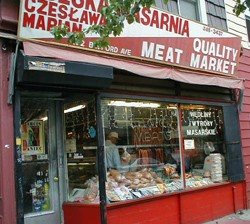
Last week, Polish meat markets in Williamsburg showed up on Gothamist, providing us with a number of interesting details.

The
outer boroughs message board at Chowhound fielded a discussion thread on the topic, and contributors fielded three options: Steve's Meat Market (104 Nassau Street), W-Nassau Meat Market (915 Manhattan Avenue) and Polska Masarnia (172 Bedford Avenue).

They also brought forward Joshua Williams’s “
More Than a Pierogi” from billburg.com, about Polish food in Williamsburg and Greenpoint. The article starts out with Bar Mleczny (Milk Bars) and discusses the glories of pierogi and golabki, as well as other Polish favorites.

The article also gives a number of Polonophile listings:


Greenpoint

  • Wedel’s Chocolate Store (722 Manhattan Avenue)
  • Lomzynianka (646 Manhattan Avenue between Naussau and Norman)
  • Christina’s (853 Manhattan Avenue between Milton and Noble)
  • Stylowa Restaurant(694 Manhattan Avenue between Naussau and Norman)
Williamsburg
  • Kasia’s Restaurant (146 Bedford Avenue between North 6th and 7th)
  • S&B Restaurant (194 Bedford Avenue at North 9th)
Downtown Brooklyn
  • Teresa’s (80 Montague Street at Hicks Street)
Manhattan
  • Teresa’s (103 First Avenue between 6th and 7th Street)
  • Christine’s (208 First Avenue between 12th and 13th Streets)

Tuesday, February 21, 2006

New York Times looks at Polish Milk Bars

Sunday's New York Times City Section featured Carolyn Slutsky's "Urban Studies: PiningWorkers Uniting, Over Pirogi," about the milk bars of Greenpoint.

A milk bar is essentially a cafeteria brought to Brooklyn via Communist Poland. Despite their association with the ancien regime, they remain popular today and serve as a reminder of home for the city's Polish immigrants. And for the local hipsters, they are a huge bargain with few entrees costing more than $6.00.


The article cites Pyza (Nassau Avenue near McGuinness Boulevard), but there are several more throughout the neighborhood. Email Slavs of New York with the name and address of your favorite, and we'll add it to the bars and restaurants links!

(Photo: Michelle V. Agins for The New York Times)

Monday, December 12, 2005

Making ends meet for Polish immigrants

The latest issue of Voices That Matter includes “Making ends meet for Polish immigrants,” translated into English from the Polish-language Nowy Dziennik.

The article delves into the question of "what do Polish immigrants spend their money on?" It paints a picture of careful consumers who strive to save as much money as possible.

Alcohol, nevertheless, remains a wide-spread luxury. “A Pole is not a camel, he has to drink,” Marek of Greenpoint told the paper. “I don’t even count how much I spend on beer because it upsets me, but I think it probably would be a lot. I have to be able to have some fun after work.”

Aside from alcohol, rent appears to be the biggest expense, followed by groceries. Education and medical expenses make up another big chunk of many Polish immigrants' budgets, though some in the article admitted to putting of medical care to save the money.

Not everyone is in such dire straights, however. Irena, a tax preparer whose clients are mostly Polish, told Nowy Dziennik that most of her clients declare about $30,000 per year, with more than a quarter making over $40,000 and about ten percent making over $100,000. The more wealthy Polish immigrant, she believes, are younger people with managerial positions and good educations working in US companies. Similarly, business owners and smaller contractors are doing quite well for themselves.

"So maybe Poles simply complain more than they have reason to, as it is a part of their nature. But, they are able to save. Or maybe only some don’t have real reasons to complain; the truth is somewhere in the middle," Nowy Dziennik concludes.

Monday, November 21, 2005

Infused Vodka Bar Crawl

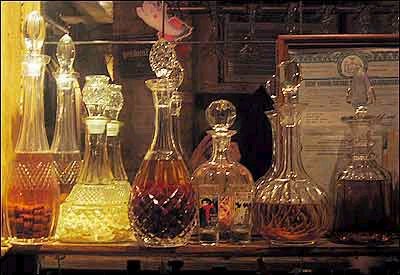
New York Magazine recently published an internet-exclusive, Bar Buzz: An Infused Vodka Bar Crawl. The bar crawl in the article is led by a true master, John Rose, author of the Vodka Cookbook. Who better to guide us through the city's best Russian bars?

Rose leads us first to
Uncle Vanya (315 West 54th Street at Eighth Avenue), then to the near-by Russian Vodka Room (265 West 52nd Street between Eighth Avenue and Broadway) and finally to Anyway Cafe (34 East 2nd Street at Second Ave) way down in the East Village.

Though not on the bar crawl, a sidebar points out that something similar to Rose's Spirited Hot Chocolate is served in Greenpoint at
CoC66 (66 Greenpoint Avenue between Franklin and West Streets), and that Savalas (285 Bedford Avenue between Grand and South First Streets) has come up with...Oreo vodka: "Wrap 6 bags of double-stuffed Oreos in a cheesecloth and steep it in 4.5 liters of vodka for four days."

The artice also features a number of Rose's vodka recipies you can try at home:

Wednesday, October 19, 2005

Slavic WIlliamsburg & Greenpoint

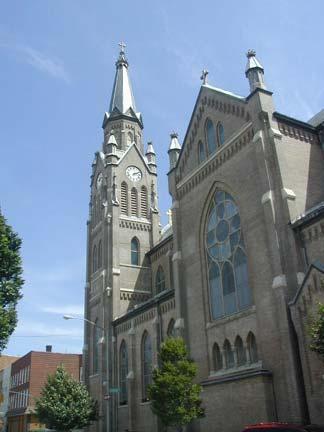
The most densely Slavic part of New York City is easily Greenpoint, in Brooklyn. The bulk of the neighborhood is clearly Polish, with the first Polish immigrants arriving around 1890 and founding the monumental St. Stanislaus Kostka Church (607 Humboldt Street at Driggs) in 1896. The building dates from 1903.

The local Polish community – and the church – are so important to the area that Humboldt Street in front of the church is known as Lech Walesa Place, and Driggs Street is called Pope John Paul II Plaza. Another nearby Polish-named landmark is the Kosciuszko Bridge, joining Brooklyn and Queens. Formerly the Meeker Avenue Bridge, it was renamed in honor of Polish patriot Tadeusz Kosciuszko in 1940.

Other Slavic landmarks include the Greek Catholic Church of St. Elias (149 Kent Street between Manhattan Avenue and Franklin Street), and the Polish National Home, better known to local hipsters as the
Warsaw (261 Driggs Avenue).

The nicest Polish bookstore in the area by far is
Ksiegarnia Literacka (161 Java Street). Polish restaurants include Old Poland Bakery and Restaurant (192 Nassau Street), Pod Wierchami (119 Nassau Street), Lomzynianka (646 Manhattan Avenue), Stylowa (694 Manhattan Avenue), Christina's (853 Manhattan Avenue), Polish and Slavic Credit Union (175 Kent Street) and Little Poland (136 Greenpoint Avenue)

On the border of Greenpoint and Williamsburg is one of the most impressive buildings in either neighborhood: the
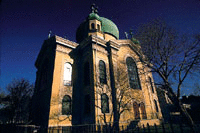
Russian Orthodox Cathedral of the Transfiguration of Our Lord (228 N.12th Street at Driggs). The church is easily recognizable thanks to its five large copper domes (currently being restored). The church was built between 1916 and 1921, and was modeled after the Moscow Kremlin’s Cathedral of the Dormition. The iconostas within features icons painted by monks from Kiev’s famous Monastery of the Caves. The congregation is largely Carpatho-Rusyn, and the parish priest, Very Rev. Wiaczeslaw Krawczuk, is Belarusian.

Williamsburg, just south of Greenpoint, is also not lacking in Slavic sites. The most important is easily the Holy Trinity Church of the Ukrainian Autocephalic Orthodox Church in Exile (117-185 S.5th Street at New Street), which occupies a landmark building built in 1906 as the main branch of the Williamsburg Trust Company. It served in that capacity just a few years, until 1911, and then was abandoned until 1928 when it became a courthouse. The Ukrainians took it over in the 1960s.

Sources of information about Poles in Greenpoint include
Search for Polonia by Kari Levinson and Sally Valentin and If You're Thinking of Living In/Greenpoint; An Inviting Area, Once You Get There by Dulcie Leimbach in the New York Times. For information about the small Polish presence in Queens, try Polish In Queens:Never Afraid To Work Hard For Their Dreams by Tamara Hartman.

For info on Transfiguration Cathedral, check out
At Russian Orthodox Church in Williamsburg; Restoring the Cupolas Of a Landmark Cathedral in the New York Times, From Russia With Love - The story of Brooklyn's most beautiful cathedral from billburg.com and the church’s listing in the OCA directory of parishes.

(Photo: (top) St. Stanislaus from Forgotten New York; (bottom) Transfiguration Cathedral by Jason Kempin, from
billburg.com)

Thursday, October 13, 2005

New York's Carpatho-Rusyns

Until 2003, the Metro New Jersey - New York Chapter of the Carpatho-Rusyn Society (C-RS) existed to provide a social outlet for the city's Carpatho-Rusyn (or Ruthenian, Carpatho-Russian, or Lemko) community. At that time, however, it was expected that a proper New York City Chapter would be created and so the chapter was renamed simply the New Jersey Chapter. The NYC Chapter never materialized, so the NJ Chapter remains the closest link the city's Rusyns have to Rusyn communities throughout the country and around the world.

Carpatho-Rusyns are a small Slavic group found in the Carpathian mountains, along the borders of what is now Poland, Slovakia, Hungary, Ukraine and Romania. Pockets also live along the Serbian-Croatian border.


They emmigrated in large numbers to the United States starting in the 1880s, with many settling in New York City - particularly in Lower Manhattan, the Lower East Side and the East Village and in Greenpoint. Major Rusyn landmarks in the city inclulde St. Nicholas Carpatho-Russian Orthodox Church (288 East 10th Street at Avenue A) and St. Mary's Ruthenian Catholic Church (246 Easat 15th Street) in the East Village, and the Russian Orthodox Cathedral of the Transfiguration (228 N. 12th Street) in Greenpoint. The most famous Carpatho-Rusyn New Yorker is by far Andy Warhol.

On Saturday, the C-RS will hold its monthly meeting at the public library in Wayne, NJ, with a presentation entitled
A Rusyn World Congress in a Spa Town. Orestes and Katarina Mihaly and Paul Best, three of the North American delegates to the June 2005 World Congress of Rusyns, held in Krynica, Poland, will provide an overview of that important international social and cultural gathering of Rusyns from around the world.

Also on hand will be Maria Silvestri, who headed the North American youth delegation to the World Forum of Rusyn Youth as leader of
Rusyn Outpost: North America. She will not only describe the World Forum and its activities, but will also present interviews with young Rusyns from several countries that she recorded while in Krynica.

A Rusyn World Congress in a Spa Town will take place from 2:00 p.m. to 4:00 p.m. at the Wayne Public Library, 461 Valley Road, Wayne, NJ. From Manhattan, take NJ Transit bus 197 from Port Authority to the Valley Road/Preakness Avenue stop in Wayne (the library, in the Wayne Municipal Complex, will be right across the street). The 1:00 p.m. bus departs Port Authority and arrives in Wayne at 1:47 PM.

Meanwhile, the New York Chapter is still in the process of forming. If you would be interested in participating, please email
nycslav@yahoo.com for more information.

(Photo: St. Mary's, by Bob Kisch, from http://worldisround.com/articles/17913/index.html)