Showing posts with label east village. Show all posts

Saturday, January 09, 2010

Ukrainian Christmas at Veselka (including recipies!)

On 6 January, the New York Times published an excellent article about Ukrainian East Village stalwart Vesekla, "A Ukrainian Beacon in the East Village."

Nicely timed for Old Calendar Christmas Eve, the article describes the history of the restaurant, and the Ukrainian Sviata Vecheria Christmas Eve tradition. The article even includes recipies for Ukrainian Christmas BorschtUkrainian Mushroom and Onion Dumplings (Vushka) and Spiced Dried Fruit Compote (Uzvar).


And for more recipies, check out the Veselka Cookbook, published late last year.

Sunday, November 02, 2008

Update: Recent News

As we're catching up on our blogging, here's a selection of recent news:

Stalin on Cooper Square

The Cooper Union's main building on East Seventh Street is displaying a 1952 Picasso portrait of Stalin, part of an exhibit entitled Stalin by Picasso or Portrait of Woman With Mustache by Lene Berg. The exhibit runs through 6 December. The New York Times notes that Stalin joins the statue of Lenin atop the Red Square building on East Houston Street and links to a 1997 note explaining how that statue got there.

And while you're checking out the Cooper Union exhibit, check out the Slavs of New York East Village walking tour as well!

Hot Kielbasa!

Meanwhile, in Greenpoint… Sikorski Meat Market got busted last month for serving up cocaine when customers ordered “hot kielbasa.” The Brooklyn Eagle reports that 26 defendants now face between 10 years and life in prison. And, it turns out the FBI and NYPD have a Eurasian Organized Crime Task Force operating in the city – who knew?

The Mosque?

Another controversy last month concerned an “ironic” hipster bag produced by Brooklyn Novelty that features Greenpoint, and shows the Russian Orthodox Cathedral of the Transfiguration labeled as “The Mosque.” New York Shitty broke the story, and the New York Post followed up with unhappy comments from clerics at the church. The bag remains on sale…

Future of Protection Cathedral

Finally, big changes are afoot at the Russian Orthodox Cathedral of the Holy Virgin Protection (59 East 2nd Street). Curbed reports that the church, currently being considered for landmark designation, is looking to put an eight-storey residential structure above the existing building.

(Cooper Union photo: Gianni Cipriano for The New York Times; Photo of Rev. Wiaczeslaw Krawczuk from the New York Post)
Sunday, August 10, 2008

Walking Tour: The East Village

Start at Union Square, and walk east along the northern side of 14th Street. You will soon hit a small shop, Russian Souvenirs (227 14th Street), between Second and Third Avenues. The shop has seemingly been there forever, and is a great place for traditional Russian arts and crafts, and Soviet kitsch.

Once you hit Second Avenue, you can walk north one block to Stuyvesant Square (not really part of the East Village, but close enough), where you will find the Byzantine (Ruthenian) Catholic church of
St. Mary (246 East 15th Street), dating from 1964.

Diagonally across the park, at East 17th Street and Nathan D. Perlman Place is a
bust of Czech composer (and Slav of New York, at least for a time in 1892) Anton Dvořák by Yugoslav sculptor Ivan Meštrović

Leaving Stuyvesant Square, the Slavic heart of the East Village unfolds southward down Second Avenue. On the west side of the street, you pass the
Ukrainian Orthodox Federal Credit Union (215 Second Avenue) and then the Ukrainian Congress Committee of America (203 Second Avenue), and across Second Avenue on the east side are the diner Little Poland (200 Second Avenue), and the Jozef Pilsudski Institute of America in the Polish National Home (180 Second Avenue).

One of the most important blocks for our purposes is Second Avenue between St. Mark’s Place and 9th Street. On the northeast corner you’ll find the popular Ukrainian diner
Veselka Restaurant (144 Second Avenue), and right next door is the Ukrainian National Home (142 Second Avenue). Though there are no windows, the food inside is top notch. Also in the building are the Karpaty Pub, and Lys Mykyta bar.

A couple doors down is a building with an impressive medallion of Ukrainian national poet Taras Shevchenko but no other signage (136 Second Avenue). Inside are the Dibrova Social Club (CYM) and the
Ukrainian Free University Foundation Inc. Across the street you’ll find the last of the great Slavic meat markets, Baczynsky’s (139 Second Avenue, note that it is closed until September 2008).

One more block down, you’ll see the small Polish diner Stage Restaurant (128 Second Avenue), and a few doors down the Ukrainian Sports Club (122 Second Avenue).

From here, cross Second Avenue and continue west along East 7th Street to find the cultural center of the local Ukrainian Community. The landmark
St. George Ukrainian Catholic Church (30 East 7th Street) dates from 1977, but a much older structure, St. George Ruthenian Catholic Church, once stood on the same spot. On the north side of the street is the excellent Surma Book & Music Store (11 East 7th Street), well worth a visit.

Take the short side street Taras Shevchenko Place next to the church down to 6th Street. You’ll find
St. George Academy (215 East 6th Street) on the corner, and walking east toward Second Avenue you’ll find the new Ukrainian Museum (222 East 6th Street). Check out the latest exhibits, and make sure to visit the gift shop (though the selection at Surma is much wider).

Now walk back out to Second Avenue, cross to the east side of the street and walk north a few doors. You’ll see a building with a Cyrillic inscription that is the Self Reliance Federal Credit Union (108 Second Avenue). Turn onto 7th Street and walk east towards First Avenue.

A newcomer to the Slavic world of the East Village is the Polish-themed bar
Klimat (77 East 7th Street), with a wide selection of beer and wine from Slavic countries, as well as traditional Polish food. Next door is the stalwart Ukrainian bar Blue and Gold (79 East 7th Street). If you’re interested, you can continue along 7th Street and pick up the Slavs of New York Walking Tour of Alphabet City to venture further.

Otherwise, on First Avenue between 6th and 7th Street you’ll see the restaurant
Polonia (110 First Avenue), and between St. Mark’s Place and 9th Street is First Avenue Pierogie & Deli (130 First Avenue).

Around the corner is the
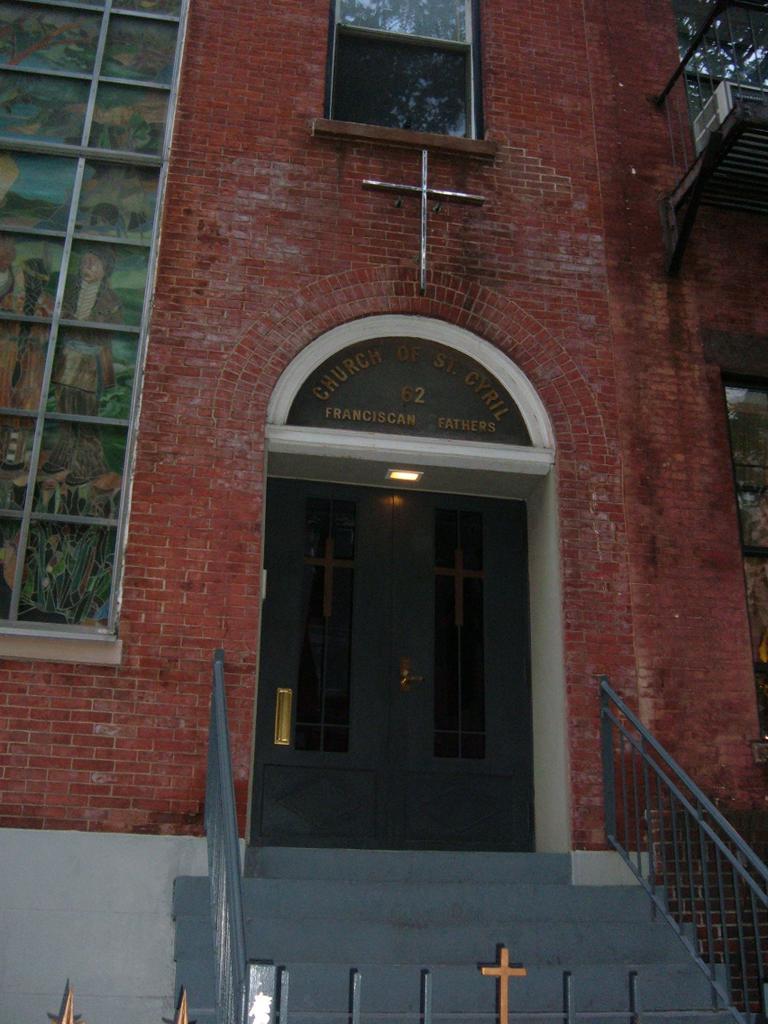
Slovenian parish of St. Cyril (62 St. Mark's Place), a reminder that the East Village historically was much more than Ukrainians, Rusyns and Poles. Earlier times also saw vibrant Bulgarian, Czech, Slovak, and, yes, Slovene communities (among others).

Walk back to Second Avenue and continue south. An interesting sight is
KGB Bar (85 East 4th Street), just around the corner. The building in a previous life was the home to the Ukrainian Communist Party in the United States, but today is home not only to the bar but also the Kraine Theatre.

Further down Second Avenue is the Russian
Anyway Cafe (34 East 2nd Street), and between First and Second Avenues is the Orthodox Cathedral of the Holy Virgin Protection (59 East 2nd Street). Formerly a Russian-oriented parish, the church today takes in a wider audience. The building was originally the Mt. Olivet Memorial Church, and became an Orthodox church in 1943.

Continuing along East 2nd Street and crossing First Avenue you’ll find the small shop Arka - Ukrainian Arts (26 First Avenue). The store keeps somewhat irregular hours – right now, they’re open from 10:00 a.m. to 5:00 p.m. on Tuesdays, Thursdays and Fridays.

At the end of First Avenue is
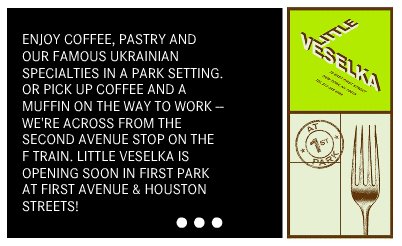
Little Veselka, which operates out of a kiosk in First Park, between 1st Street and Houston Street. Seating is available in the park.

And finally, if you’re feeling adventurous, walk down Houston and you’ll find the apartment complex
Red Square (250 East Houston Street) between Avenues A and B. On the roof is a statue of Lenin rescued from the last days of the Soviet Union.

For some good background on the Ukrainians of the East Village, check out "
Ukrainian East Village: A Shortened Oral History of an Immigrant Neighborhood” from the New York Press back in 2001. And for something a bit more substantial, taking in Ukrainians, Poles, Russians and Carpatho-Rusyns (Carpatho-Russians), try Yuri Kapralov’s Once There Was a Village, documenting the author’s time in the neighborhood in the late 1970s.

Monday, August 04, 2008

The Return of the Slavs

Kurowycky Meat Products used to be at 124 First Avenue between 7th and 8th Street, but it closed after 52 years on 2 June 2007.

Today, Jeremiah's Vanishing New York reports on what is happening to the building. Apparently there was interest in opening the space as a restaurant, but the local community board turned down the liquor license application and the interested restaurateurs backed out.

So now rumor has it that it will be turned into a porn store. Jeremiah comments, “When a high-end restaurant is passed over for porn, maybe it’s time to say welcome back, bad old East Village!” But it seems there is still a chance that a liquor license will be approved, and the space will open as a restaurant.

The loss of Kurowycky Meat Products followed hot on the heels of
the final demise of Kiev diner, a major landmark for the local Ukrainians, the latest in a long string of Slavic establishments closing up shop in the face of gentrification.

Lately, though, the gentrification of the neighborhood has taken a new twist: the return of the Slavs.

First up was the Klimat (77 East 7th Street), near the unreconstructed Blue & Gold bar and the gentrified Café 81 (pregentrification: Verchovyna Tavern). Klimat is officially Polish, but has a beer menu and a wine list that covers most of Eastern Europe. The menu also includes pierogies, kielbasa and other Slavic East Village soul food.

And just last month, the Serbs set up an outpost in Alphabet City: Kafana (116 Avenue C, between 7th and 8th Streets). The most detailed review seems to be in the Village Voice. The menu is extensive, the food is excellent. And the Slavs are back in town.

Addendum: New York Magazine has just annouced that Veselka (144 Second Ave. and Ninth Street) is going ahead with the creation of a new location - Veselka Bowery - on East First Street, to be open next summer. Meanwhile, the original location is continuing with its planned expansion into a neighboring space on East Ninth Street.

Photos: Kurowycky from Jeremiah's Vanishing New York; Klimat from New York Magazine.

Monday, October 08, 2007

Czechoslovak Independence Day Weekend

Once again, Sunday’s City Section of the New York Times featured a bit of Slavic New York – Bohemian Hall and Beer Garden in Astoria (Joseph V. Tirella’s Welcome. But Don’t Call Them German).

Last week, the Times featured the perseverance of a group of Ukrainian women in the East Village struggling to keep their luncheonette going. Formerly home to significant communities of Poles, Ukrainians and Carpatho-Rusyns, the East Village in recent years has been shedding more and more of its Slavic character.

In Astoria, however, the problem is similar but very different.
Bohemian Hall is one of the city’s oldest and most impressive Slavic sites, but is lately becoming a victim of its own success. As the beer hall gets more and more popular among New Yorkers at large, few are aware of its Czech (and Slovak) character. Many, such as one of the people quoted in the article, are under the impression that if it is a beer hall, it must be German.

Bohemian Hall is full of Czech and Czechoslovak memorabilia, Czech beers, Czech food, and a large Czech flag flies above the front door. If people are not aware of its role in the local Czech and Slovak communities, it is not for lack of trying.

The management is trying to play up its pedigree by hosting cultural events – this summer’s Czech film series, for example. Some, though think it won’t matter and the public will continue to overlook
Bohemian Hall’s Czech and Slovak character. One Czech patron concluded, “They don’t know because they don’t care.”

Meanwhile, Saturday was the annual Czech Street Festival on 83rd Street between Park and Madison. The festival celebrates the independence of Czechoslovakia in 1918, and even though it is primarily a Czech event today, it also features New York’s Slovak and Carpatho-Rusyn communities who also made up Czechoslovakia at that time.

Erik Sunguryan sent some photos from the event:

Monday, October 01, 2007

Shche Ne Vmerla (Mala) Ukrayina - (Little) Ukraine has not yet died!

Sunday's City Section of the New York Times included an article (and a video on the website) by Adam B. Ellick about the Ukrainian luncheonette in the East Village across the street from St. George Ukrainian Catholic Church on 7th Street at Taras Shevchenko Place.


Local Ukrainian women have run the luncheonette for more than 30 years as a way to raise money for the church and its school. According to the Times, they manage to turn varenyky (pierogies), borsht and holubki into as much as $80,000 each year.

The luncheonette closed last spring after the deaths of four of the women, but reopened on 9 September - and will be open Fridays through Sundays for the forseeable future.

The women's resilience is much appreciated not only by local Ukrainians but also by other Slavs of New York. Once a major center of Ukrainian, Polish and Carpatho-Rusyn life, the East Village has lately been losing much of its Slavic character.

Leshko's closed in 1999, followed by Kiev in 2004. And on 1 June this year, Teresa's Polish restaurant on First Avenue closed due to high rent, according to Fr. Christopher Calin of the 2nd Street Cathedral.

Photo: Joe Fornabaio for The New York Times

Wednesday, May 30, 2007

Loss of another East Village Slavic landmark...

When Kurowycky Meat Products (124 First Avenue between 7th and 8th Street) was forced to remove fresh meats from its windows last fall, owner Jerry Kurowyckyj commented to the New York Times, “…this place looks like it’s going out of business tomorrow.”
Sadly, Kurowycky Meat Products - one of the East Village’s last remaining smokehouses - really is going out of business on 2 June, after 52 years.

By way of explanation, owners Ezya and Jerry Kurowyckyj have posted this message on their website:

“Today's economic climate just does not support a small business on the scale that ours endeavors to survive in. Thank you all for all your years of support. We are closing as of this Saturday, June 2nd. It was a great ride and again, we thank you all.”

Photo by
Shanna Ravindra for New York Magazine.

Thursday, April 26, 2007

Vychodna Dolina

Vychodna Dolina, the female folk singing group of St Nicholas Carpatho-Russian Orthodox Church in the East Village, is raising money to fund a trip abroad and is looking for support.

The group will perform on 25 August at the 4th Annual Recognize and Preserve the Traditions of Your Ancestors Festival in Jarabina, Slovakia. The group is made up of 13 Rusyn singers from the New York City area, and is a mix of both American-born and immigrants from the Rusyn villages of Jarabina, Litmanova, Kamienka, and Velky Lipnik, Slovakia. Vychodna Dolina was founded in the late 1980s at St. Nicholas Church.

The invitation to perform at the festival follows the group’s 2001 pilgrimage to their ancestral villages, today located in Slovakia but still populated mainly by members of Slovakia’s Rusyn minority. While in Slovakia, the women met the Jarabina folk ensemble Polana and quickly formed a bond. Last summer, Vychodna Dolina and St. Nicholas parish helped Polana come to New York City to perform for Rusyns and others living here. Now, Polana has invited Vychodna Dolina to perform in Slovakia.

Anyone interested in contributing to the cause can send a check made out to the Carpatho-Rusyn Society with “Vychodna Dolina Donation” in the memo section to the following address: Carpatho-Rusyn Society, Vychodna Dolina Donation, 125 Westland Drive, Pittsburgh, PA 15217-2538.


Another way to help out is to buy tickets for the Majales Zabava (May Dance) at St. Nicholas Orthodox Church (288 East 10th Street at Avenue A) that is being held on Saturday, 12 May, from 8:00 p.m. to 2:00 a.m. The party is sponsored by Vychodna Dolina, but music will be provided by VoxEthnika. They’re asking for a $20.00 donation in advance (before 6 May) and $25.00 at the door. Ticket price includes admission, cake and coffee and more food and drinks will be available for purchase.

To get tickets or more information, call Monika (Kanova) Kormanik at 646-644-6714, Magda Matlak at 718-373-2279 or Stephanie Salony at 908-284-0561.

Monday, January 15, 2007

Ukrainian Art Nouveau at the Ukrainian Museum

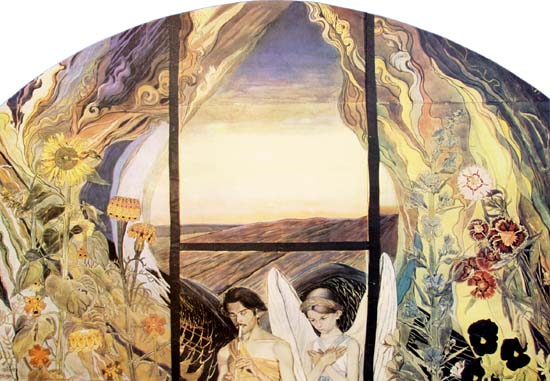
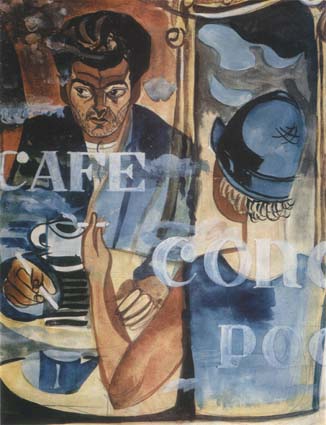
Slavs of New York finally made it to the Ukrainian Museum last weekend to check out the show Ukrainian Sculpture and Icons; A History of Their Rescue (through 28 February), but as it turns out, it was the other show, Crossroads: Modernism in Ukraine, 1910-1930 (through 11 March), that really caught our eyes.

Crossroads includes about 65 works from 21 Ukrainian avant-garde artists from private collections and museums throughout the US and Ukraine. The promotional materials feature internationally-renowned artists like Kazimir Malevych and Alexander Rodchenko.

Most interesting, however, were the lesser-known artists and the fact that the exhibition takes in the Ukrainian national variant of Art Nouveau, heavily influenced by the Viennese Secession (western Ukraine at the time was still part of Austria-Hungary).

Art Nouveau was popular among Slavs at the turn of the 20th century, and many tried to use the form to create a national artistic style for national groups still dominated by multiethnic empires like Austria-Hungary or Russia.

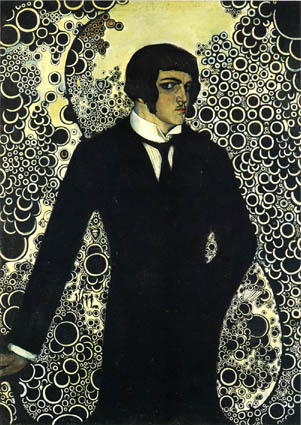
One of the key artists of Ukrainian Art Nouveau was
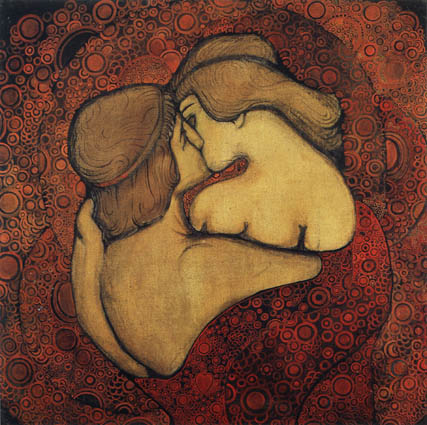
Vsevolod Maksymovych (1894-1914), whose work is clearly linked to the Viennese Secession. Maksymovych must have been something of a turn-of-the-century hipster – apparently he was prominent in both Kyiv and Moscow nightlife. Sadly, he died at the age of 21 after a drug overdose. He is represented in the current show by five works, including The Kiss (1913), a reworking of Gustav Klimt’s masterpiece.

Also influenced by Klimt was Fedir Krychevsky (1879-1947), who has two works in the show including
Love (1925-7), another reworking of Klimt’s earlier work.

Mikhajlo Zhuk (1883-1964) is yet another representative of Ukrainian Art Nouveau. His White and Black (1912-4) is an Art Nouveau masterpiece, though unlike the others it does not show links to the Viennese Secession but rather to the French and Belgian forms of Art Nouveau.

Though not connected to Art Nouveau, another set of fascinating works in the show comes from Anatol Petrytsky (1895-1964). Petrytsky, a Constructivist, is represented by a number of works but the most interesting are three portraits done as part of a larger set of portraits of Ukrainian cultural leaders of the day produced in the late 1920s and early 1930s (M. Semenko, I. Savchenko, P. Kozicky). Many of the portraits’ subjects were killed in Stalinist purges, and the artist destroyed a number of the canvases. Much of what remained were then lost during World War II. The three included in the show offer a tantalizing glimpse of what has been lost.

The exhibit runs through 11 March at the
Ukrainian Museum (222 East 6th Street between Second and Third Avenues).

Tuesday, December 19, 2006

Burek!

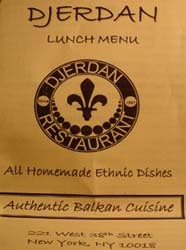
Last week, Gridskipper ran a feature on Burek in New York. Djerdan 34-04A 31st Avenue between 35th and 34th Streets in Astoria; 23-01 65th Street at 23rd Avenue in Brooklyn; and 221 West 38th Street between Seventh and Eighth Avenues in Manhattan) topped the list.

Cevabdzinica Sarajevo (37-18 34th Avenue in Astoria) was there too. A few non-Slavic places were there as well, and just might be worth checking out:
  • Zerza (Moroccan, 304 East 6th Street between First and Second Avenues in Manhattan)
  • Café Roma (Kosher, 175 West 91st Street at Amsterdam Avenue in Manhattan)
  • Tony & Tina's Pizzeria (Albanian, 2483 Arthur Avenue in the Bronx)
  • House of Pita (Middle Eastern, 32 West 48th Street in Manhattan)
  • Tasty Shawarmy (Middle Eastern, 71 7th Avenue South at Bleecker Street in Manhattan)
  • Aroma (Israeli, 160 Wooster Street at Houston in Manhattan)
And don’t forget Bosna Express (31-29 12th Street in Astoria), which somehow failed to make the list at all.

Previously on Slavs of New York:
Another Cevapdzinica opens in Queens, Bosnian Grocery Shopping and Cravings takes on Bosnian and Polish cuisine

Wednesday, October 11, 2006

Health fears threaten East Village smokehouses

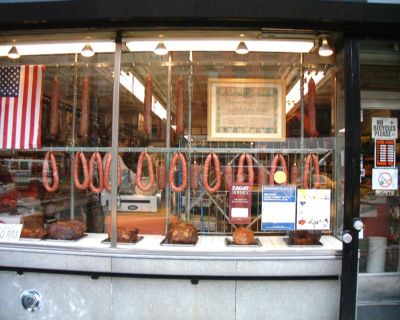
Sunday’s New York Times City Section featured “A Health Scare Revives the Smokehouse Blues,” about the switch from real meats to fake ones in the window of Kurowycky Meat Products (124 First Avenue between 7th and 8th Street).

The move was taken after the Ukrainian smokehouse was ordered by state officials to remove the fresh meats from their windows. Baczynsky’s and B & M Meat Market – the only other smokehouses remaining in the East Village – were forced to do it several years ago. State agriculture officials are concerned about the meat being tainted, perhaps with E. coli, staph, salmonella or listeria.

Jerry Kurowyckyj, the grandson of the shop’s founder, told the New York Times “It used to look full and it smelled great. Food is a visual, and this place looks like it’s going out of the business tomorrow.” He added that sales have dropped by 20 percent.

Wednesday, September 27, 2006

Special recognition for East Village Slovene parish

Slovenia’s Foreign Minister Dimitrij Rupel visited the Church of St. Cyril (62 St. Mark's Place) as the parish celebrated its 90th jubilee.

He bestowed the Award of the Government Office for Slovenes Abroad on the parish, in recognition of the church’s work preserving Slovene culture and language among immigrants, and promoting Slovene culture to the general public in New York City.

"The
St. Cyril Parish was for long the door through which Slovenian immigrants entered the US and where they found their first shelter," Rupel said on Sunday, thanking the Slovenian Franciscan order for establishing the church.

Friday, September 08, 2006

Trans-Siberian express to obliteration

The kids over Gridskipper have embarked on the “Trans-Siberian express to obliteration,” a crawl through all of New York’s Russian bars. First up was Uncle Vanya (315 West 54th Street), which they seemed to enjoy (doubly so once they hit the house infused vodka collection).

Next up was
Anyway Сafe (34 East 2nd Street, and 2nd Avenue). Like Uncle Vanya this one is more a restaurant than a bar, but also like Uncle Vanya it has more than enough liquor to go around. Apparently there was a male stripper on hand back in March (any clue what was going on there??), but when Gridskipper visited there was only a solitary bard singing chanson.

Monday, August 21, 2006

Czechoslovak American Marionette Theatre: Once There Was A Village

Just a few days short of the first anniversary of the death of writer Yuri Kapralov, the Czechoslovak American Marionette Theatre will premier their adaption of his most famous work, Once There Was A Village at Lincoln Center.


The show, like Kapralov's bok, delves into the lives of immigrants in the East Village and Alphabet City in the 1960s and 1970s.

In addition to the puppets the show also includes dance and music provided by the

Performances will be tomorrow (22 August) at 6:00 p.m. and then again at 6:45 p.m. at the South Plaza at Lincoln Center. Both shows are free and no tickets are necessary.
Hungry March Band. Lincoln Center Out of Doors! commissioned the work, titled Once There Was a Village: A Panorama of East Village history. The full production will go up in the East Village at La MaMa next February.

Tuesday, August 15, 2006

Rusyns boycott Little Veselka

We were delighted yesterday morning to open our email box and find that Thrillist had posted a .jpg of the menu of the new Little Veselka (75 East 1st Street at Houston), featuring sandwiches named after famous Ukrainians.

Excitement turned to horror, however, when we hit the end of the list – a sandwich named after Andy Warhol.

As Slavs of New York should know, Warhol’s family used to be called Warhola and hailed from the village of Mikova, in present-day Slovakia. And they were
Carpatho-Rusyns, not Ukrainians (and NO, it most certainly is NOT the same thing!).

And so the Carpatho-Rusyn boycott of Little Veselka has commenced.

The
Andy Warhol Museum in Pittsburgh actually just hosted the 9th annual Carpatho-Rusyn Event last month, highlighting Warhol’s Rusyn heritage and the bringing together the large Rusyn community of Western Pennsylvania.

The museum’s website is currently running a podcast series entitled “Living History: Early 20th Century Carpatho-Rusyn Culture in Pittsburgh,” with the latest one (
The Julia Zavacky Warhola Recordings) featuring recordings of Andy Warhol’s mother Julia from the 1950s and 1960s telling stories and singing Rusyn songs from Mikova.

Thursday, August 10, 2006

Little Veselka

Lately it's become common to witness the closure of a Slavic restaurant in the East Village (Leshko's, Kiev...) but it's a rarity to see a new one open. But yesterday that's just what happened as Veselka opened a satellite on First Avenue at Houston Street near the entrance to the F train.

With Extending New York's Borscht Belt, Jaunted reports that Little Veselka (75 First Street) is "much glassier than precursor Le Kiosk ever was, with plenty of aluminum accents, as is the style these days." The menu seems similar to that of Veselka itself, but Jaunted went nuts for the to-go borscht. Eater's EaterWire: East Village Edition decided the menu was more expensive than need be. Regardless, a new Slavic eatery in the East Village is worthy of a bit of buzz.

Previously on Slavs of New York: RIP: Leshko's and Kiev, East Village Update: Kiev goes Greek, Molode Zhyttia closes, Veselka outpost to open in July and American Grill Diner vs. Kiev

Tuesday, July 18, 2006

American Grill Diner vs. Kiev

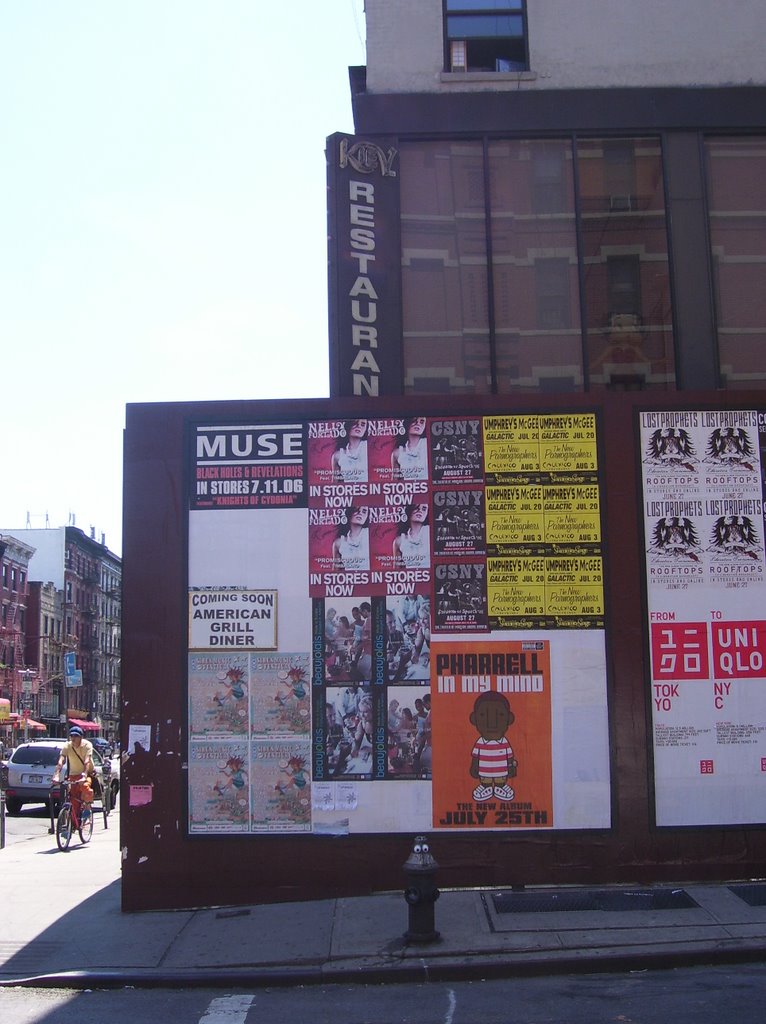
The East Village's Little Ukraine is about to lose yet another of its oldtime hangouts: Kiev (117 Second Avenue at 7th Street). We had previously reported that the diner, currrently under rennovation, would reopen as a Greek diner but would keep the old Kiev name. Apparently that is no longer the case:


Wednesday, July 05, 2006

Slavs out of World Cup

The World Cup semifinals have started, but all five Slavic teams have been eliminated.

The kids over at
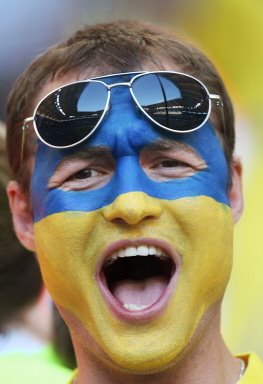
Jaunted covered Friday's Italy/Ukraine match that saw the Ukrainian team get pummelled 3-0. Jaunted caught the match at the Ukrainian Sports Club on Second Avenue, which had a full house.

"The Club itself offers a viewing experience similar to that at an Elks Club or a Boy Scout meeting; there's plenty of linoleum, fake wood paneling and brown carpeting to go around. Chairs were parked around big-screen TV, and fans were crowded behind the seats. Team Jerseys were even available for purchase, and we would have been tempted if we could have gotten a discount after Italy's first goal in the sixth minute. Before that quick strike, the room was all nervous anticipation and excitement, filling with chants of "U-kray-ee-na!" whenever the Ukranians touched the ball."

Jaunted also treked out to Bohemian Hall a couple weekends ago to catch the Ghana/Czech Republic match. "Bohemian Hall was ready for early bird fans--they were open by 10 and were selling muffins and coffee for bleary-eyed supporters arriving for the noon match. Of course, they were selling pitchers of beer as well, and most of the true Czech fans were going for the authentic, breakfast beer route. By the start of the match, the line for beer was out the door and around the corner, and the line for food at halftime was long enough that we saw several fans with pitchers of beer and glasses to sustain themselves during the wait. Bohemian Hall serves authentic grilled klobasy and sauerkraut, and it's worth the wait for the tasty sausage."
The Times Ledger posted a report on the Argentina/Serbia game at the Serbian Club in Glendale, which described slightly less World Cup fever than the scenes at the Ukrainian Sports Club and Bohemian Hall. About 40 people showed up to watch Serbia's first two games, but by the time last week's game rolled around, disappointed fans largely stayed away.

The semifinals kicked off tomorrow with with Italy defeating Germany 2-0, and continue today with Portugal v France.

Previously on Slavs of New York:
Slavs at the World Cup

(Photos from http://fifaworldcup.yahoo.com/06/en/)

Monday, July 03, 2006

Veselka outpost to open in July

Last Friday, the kids over at Gothamist discovered that East Village Ukrainian diner Veselka is about to open an outpost at First Park, on the corner of First Avenue and First Street (“One of only two places in Manhattan where a numbered street meets an avenue with the same number,” according to New York Songlines).

The new mini-Veselka will replace Le Kiosk, and is expected to serve more or less the same stuff as at their home base on Second Avenue. The grand opening is expected by mid-July.

Thursday, June 08, 2006

Slavs at the World Cup

We've gotten a few emails lately about where to watch the five Slavic teams compete at the World Cup, and so we figured we should blog it. Games begin on Friday, and not all bars will show all of the games so call ahead to figure out where's best to go. In no particular order, here's the list:
  • Czech Republic: Bohemian Hall (29-19 24th Avenue, Astoria, 718-274-4925). You can't go wrong with this big giant beer garden behind the historic Czech cultural center in Astoria. Aside from Czech beers, they're also having BBQs.

  • Croatia: Scorpio (3515 Broadway at 35th Street. Astoria, 718-956-8233). We're not 100% sure they're playing the games, but if anyone is rooting for Croatia, it's Scorpio. Be sure to try the bijela kava (like a latee), certainly the best in the city.

  • Serbia and Montenegro: Serbian Club (72-65 65th Place, Glendale, 718-821-9875). The mothership for Serbian fans. We've never been, but we hear it's well worth a visit. They've got cold beer, Balkan food and a big-screen TV. Can't go wrong.

    Fans of Croatia and Serbia and Montenegro can also check out
    Zum Stammtisch (69-46 Myrtle Avenue between 69th and 70th Streets, Glendale, 718-386-3014), which of course caters to Germans, but is also frequented by the x-YU communities in the area.

  • Ukraine: Ukrainian Sports Club (122 Second Avenue between 7th and 8th Streets, East Village, 212-475-1340). If you're a Ukraine fan, there's no other place to be. Aside from the full bar with Ukrainian beer, there's a five-foot projection screen TV. The game schedule is on the front door, pass by and check it out.

  • Poland: Smolen Bar and Grill (708 Fifth Avenue, Park Slope, 718-788-9729). There must be a stack of places rooting for Poland, but we came up with nothing. Sage, a Slavs of New York reader, came to the rescue by pointing out Smolen, a neighborhood bar frequented by Russians and Poles serving up Polish beer.
UPDATE: Croatia's games will also be shown at the Croatian Center (502 West 41st Street, 212-563-3395) in Manhattan, open to the public and free admission. Croatia v Brazil (13 June at 2:55 p.m.), Croatia v Japan (18 June at 9:00 a.m.) and Croatia v Australia (22 June at 2:55 p.m.).
And Cafe Blue Light (30th Street & 35th Avenue, Astoria) also has a live feed on a plasma TV, as well as Balkan food and $3.50 beer.