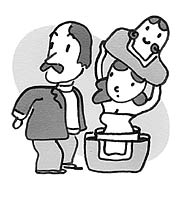
Last week, Gridskipper ran a feature on Burek in New York. Djerdan 34-04A 31st Avenue between 35th and 34th Streets in Astoria; 23-01 65th Street at 23rd Avenue in Brooklyn; and 221 West 38th Street between Seventh and Eighth Avenues in Manhattan) topped the list.
Cevabdzinica Sarajevo (37-18 34th Avenue in Astoria) was there too. A few non-Slavic places were there as well, and just might be worth checking out:
- Zerza (Moroccan, 304 East 6th Street between First and Second Avenues in Manhattan)
- Café Roma (Kosher, 175 West 91st Street at Amsterdam Avenue in Manhattan)
- Tony & Tina's Pizzeria (Albanian, 2483 Arthur Avenue in the Bronx)
- House of Pita (Middle Eastern, 32 West 48th Street in Manhattan)
- Tasty Shawarmy (Middle Eastern, 71 7th Avenue South at Bleecker Street in Manhattan)
- Aroma (Israeli, 160 Wooster Street at Houston in Manhattan)
And don’t forget Bosna Express (31-29 12th Street in Astoria), which somehow failed to make the list at all.
Previously on Slavs of New York: Another Cevapdzinica opens in Queens, Bosnian Grocery Shopping and Cravings takes on Bosnian and Polish cuisine
 Always a good source for Slavic tidbits, this week’s The City section of the New York Times came through again with Michael Pollak’s Passed for a Scandal Q&A about Communist agitator Maxim Gorky’s stay in Manhattan.
Turns out this year marks the 100th anniversary of Gorky’s Manhattan sex scandal, which hit the ceiling when The New York World published an article revealing that Gorky’s companion was not his wife, but rather an actress with whom he’d been living since he separated from his wife.
The two had been shacked up in the Hotel Bellclaire (Broadway and 77th Street, check out Christopher Gray’s 1992 Streetscapes: The Belleclaire; A 1903 Home for the Homeless for more) and were kicked out by the manager for offending common morality. No other hotel would take the pair in, and Gorky ended up continuing his speaking schedule in New York while staying with a supporter in Staten Island.
Given the mores of the time, the scandal was a big deal, and one newspaper reported that the Russian Embassy tipped off The New York World in an attempt to discredit Gorky among the American public.
Gorky was in the United States on a lecture tour to raise money for the revolutionary movement in Tsarist Russia. According to Pollack, his rhetoric earned him the nickname “The Jefferson of Russia” at the time.
Previously on Slavs of New York: New York Soviet Socialist Republic
 Sunday's New York Times highlighted one of Manhattan's lesser-known Slavic outposts: the Nicholas Roerich Museum on the Upper West Side.
The article, Seth Kugel's Specialty Museums: Finding Art, Not Crowds, in New York, also covered the Dahesh Museum, the Swiss Institute, the Museum at FIT and the Museum of the Chinese in America.
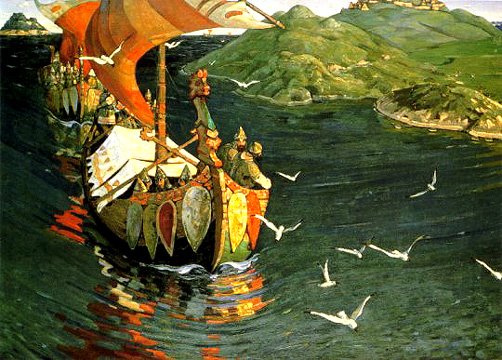
Nicholas Konstantinovich Roerich was born in St. Petersburg on 9 October 1874 to upper middle class parents. He rose to prominence in artistic circles as part of Diaghilev's Mir Iskusstva movement, and his work was among those exhibited in Paris in the landmark 1906 exhibition Diaghilev had organized. He also collaborated with Igor Stravinsky on Le Sacre du Printemps (The Rite of Spring).
With the 1917 Revolution, the Roerich family found itself in Finland and managed to escape to the United States in 1920 and he founded an organization called the Master Institute of United Arts in New York in 1921, where he wanted to realize educational concepts he had initiated in St. Petersburg.
By 1923, he and his wife Helena were in India, where they began the explorations of Central Asia that would occupy the rest of their lives. From 1928 until his death in 1947, Roerich lived in the Kullu valley in the Himalayan foothills, and it was there that he established the Urusvati Himalayan Research Institute.
Roerich's school closed in 1937 during the Great Depression but was reopened in 1949 as the Nicholas Roerich Museum, at 319 West 107th Street. The museum features about 200 of Roerich's paintings, mostly from his Himalayan expeditions but also including set designs for Le Sacre du Printemps. The museum is open Tuesday through Sunday from 2:00 to 5:00 p.m., and admission is by donation.
 Last week, Gridskipper ran a feature on Burek in New York. Djerdan 34-04A 31st Avenue between 35th and 34th Streets in Astoria; 23-01 65th Street at 23rd Avenue in Brooklyn; and 221 West 38th Street between Seventh and Eighth Avenues in Manhattan) topped the list.