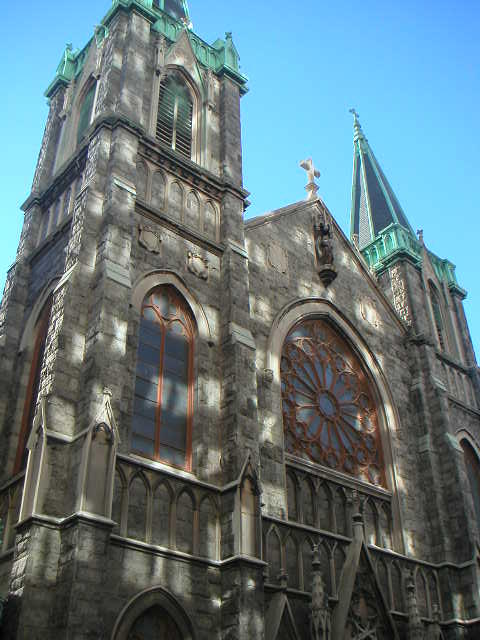
 The other week, Slavs of New York was lucky enough to join the Municipal Arts Society’s walking tour of Bohemian National and the Sokol Halls, led by Joe Svehlak. Everyone is encouraged to visit Bohemian National Hall, but Sokol Hall is a bit less of a public space so getting inside was a treat.
 Just inside the door is a small pub, and among the decorations are five large medallions – one each for Bohemia, Moravia, Silesia, Slovakia and Subcarpathian Rus (Ruthenia), the five parts of Czechoslovakia from 1918 to 1939. The guide said they were originally from the Czechoslovak pavilion from the 1939-1940 World’s Fair in Flushing Meadows, Queens.
The Munich Agreement was in September 1938, and Hitler invaded on 14 March 1939. Slovakia declared independence on 14 March, and Ruthenia on 15 March (the latter was then occupied by Hungary just about 24 hours later). The rest of Czechoslovakia was reorganized as the Nazi Protectorate of Bohemia and Moravia. Czechoslovakia would not reemerge until the close of World War II.

So how was there a World’s Fair pavilion for a state that did not exist?
Turns out, the contract with the fair organizers was signed in 1938, and at the time of the Nazi invasion the following March the building was already about half-done. The plans were scaled down, but preparations went forward.
 Mayor Fiorello La Guardia emerged as a leading proponent of Czechoslovak independence, quickly meeting with Czechoslovak representatives and assuring that so long as the United States did not recognize the German moves the Czechoslovak envoys would keep their titles and authority. When Nazi Germany (the only major country not participating in the fair) tried to keep the Czechoslovak pavilion from opening, La Guardia set up a “citizens’ committee” to raise funds to help complete the pavilion and its exhibits.
The pavilion became a symbol of Czechoslovak resistance to Nazi domination. Former Czechoslovak president Edvard Benes spoke at the dedication of the pavilion on 31 May, highlighting the struggle of the Czechs, Slovaks and Carpatho-Russians (Rusyns) in Europe and thanking La Guardia, noting that “This pavilion, ladies and gentlemen, is the free and independent Czecho-Slovakia of the near past and the free and independent Czecho-Slovakia of the near future.”
 The Czechoslovak pavilion stood between the pavilions of the Soviet Union and Japan. Here’s a description of the finished pavilion from the New York Times on 30 April 1939:
The progress of the country during its twenty-year existence is the central theme, and the products and resources of the land and people are represented and demonstrated – such products as iron, steel, textiles, shoes, beer, hams, Glass blowing and etching are shown. A restaurant and open-air beer garden are included in the project.
 Yugoslav pavilion featured a large, illuminated map of the country, as well as a model of the oldest pharmacy in the world, from Dubrovnik. Also highlighted were Yugoslavs who have made contributions to the United States, such as Nikola Tesla and Michael Pupin.
Mayor La Guardia spoke in Croatian, a language he learnt while stationed in the United States Consular Service in Fiume (Rijeka), at the opening of the Yugoslav pavilion in May. Among his comments:
The people of Yugoslavia are generous, kindly and peace-loving. Whenever there is trouble in the Balkans, look for the reason, and it will be found to come from without and not from within. Let the strong and big nations leave the Balkans alone and peace will prevail there.
 The Polish pavilion was built around the 348th anniversary of the first Polish Constitution, and included – among a wide variety of exhibits – the Jagellonian globe, which is believed to be the first to show the name “America.”
 The Soviet Pavilion was universally acclaimed as a major highlight of the fair. The building was the tallest on the fairgrounds, other than the iconic Trylon structure. Estimates for its cost ranged from $4 to 6 million, by far the most of any World’s Fair structure. Among the materials used in its construction were nine different sorts of marble brought over specially from the USSR.
The building was topped by a 79-foot-tall worker holding aloft an illuminated red star, nick named Big Joe. After complaints, Fair officials had to put a US flag atop the Parachute Jump (which was later relocated to Coney Island) to ensure it flew higher than the Soviet star.
 Exhibits inside included a map of the Soviet Union covered in precious stones, two cinemas, a restaurant, and even a full-scale replica of a portion of Moscow’s Mayakovsky metro station (the station was brand new, having just been completed in 1938).
 At the end of the 1939 season, the Soviet Union pulled out of the fair, and its building was taken apart and shipped back to Moscow.
So how was there a World’s Fair pavilion for a state that did not exist?
Turns out, the contract with the fair organizers was signed in 1938, and at the time of the Nazi invasion the following March the building was already about half-done. The plans were scaled down, but preparations went forward.
 Mayor Fiorello La Guardia emerged as a leading proponent of Czechoslovak independence, quickly meeting with Czechoslovak representatives and assuring that so long as the United States did not recognize the German moves the Czechoslovak envoys would keep their titles and authority. When Nazi Germany (the only major country not participating in the fair) tried to keep the Czechoslovak pavilion from opening, La Guardia set up a “citizens’ committee” to raise funds to help complete the pavilion and its exhibits.
The pavilion became a symbol of Czechoslovak resistance to Nazi domination. Former Czechoslovak president Edvard Benes spoke at the dedication of the pavilion on 31 May, highlighting the struggle of the Czechs, Slovaks and Carpatho-Russians (Rusyns) in Europe and thanking La Guardia, noting that “This pavilion, ladies and gentlemen, is the free and independent Czecho-Slovakia of the near past and the free and independent Czecho-Slovakia of the near future.”
 The Czechoslovak pavilion stood between the pavilions of the Soviet Union and Japan. Here’s a description of the finished pavilion from the New York Times on 30 April 1939:
The progress of the country during its twenty-year existence is the central theme, and the products and resources of the land and people are represented and demonstrated – such products as iron, steel, textiles, shoes, beer, hams, Glass blowing and etching are shown. A restaurant and open-air beer garden are included in the project.
Yugoslav pavilion featured a large, illuminated map of the country, as well as a model of the oldest pharmacy in the world, from Dubrovnik. Also highlighted were Yugoslavs who have made contributions to the United States, such as Nikola Tesla and Michael Pupin.Mayor La Guardia spoke in Croatian, a language he learnt while stationed in the United States Consular Service in Fiume (Rijeka), at the opening of the Yugoslav pavilion in May. Among his comments:
The people of Yugoslavia are generous, kindly and peace-loving. Whenever there is trouble in the Balkans, look for the reason, and it will be found to come from without and not from within. Let the strong and big nations leave the Balkans alone and peace will prevail there.
Among the 60 states participating at the 1939 World’s Fair were three more Slavic states: Yugoslavia, Poland and the Soviet Union.
 The
The
 The
The  The Polish pavilion was built around the 348th anniversary of the first Polish Constitution, and included – among a wide variety of exhibits – the Jagellonian globe, which is believed to be the first to show the name “America.”
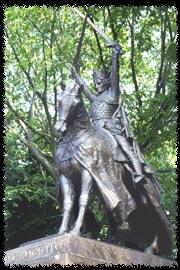
The statue of King Jagiello by Stanisław K. Ostrowski, originally placed in front of the Polish pavilion, is one of the rare artifacts of the 1939-1940 World’s Fair still publicly displayed in New York. The statue now sits in Manhattan’s Central Park, near the Turtle Pond.
 The Soviet Pavilion was universally acclaimed as a major highlight of the fair. The building was the tallest on the fairgrounds, other than the iconic Trylon structure. Estimates for its cost ranged from $4 to 6 million, by far the most of any World’s Fair structure. Among the materials used in its construction were nine different sorts of marble brought over specially from the USSR.
The building was topped by a 79-foot-tall worker holding aloft an illuminated red star, nick named Big Joe. After complaints, Fair officials had to put a US flag atop the Parachute Jump (which was later relocated to Coney Island) to ensure it flew higher than the Soviet star.
 Exhibits inside included a map of the Soviet Union covered in precious stones, two cinemas, a restaurant, and even a full-scale replica of a portion of Moscow’s Mayakovsky metro station (the station was brand new, having just been completed in 1938).
 At the end of the 1939 season, the Soviet Union pulled out of the fair, and its building was taken apart and shipped back to Moscow.
 On 3 January 1940, the New York Times ran a story about the dismantling of Big Joe entitled “Soviet Worker at Fair is ‘Purged’” commenting tongue-in-cheek that “Stalin’s extended his purge to the United States yesterday and ‘Big Joe’… was decapitated by a derrick.”
Initially, there were plans to reassemble the pavilion at Gorky Park in Moscow, but this was never done and the final fate of Big Joe and the rest of the exhibits remain a mystery.
Initially, there were plans to reassemble the pavilion at Gorky Park in Moscow, but this was never done and the final fate of Big Joe and the rest of the exhibits remain a mystery.