Saturday, January 09, 2010
Ukrainian Christmas at Veselka (including recipies!)
Sunday, August 10, 2008
Walking Tour: The East Village
Start at Union Square, and walk east along the northern side of 14th Street. You will soon hit a small shop, Russian Souvenirs (227 14th Street), between Second and Third Avenues. The shop has seemingly been there forever, and is a great place for traditional Russian arts and crafts, and Soviet kitsch.
Once you hit Second Avenue, you can walk north one block to Stuyvesant Square (not really part of the East Village, but close enough), where you will find the Byzantine (Ruthenian) Catholic church of St. Mary (246 East 15th Street), dating from 1964.Leaving Stuyvesant Square, the Slavic heart of the East Village unfolds southward down Second Avenue. On the west side of the street, you pass the Ukrainian Orthodox Federal Credit Union (215 Second Avenue) and then the Ukrainian Congress Committee of America (203 Second Avenue), and across Second Avenue on the east side are the diner Little Poland (200 Second Avenue), and the Jozef Pilsudski Institute of America in the Polish National Home (180 Second Avenue).
One of the most important blocks for our purposes is Second Avenue between St. Mark’s Place and 9th Street. On the northeast corner you’ll find the popular Ukrainian diner Veselka Restaurant (144 Second Avenue), and right next door is the Ukrainian National Home (142 Second Avenue). Though there are no windows, the food inside is top notch. Also in the building are the Karpaty Pub, and Lys Mykyta bar.A couple doors down is a building with an impressive medallion of Ukrainian national poet Taras Shevchenko but no other signage (136 Second Avenue). Inside are the Dibrova Social Club (CYM) and the Ukrainian Free University Foundation Inc. Across the street you’ll find the last of the great Slavic meat markets, Baczynsky’s (139 Second Avenue, note that it is closed until September 2008).
One more block down, you’ll see the small Polish diner Stage Restaurant (128 Second Avenue), and a few doors down the Ukrainian Sports Club (122 Second Avenue).
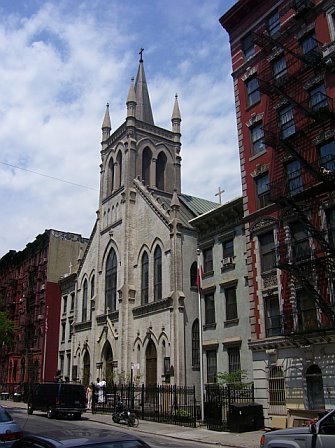
From here, cross Second Avenue and continue west along East 7th Street to find the cultural center of the local Ukrainian Community. The landmark St. George Ukrainian Catholic Church (30 East 7th Street) dates from 1977, but a much older structure, St. George Ruthenian Catholic Church, once stood on the same spot. On the north side of the street is the excellent Surma Book & Music Store (11 East 7th Street), well worth a visit.
Now walk back out to Second Avenue, cross to the east side of the street and walk north a few doors. You’ll see a building with a Cyrillic inscription that is the Self Reliance Federal Credit Union (108 Second Avenue). Turn onto 7th Street and walk east towards First Avenue.A newcomer to the Slavic world of the East Village is the Polish-themed bar Klimat (77 East 7th Street), with a wide selection of beer and wine from Slavic countries, as well as traditional Polish food. Next door is the stalwart Ukrainian bar Blue and Gold (79 East 7th Street). If you’re interested, you can continue along 7th Street and pick up the Slavs of New York Walking Tour of Alphabet City to venture further.
Around the corner is the Slovenian parish of St. Cyril (62 St. Mark's Place), a reminder that the East Village historically was much more than Ukrainians, Rusyns and Poles. Earlier times also saw vibrant Bulgarian, Czech, Slovak, and, yes, Slovene communities (among others).
Walk back to Second Avenue and continue south. An interesting sight is KGB Bar (85 East 4th Street), just around the corner. The building in a previous life was the home to the Ukrainian Communist Party in the United States, but today is home not only to the bar but also the Kraine Theatre.
Further down Second Avenue is the Russian Anyway Cafe (34 East 2nd Street), and between First and Second Avenues is the Orthodox Cathedral of the Holy Virgin Protection (59 East 2nd Street). Formerly a Russian-oriented parish, the church today takes in a wider audience. The building was originally the Mt. Olivet Memorial Church, and became an Orthodox church in 1943.Continuing along East 2nd Street and crossing First Avenue you’ll find the small shop Arka - Ukrainian Arts (26 First Avenue). The store keeps somewhat irregular hours – right now, they’re open from 10:00 a.m. to 5:00 p.m. on Tuesdays, Thursdays and Fridays.
And finally, if you’re feeling adventurous, walk down Houston and you’ll find the apartment complex Red Square (250 East Houston Street) between Avenues A and B. On the roof is a statue of Lenin rescued from the last days of the Soviet Union.
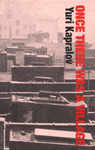
For some good background on the Ukrainians of the East Village, check out "Ukrainian East Village: A Shortened Oral History of an Immigrant Neighborhood” from the New York Press back in 2001. And for something a bit more substantial, taking in Ukrainians, Poles, Russians and Carpatho-Rusyns (Carpatho-Russians), try Yuri Kapralov’s Once There Was a Village, documenting the author’s time in the neighborhood in the late 1970s.
Monday, August 04, 2008
The Return of the Slavs
So now rumor has it that it will be turned into a porn store. Jeremiah comments, “When a high-end restaurant is passed over for porn, maybe it’s time to say welcome back, bad old East Village!” But it seems there is still a chance that a liquor license will be approved, and the space will open as a restaurant.
The loss of Kurowycky Meat Products followed hot on the heels of the final demise of Kiev diner, a major landmark for the local Ukrainians, the latest in a long string of Slavic establishments closing up shop in the face of gentrification.
Lately, though, the gentrification of the neighborhood has taken a new twist: the return of the Slavs.
First up was the Klimat (77 East 7th Street), near the unreconstructed Blue & Gold bar and the gentrified Café 81 (pregentrification: Verchovyna Tavern). Klimat is officially Polish, but has a beer menu and a wine list that covers most of Eastern Europe. The menu also includes pierogies, kielbasa and other Slavic East Village soul food.
And just last month, the Serbs set up an outpost in Alphabet City: Kafana (116 Avenue C, between 7th and 8th Streets). The most detailed review seems to be in the Village Voice. The menu is extensive, the food is excellent. And the Slavs are back in town. Addendum: New York Magazine has just annouced that Veselka (144 Second Ave. and Ninth Street) is going ahead with the creation of a new location - Veselka Bowery - on East First Street, to be open next summer. Meanwhile, the original location is continuing with its planned expansion into a neighboring space on East Ninth Street.
Monday, March 03, 2008
Forum of Slavic Cultures finally online!

The Forum's members are: Belarus, Bosnia and Herzegovina, Bulgaria, Croatia, Macedonia, Montenegro, Poland, the Russian Federation, Serbia, Slovakia, Slovenia and Ukraine, with The Czech Republic as an observer status. Attention is also paid to Slavic minorities in non-Slavic countries, including the Lusatian Sorbs in Germany.Monday, October 08, 2007
Czechoslovak Independence Day Weekend
Once again, Sunday’s City Section of the New York Times featured a bit of Slavic New York – Bohemian Hall and Beer Garden in Astoria (Joseph V. Tirella’s Welcome. But Don’t Call Them German). Last week, the Times featured the perseverance of a group of Ukrainian women in the East Village struggling to keep their luncheonette going. Formerly home to significant communities of Poles, Ukrainians and Carpatho-Rusyns, the East Village in recent years has been shedding more and more of its Slavic character.
In Astoria, however, the problem is similar but very different. Bohemian Hall is one of the city’s oldest and most impressive Slavic sites, but is lately becoming a victim of its own success. As the beer hall gets more and more popular among New Yorkers at large, few are aware of its Czech (and Slovak) character. Many, such as one of the people quoted in the article, are under the impression that if it is a beer hall, it must be German.
Bohemian Hall is full of Czech and Czechoslovak memorabilia, Czech beers, Czech food, and a large Czech flag flies above the front door. If people are not aware of its role in the local Czech and Slovak communities, it is not for lack of trying.
The management is trying to play up its pedigree by hosting cultural events – this summer’s Czech film series, for example. Some, though think it won’t matter and the public will continue to overlook Bohemian Hall’s Czech and Slovak character. One Czech patron concluded, “They don’t know because they don’t care.”
Meanwhile, Saturday was the annual Czech Street Festival on 83rd Street between Park and Madison. The festival celebrates the independence of Czechoslovakia in 1918, and even though it is primarily a Czech event today, it also features New York’s Slovak and Carpatho-Rusyn communities who also made up Czechoslovakia at that time.
Erik Sunguryan sent some photos from the event:


Thursday, October 04, 2007
Little Odessa on Gridskipper
The kids over at Gridskipper put up a useful map and guide to Brighton Beach - New York's Little Odessa - this week. Most of the sea-side neighborhood's 350,000 residents are from the former Soviet Union, and virtually all of the local shops and restaurants cater to the community. Monday, October 01, 2007
Shche Ne Vmerla (Mala) Ukrayina - (Little) Ukraine has not yet died!

The luncheonette closed last spring after the deaths of four of the women, but reopened on 9 September - and will be open Fridays through Sundays for the forseeable future.
The women's resilience is much appreciated not only by local Ukrainians but also by other Slavs of New York. Once a major center of Ukrainian, Polish and Carpatho-Rusyn life, the East Village has lately been losing much of its Slavic character.
Wednesday, May 30, 2007
Loss of another East Village Slavic landmark...
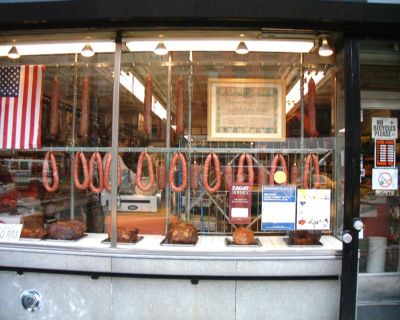
When Kurowycky Meat Products (124 First Avenue between 7th and 8th Street) was forced to remove fresh meats from its windows last fall, owner Jerry Kurowyckyj commented to the New York Times, “…this place looks like it’s going out of business tomorrow.”Sadly, Kurowycky Meat Products - one of the East Village’s last remaining smokehouses - really is going out of business on 2 June, after 52 years.
By way of explanation, owners Ezya and Jerry Kurowyckyj have posted this message on their website:
“Today's economic climate just does not support a small business on the scale that ours endeavors to survive in. Thank you all for all your years of support. We are closing as of this Saturday, June 2nd. It was a great ride and again, we thank you all.”
Photo by Shanna Ravindra for New York Magazine.
Monday, April 30, 2007
Motyl’s Factory
By Andrew YurkovskyAlexander Motyl is on a roll. Call his latest enterprise the “fiction factory.” Having produced six nonfiction books, the Rutgers University political scientist has embarked on a new challenge—the Great American Novel—and added a Ukrainian twist.
Not that Motyl, one of the country’s top experts on Russia and eastern Europe, has anything to prove. The New York City native—he grew up in the Lower East Side’s Ukrainian community—is an accomplished painter as well as an internationally recognized scholar.
Two years ago, Motyl published his first novel, “Whiskey Priest,” a thriller that takes place against the background of Ukraine’s 2004 Orange Revolution. The novel, which begins in Vienna with the murders of three high-profile professors, allowed Motyl to settle some professional scores and to reflect on post-Cold War angst.
Motyl recently completed a second novel, “Who Killed Andrei Warhol,” slated for publication later this year by Seven Locks Press. He will read from “Who Killed Andrei Warhol” and “Whiskey Priest” at the Cornelia Street Café on May 5.
The Warhol book gives Motyl a chance to combine his many interests and to riff, yet again, on things Ukrainian. Warhol’s family hailed from eastern Slovakia and was of Rusyn, or Ruthenian, stock. Rusyns speak a language similar to Ukrainian and are regarded by some as part of the same ethnic group.As it turns out, identity has been an ongoing preoccupation of Motyl’s. He achieved renown as a Sovietologist for his focus on non-Russians in the former USSR and for his attempt to understand how the socialist state was unique.
Not long ago, Motyl and I sat down to talk about political developments in Ukraine and his extracurricular activities.
Q: Last year, Viktor Yanukovych, the rival of Ukrainian President Viktor Yushchenko and the Kremlin’s candidate for the Ukrainian presidency in 2004, returned to the prime minister’s office in Kiev. Do you think the victory of Yanukovych and his Party of Regions is a setback for democracy in Ukraine?
“I think the Orange Revolution did not erupt simply overnight. I think there was a long institutional and societal transformation that preceded it. That’s Point One. My argument is Ukraine has changed since 1990. Two: Ukraine has changed since 2004; Ukrainians have changed since 2004. ... It’s not 2004, in other words. We haven’t gone back. Maybe there’s a circle, but it’s more like a spiral.”
Q: You take your fellow academics to task in “Whiskey Priest.” There isn’t an admirable one in the lot. How do you reconcile that depiction of your profession with your own work as a teacher?
“The intellectuals among the professoriate who are on the cutting edge, developing new theories and new visions and things of that sort—I hold them in fairly low esteem. The ones doing the grunt work—teaching the students, taking care of them—those I hold in fairly high esteem. But we don’t know about them. They are like the nurses in a hospital. They do all of the work, but they generally don’t attract too much attention. ... Teaching is the one part of being an academic that I’ve always been committed to. I enjoy it immensely.”
Q: Can you tell me about your new novel, “Who Killed Andrei Warhol”?
“The book is written in the form of a diary by a Soviet Ukrainian journalist based in Leningrad And he’s totally Sovietized. He may even be a KGB agent. He comes to New York in February of ’68 at the height of the garbage strike to cover the impending American revolution. And, of course, part of his cover is he has an office at the CPUSA [the American Communist Party].”
The American Communist Party headquarters shared the same building as Andy Warhol’s Factory, on Union Square in Manhattan.
“He meets Warhol. They hit it off. They talk about art; they drink vodka. Warhol invites him home, and his mother makes pierogies. All this kind of stuff. And, of course, he also gets involved with [Warhol assailant] Valerie Solanis; he gets involved with the FBI; he witnesses the race riots in Newark; he goes up to Columbia during the student demonstrations in 1968. ...
“So I was able to draw on a lot of the stuff I read about Warhol plus on my own knowledge of what Soviet thinking/jargon was like and bring these two together. At least that’s what I tried to do. The absurdity of the encounter—aside from I think the intrinsic absurdity of a Soviet journalist meeting Andy Warhol—is that the journalist interprets Warhol as a socialist-realist painter: a working-class Ruthenian [Rusyn].”
No more absurd, perhaps, than the working-class Ukrainian who has become a professor, a painter and, now, a novelist.
-----
The Second Annual Ukrainian Night, 5 May Cornelia Street Café (29 Cornelia Street, tel: 212-989-9319). Two sets, $10 per set. First set: 6-8 p.m. Second set: 9-11 p.m. With fiction writer Irene Zabytko, poets Vasyl Makhno and Dzvinia Orlowsky, and filmmakers Andrij Parekh and Roxy Toporowych.
Monday, January 15, 2007
Ukrainian Art Nouveau at the Ukrainian Museum
Slavs of New York finally made it to the Ukrainian Museum last weekend to check out the show Ukrainian Sculpture and Icons; A History of Their Rescue (through 28 February), but as it turns out, it was the other show, Crossroads: Modernism in Ukraine, 1910-1930 (through 11 March), that really caught our eyes.Crossroads includes about 65 works from 21 Ukrainian avant-garde artists from private collections and museums throughout the US and Ukraine. The promotional materials feature internationally-renowned artists like Kazimir Malevych and Alexander Rodchenko.
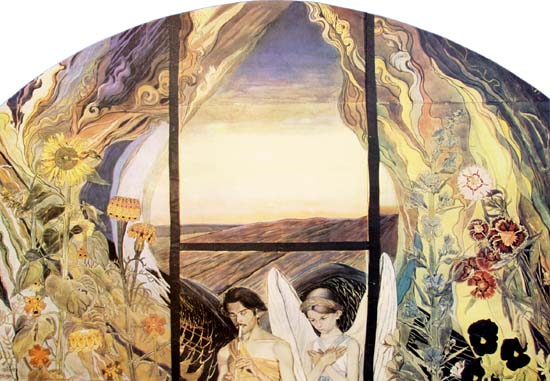
Most interesting, however, were the lesser-known artists and the fact that the exhibition takes in the Ukrainian national variant of Art Nouveau, heavily influenced by the Viennese Secession (western Ukraine at the time was still part of Austria-Hungary).
Art Nouveau was popular among Slavs at the turn of the 20th century, and many tried to use the form to create a national artistic style for national groups still dominated by multiethnic empires like Austria-Hungary or Russia.
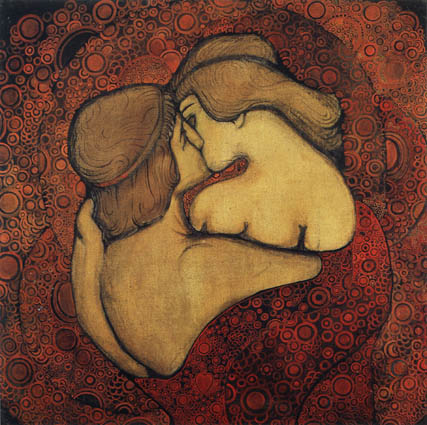
One of the key artists of Ukrainian Art Nouveau was Vsevolod Maksymovych (1894-1914), whose work is clearly linked to the Viennese Secession. Maksymovych must have been something of a turn-of-the-century hipster – apparently he was prominent in both Kyiv and Moscow nightlife. Sadly, he died at the age of 21 after a drug overdose. He is represented in the current show by five works, including The Kiss (1913), a reworking of Gustav Klimt’s masterpiece.Also influenced by Klimt was Fedir Krychevsky (1879-1947), who has two works in the show including Love (1925-7), another reworking of Klimt’s earlier work.
Mikhajlo Zhuk (1883-1964) is yet another representative of Ukrainian Art Nouveau. His White and Black (1912-4) is an Art Nouveau masterpiece, though unlike the others it does not show links to the Viennese Secession but rather to the French and Belgian forms of Art Nouveau.
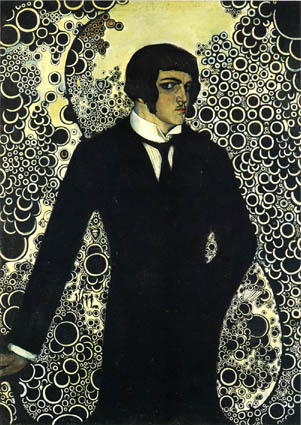
Though not connected to Art Nouveau, another set of fascinating works in the show comes from Anatol Petrytsky (1895-1964). Petrytsky, a Constructivist, is represented by a number of works but the most interesting are three portraits done as part of a larger set of portraits of Ukrainian cultural leaders of the day produced in the late 1920s and early 1930s (M. Semenko, I. Savchenko, P. Kozicky). Many of the portraits’ subjects were killed in Stalinist purges, and the artist destroyed a number of the canvases. Much of what remained were then lost during World War II. The three included in the show offer a tantalizing glimpse of what has been lost.The exhibit runs through 11 March at the Ukrainian Museum (222 East 6th Street between Second and Third Avenues).
Wednesday, October 11, 2006
Health fears threaten East Village smokehouses
Sunday’s New York Times City Section featured “A Health Scare Revives the Smokehouse Blues,” about the switch from real meats to fake ones in the window of Kurowycky Meat Products (124 First Avenue between 7th and 8th Street).The move was taken after the Ukrainian smokehouse was ordered by state officials to remove the fresh meats from their windows. Baczynsky’s and B & M Meat Market – the only other smokehouses remaining in the East Village – were forced to do it several years ago. State agriculture officials are concerned about the meat being tainted, perhaps with E. coli, staph, salmonella or listeria.
Jerry Kurowyckyj, the grandson of the shop’s founder, told the New York Times “It used to look full and it smelled great. Food is a visual, and this place looks like it’s going out of the business tomorrow.” He added that sales have dropped by 20 percent.
Monday, August 21, 2006
Czechoslovak American Marionette Theatre: Once There Was A Village
Just a few days short of the first anniversary of the death of writer Yuri Kapralov, the Czechoslovak American Marionette Theatre will premier their adaption of his most famous work, Once There Was A Village at Lincoln Center. The show, like Kapralov's bok, delves into the lives of immigrants in the East Village and Alphabet City in the 1960s and 1970s.
In addition to the puppets the show also includes dance and music provided by the
Performances will be tomorrow (22 August) at 6:00 p.m. and then again at 6:45 p.m. at the South Plaza at Lincoln Center. Both shows are free and no tickets are necessary.
Hungry March Band. Lincoln Center Out of Doors! commissioned the work, titled Once There Was a Village: A Panorama of East Village history. The full production will go up in the East Village at La MaMa next February.
Tuesday, August 15, 2006
Rusyns boycott Little Veselka
We were delighted yesterday morning to open our email box and find that Thrillist had posted a .jpg of the menu of the new Little Veselka (75 East 1st Street at Houston), featuring sandwiches named after famous Ukrainians.
Excitement turned to horror, however, when we hit the end of the list – a sandwich named after Andy Warhol.As Slavs of New York should know, Warhol’s family used to be called Warhola and hailed from the village of Mikova, in present-day Slovakia. And they were Carpatho-Rusyns, not Ukrainians (and NO, it most certainly is NOT the same thing!).
And so the Carpatho-Rusyn boycott of Little Veselka has commenced.
The Andy Warhol Museum in Pittsburgh actually just hosted the 9th annual Carpatho-Rusyn Event last month, highlighting Warhol’s Rusyn heritage and the bringing together the large Rusyn community of Western Pennsylvania.
The museum’s website is currently running a podcast series entitled “Living History: Early 20th Century Carpatho-Rusyn Culture in Pittsburgh,” with the latest one (The Julia Zavacky Warhola Recordings) featuring recordings of Andy Warhol’s mother Julia from the 1950s and 1960s telling stories and singing Rusyn songs from Mikova.
Thursday, August 10, 2006
Little Veselka
Lately it's become common to witness the closure of a Slavic restaurant in the East Village (Leshko's, Kiev...) but it's a rarity to see a new one open. But yesterday that's just what happened as Veselka opened a satellite on First Avenue at Houston Street near the entrance to the F train.
With Extending New York's Borscht Belt, Jaunted reports that Little Veselka (75 First Street) is "much glassier than precursor Le Kiosk ever was, with plenty of aluminum accents, as is the style these days." The menu seems similar to that of Veselka itself, but Jaunted went nuts for the to-go borscht. Eater's EaterWire: East Village Edition decided the menu was more expensive than need be. Regardless, a new Slavic eatery in the East Village is worthy of a bit of buzz.Previously on Slavs of New York: RIP: Leshko's and Kiev, East Village Update: Kiev goes Greek, Molode Zhyttia closes, Veselka outpost to open in July and American Grill Diner vs. Kiev
Tuesday, July 18, 2006
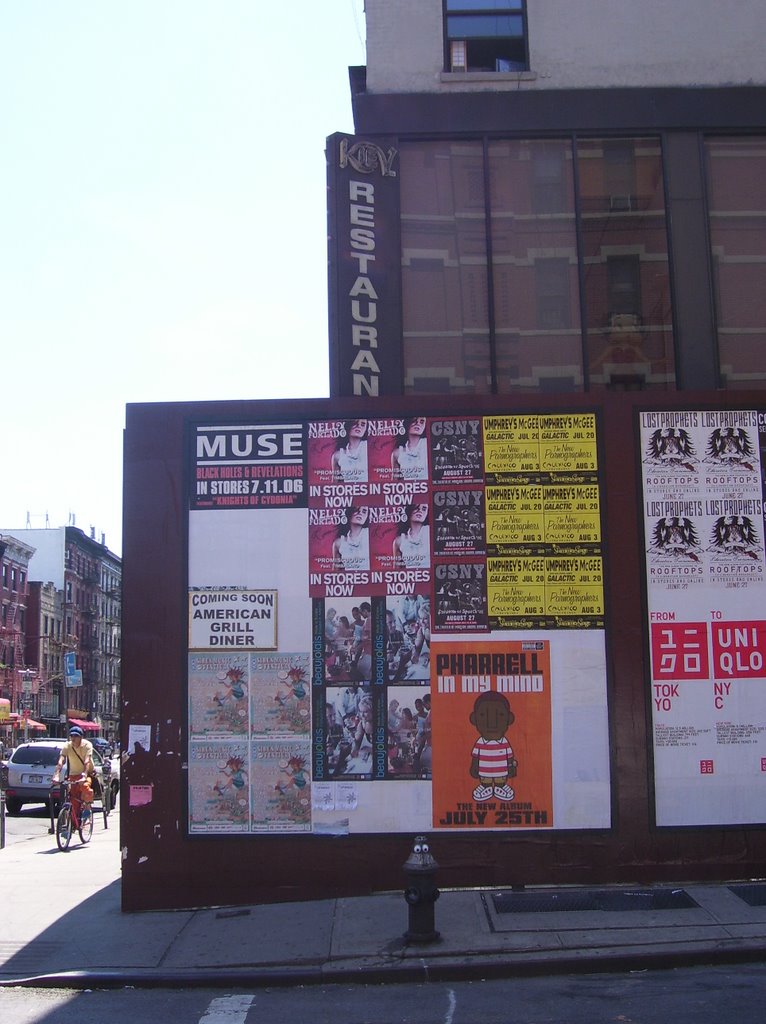
American Grill Diner vs. Kiev

Monday, July 10, 2006
Hütz to the Rescue
Last month the Village Voice profiled Gogol Bordell's Eugene Hütz in Tricia Romano's Hütz to the Rescue. The review kicks off by offering Hütz as the solution to "the lame state of New York nightlife," and the praise just goes up from there. Hütz has been travelling the world lately looking for new sounds and new performers, from Russia to Morocco. "I get in a car with my Ukrainian guide and basically drive to certain locations just to meet these people because they live in such isolation. A lot of the wild kids, they don't even know they are gypsies. They don't know what the fuck happened to them and why they are there. But what they do artistically is uncomparable to anything." Some will show up this fall at the second annual New York Gypsy Festival.
The profile also included a photo gallery, Curing your various ills via super Hützness, with some great shots of Gogol Bordello in action.
(Photo: Tricia Romano for the Village Voice)
Wednesday, July 05, 2006
Slavs out of World Cup
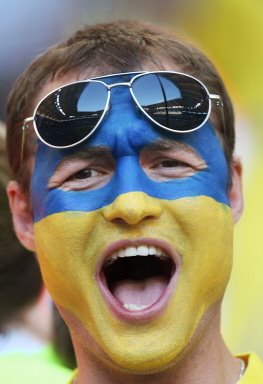
The World Cup semifinals have started, but all five Slavic teams have been eliminated.The kids over at Jaunted covered Friday's Italy/Ukraine match that saw the Ukrainian team get pummelled 3-0. Jaunted caught the match at the Ukrainian Sports Club on Second Avenue, which had a full house.
"The Club itself offers a viewing experience similar to that at an Elks Club or a Boy Scout meeting; there's plenty of linoleum, fake wood paneling and brown carpeting to go around. Chairs were parked around big-screen TV, and fans were crowded behind the seats.
Team Jerseys were even available for purchase, and we would have been tempted if we could have gotten a discount after Italy's first goal in the sixth minute. Before that quick strike, the room was all nervous anticipation and excitement, filling with chants of "U-kray-ee-na!" whenever the Ukranians touched the ball."Jaunted also treked out to Bohemian Hall a couple weekends ago to catch the Ghana/Czech Republic match. "Bohemian Hall was ready for early bird fans--they were open by 10 and were selling muffins and coffee for bleary-eyed supporters arriving for the noon match. Of course, they were selling pitchers of beer as well, and most of the true Czech fans were going for the authentic, breakfast beer route. By the start of the match, the line for beer was out the door and around the corner, and the line for food at halftime was long enough that we saw several fans with pitchers of beer and glasses to sustain themselves during the wait. Bohemian Hall serves authentic grilled klobasy and sauerkraut, and it's worth the wait for the tasty sausage."
The Times Ledger posted a report on the Argentina/Serbia game at the Serbian Club in Glendale, which described slightly less World Cup fever than the scenes at the Ukrainian Sports Club and Bohemian Hall. About 40 people showed up to watch Serbia's first two games, but by the time last week's game rolled around, disappointed fans largely stayed away.The semifinals kicked off tomorrow with with Italy defeating Germany 2-0, and continue today with Portugal v France.
Previously on Slavs of New York: Slavs at the World Cup
(Photos from http://fifaworldcup.yahoo.com/06/en/)
Monday, July 03, 2006
Veselka outpost to open in July
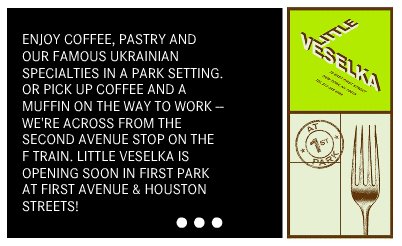
Last Friday, the kids over at Gothamist discovered that East Village Ukrainian diner Veselka is about to open an outpost at First Park, on the corner of First Avenue and First Street (“One of only two places in Manhattan where a numbered street meets an avenue with the same number,” according to New York Songlines).The new mini-Veselka will replace Le Kiosk, and is expected to serve more or less the same stuff as at their home base on Second Avenue. The grand opening is expected by mid-July.
Thursday, June 08, 2006
Slavs at the World Cup
We've gotten a few emails lately about where to watch the five Slavic teams compete at the World Cup, and so we figured we should blog it. Games begin on Friday, and not all bars will show all of the games so call ahead to figure out where's best to go. In no particular order, here's the list: - Czech Republic: Bohemian Hall (29-19 24th Avenue, Astoria, 718-274-4925). You can't go wrong with this big giant beer garden behind the historic Czech cultural center in Astoria. Aside from Czech beers, they're also having BBQs.
- Croatia: Scorpio (3515 Broadway at 35th Street. Astoria, 718-956-8233). We're not 100% sure they're playing the games, but if anyone is rooting for Croatia, it's Scorpio. Be sure to try the bijela kava (like a latee), certainly the best in the city.
- Serbia and Montenegro: Serbian Club (72-65 65th Place, Glendale, 718-821-9875). The mothership for Serbian fans. We've never been, but we hear it's well worth a visit. They've got cold beer, Balkan food and a big-screen TV. Can't go wrong.
Fans of Croatia and Serbia and Montenegro can also check out Zum Stammtisch (69-46 Myrtle Avenue between 69th and 70th Streets, Glendale, 718-386-3014), which of course caters to Germans, but is also frequented by the x-YU communities in the area.
- Ukraine: Ukrainian Sports Club (122 Second Avenue between 7th and 8th Streets, East Village, 212-475-1340). If you're a Ukraine fan, there's no other place to be. Aside from the full bar with Ukrainian beer, there's a five-foot projection screen TV. The game schedule is on the front door, pass by and check it out.
- Poland: Smolen Bar and Grill (708 Fifth Avenue, Park Slope, 718-788-9729). There must be a stack of places rooting for Poland, but we came up with nothing. Sage, a Slavs of New York reader, came to the rescue by pointing out Smolen, a neighborhood bar frequented by Russians and Poles serving up Polish beer.
And Cafe Blue Light (30th Street & 35th Avenue, Astoria) also has a live feed on a plasma TV, as well as Balkan food and $3.50 beer.
Thursday, May 11, 2006
Walking Tour: Slavic Alphabet City
Start on East 7th Street near Avenue A, at St. Mary's American Carpatho-Russian Orthodox Church (#1., 121 East 7th Street). The building started out as part of the Hungarian Reformed Church, then the Carpatho-Rusyns moved in. The group is pretty evenly split between the Green Catholic and Orthodox Churches, and in the United States in the early 20th century it was not uncommon for entire parishes to go from one to the other. Like this one. The Carpatho-Rusyns here started out as Ressurection Greek Catholic Church, and then became the Eastern Orthodox Church of SS. Peter and Paul. They settled on the name St. Mary's in the 1960s. 
Just a couple doors down is New York Citys first Polish Roman Catholic parish, St. Stanislaus Kostka (#2., 101 East 7th Street). The parish started out in 1872, but the building was not built until 1900-1901. Outside the building are a bust of Pope John Paul II, and a memorial plaque to the Poles who died in the September 11 attacks.
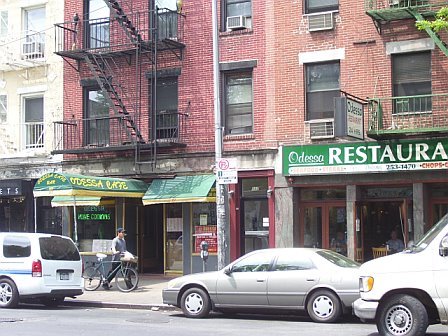
Walk down to the corner of Avenue A and turn left. In the middle of the block, you'll see Odessa Cafe and Bar (#3., 117 Avenue A) and Odessa Restaurant (#4., 119 Avenue A). Both are great spots for a quick bite.
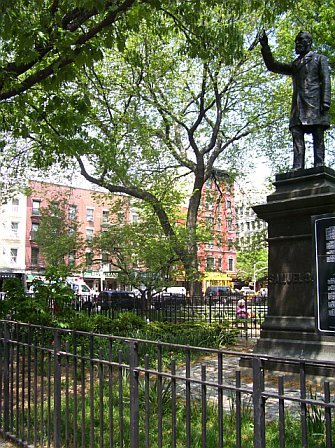
Continuing across East 7th Street to the southwest corner of Tompkins Square Park, take note of the Paderewski Tree (#5.), a tribute to Polish composer Ignacy Jan Paderewski, who died in New York in 1941. The tree was dedicated on the 60th anniversary of Paderewski's death by then-mayor Fiorello LaGuardia. It was sponsored by local Polish organizations and St. Stanislaus Church, where Paderewski was once a parishoner. The corner is also the home of the Tompkins Square Park Greenmarket.
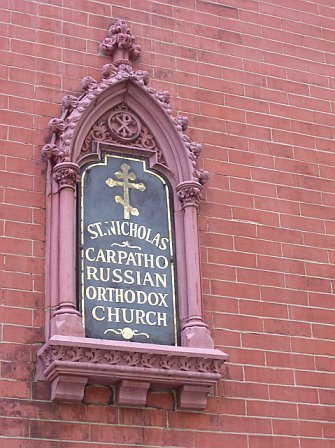
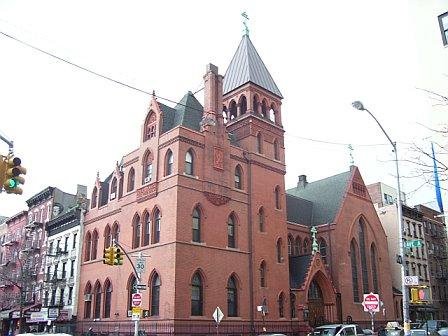
Back over on Avenue A across the street from the northwest corner of Tompkins Square Park is Manhattan's other Carpatho-Russian Orthodox parish, St. Nicholas (#6., 228 East 10th Street). Originaly a mission chapel of St. Mark's in the Bowery, the Carpatho-Rusyns acquired the building in the late 1920s. It was built in 1883 by James Renwick Jr. (architect of, among other things, the Smithsonian Institution in Washington D.C.) and W.H. Russell, and was featured in the 2001 film A Legacy of Faith.
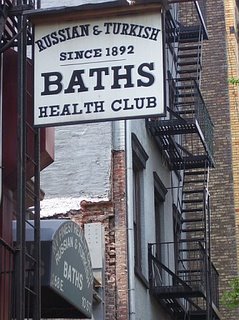
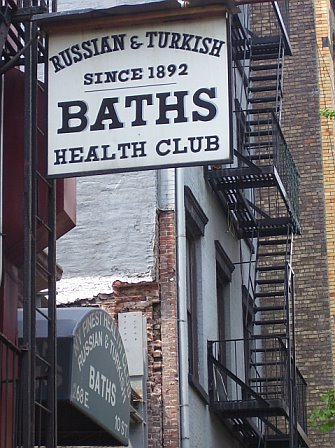
Just down the street is an East Village institution, the Russian & Turkish Baths (#7., 268 East 10th Street), founded in 1892. The place offers a full selection of banya treatments, as well as Russian soulfood at Anna's Restaurant.
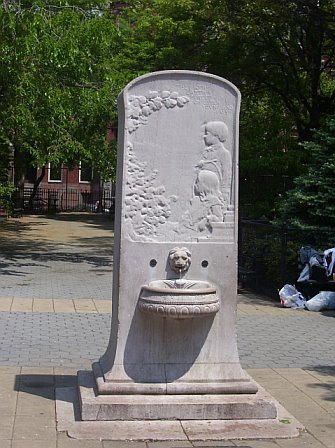
Now cross back and enter Tompkins Square Park. Behind the pavillion near the athletic courts is the General Slocum Memorial (#8.). This isn't really a Slavic site per se, but bear with me. The marble monument commemorates the General Slocum Disaster of 1904, which claimed the lives of over 1000 Germans from the East Village (then known as Kleindeutschland, or Little Germany).
At the time, the area was home to more than 80,000 Germans but they quickly fled the neighborhood in the wake of the tragedy and resettled on the Upper East Side in Yorkville. It was with the exodus of the Germans that the Slavs first came to settle in the East Village and Alphabet City.
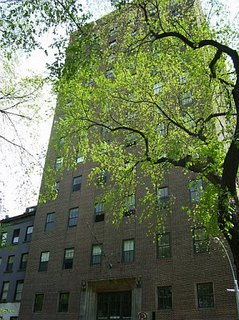
One major institution for the Slavic newcomers sits across the park: Christadora House (#9., 1 Tompkins Square). Christadora House was founded by philanthropists in 1867 as a settlement house providing social services to Russians, Poles, Ukrainians, Carpatho-Rusyns and other Slavic immigrants in the neighborhood. The settlement house moved into this 17-storey building once it was completed in 1928. At that time it was the tallest building in the world dedicated to social services.
Later, it hosted George Gershwin's first public recital, and, even later, it was where Iggy Pop wrote the song Avenue B. Today, it is home to luxuy condos.
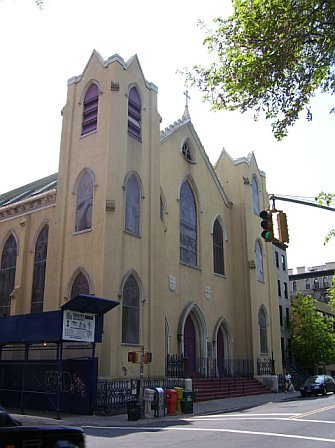
Continuing along Avenue B, youll come upon St. Brigid's Church (#10., 119 Avenue B). Though a Roman Catholic church, it hosted the nacent Ukrainian Catholic St. George parish from 1890 to 1905. Today, St. George is a Byzantine landmark on East Seventh Street, but St. Brigid's is facing the wrecking ball.
From here, make your way towards Avenue C. It's a good idea to check out the East Village Park Conservancy's Community Gardens map and pass by some of the local gardens on the way. Aim for El Jardin de paraiso (#11.) and Orchard Alley (#12.), both between Avenues C and D on East 4th Street.
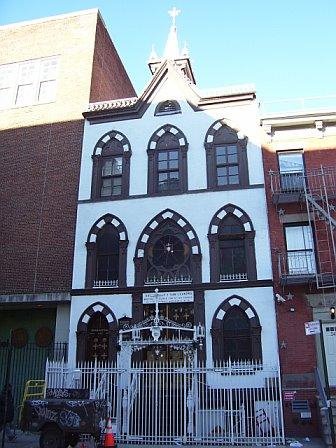
They sit on the same block as perhaps the most intriguing Slavic site in the neighborhood, the out-of-the-way San Isidoro y San Leandro Orthodox Catholic Church of the Hispanic Rite (#13., 345 East 4th Street).
Few specifics are available about the building’s history, but it was built in 1895 as the first home of the Roman Catholic St. Elizabeth of Hungary parish. When that parish moved uptown to Yorkville, the building became the Russian - Greek Orthodox Chapel of the Holy Trinity serving the Russian and Greek embassies. Later, it became the Russian Orthodox Church of St. Nicholas, which eventually moved to East 97th Sreet.
Today, the building is part of the Western Orthodox Benedictine Friars of the Hispanic Mozarabic Rite, though it still bears the royal seal of the Russian Czars on its façade.
Finally, Alphabet City is also home to The Monastery of St. Mary of Egypt / Mercy House (#15., 320 East 3rd Street), established in 1994 by the Russian Orthodox Church Outside of Russia. After a dispute, however, the monastery switched allegiances and is now part of the parish of the Russian Orthodox Church’s St. Nicholas Cathedral on the Upper East Side at East 97th Street near Fifth Avenue.