Sunday’s Travel Section of the New York Times included the article “Weekend in New York Romanian and Bulgarian Culture: Danube (Both Sides) on Hudson” featuring Bulgarian restaurants on the Lower East Side of Manhattan and in Astoria, Queens.
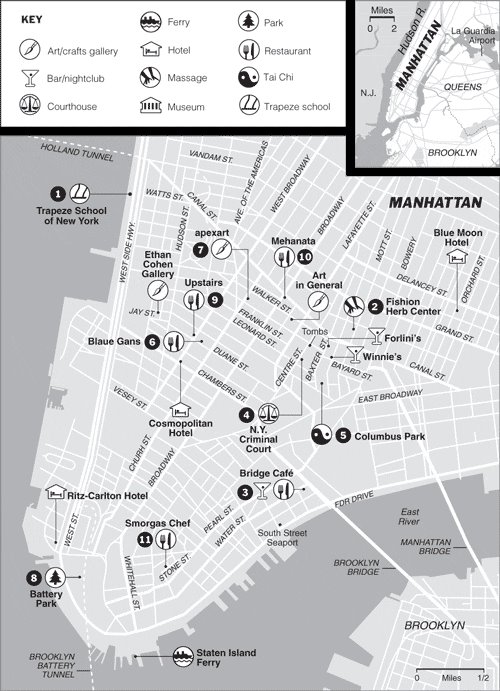
Seth Kugel writes that there are 22,000 Romanian (not Slavic) and 4,000 Bulgarian (Slavic) immigrants in the five boroughs. The most obvious center of Bulgarian life in the city is Mehanata, (113 Ludlow Street) well known as a bar/disco but less so for its food (which isn’t bad at all). The Times prefers the menu at Bulgara (37-10 11th Street, Long Island City) instead.
 The article also points out a couple Bulgarian happenings, including the Bulgarian Film Festival at Scandinavian House (58 Park Avenue). Three screenings are left, all on Friday, 27 April:
- 7:00 p.m., Sparrows in October (Vrabci prez oktomvri, Henry Koulev, Bulgaria 2006, 100")
- 9:00 p.m., George and the Butterflies (Georgi i peperydite, Andrey Paounov, Bulgaria 2006, 56")
- 10:00 p.m., The North Side of the Sunflower (Severnata strana na slunchogleda, Ivan Mladenov, Bulgaria 2006, 51")
The Bulgarian Virtuosi will also perform at Carnegie Hall Weill Recital Hall (154 West 57th Street) on Sunday, 29 April at 2:00 p.m. Performers include the Bulgarian Virtuosi Chamber Orchestra, Stefan Linev, Music Director and Conductor, violinist David Bowlin, cellist Kalin Ivanov and clarinetist Todd Brunel. The program features three 20th and 21st century works from Bulgarian composers. Tickets are $30 and $20 for students and seniors. The Bulgarian Consulate (121 East 62nd Street) also regularly hosts free concert evenings with Bulgarian performers.
And finally, Eleanor Gilpatrick will be showing her painted landscapes of Bulgaria at the Jadite Gallery (413 West 50th. Street) starting on 1 May.
More on the Bulgarians of New York on Slavs of New York.
Photo: Bulgara, by Robert Caplin for The New York Times
 The 25 July meeting of Community Board 3 saw the application for Mehanata’s new liquor license denied despite over 1750 signatures on a petition, the endorsement of over 500 local residents and numerous other shows of support. So Mehanata will not be able to reopen as planned at its new Ludlow Street location any time soon.
To get an idea of the debate over the bar’s new location, check out the comments on our 21 July post, Save Mehanata! Somehow most of the comments are negative and are against reopening the bar on Ludlow Street, but we (as East Village residents ourselves) agree with the anonymous commenter who asked why the naysayers live on the LES at all if they are bothered by the nightlife.
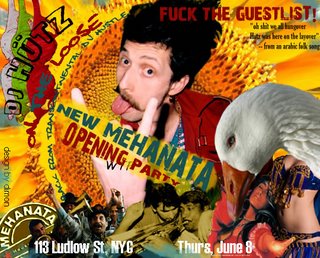
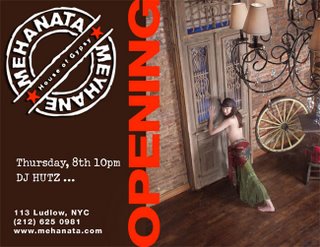
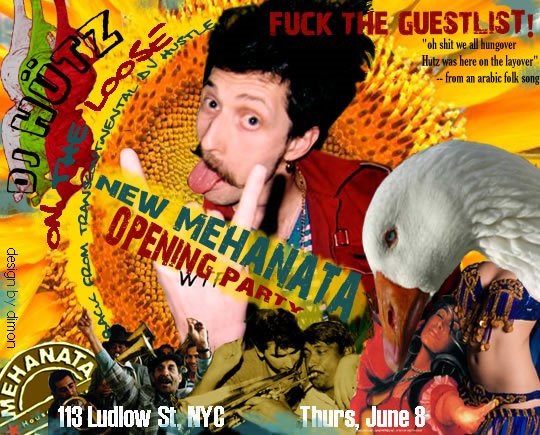
 Strange things have been afoot at Mehanata ever since it reopened at its new location at 113 Ludlow Street last month. Finally a clarification, but the news is not good.
Apparently, the Community Board reversed its earlier decision and denied the bar the transfer of its liquor and cabaret licenses, and Mehanata was shut down virtually as soon as it had reopened. Now, they have applied for new licenses, but after the 17 July meeting of Community Board 3, it looks like the licenses will not be approved.
Mehanata's owners explained that the decision was due to "a number of arbitrary and unsubstantiated reasons... (e.g. "the proposed use of this location as a dance space…is inconsistent with the primarily residential character of Ludlow street" at a site that has hosted a number of clubs/bars during the past many years – Seho, Lickwed, etc.)," and are now accusing the Community Board of "hidden intolerance towards New York's global thinking community as well as the immigrant circles ... colliding with the idea of bringing Gypsy Punk, Balkan, and Eastern European, Turkish music and culture to NYC."
Clearly Mehanata needs our help. The easiest thing to do is to send an email supporting Mehanata to Community Board 3 at info@cb3manhattan.org. Please include your name and address, and tell the board how much you love the bar and its mission, and that you really DO want it in the neighborhood.
You can also come check out the new digs at 113 Ludlow Street between Rivington and Delancy tonight (Friday) and Saturday from 6:00 to 11:00 p.m. and sign the petition to the Community Board.
And if you're a bit more ambitious, you can also attend the next Community Board meeting, on 25 July at the Chinatown YMCA Beacon Center (inside PS 131 at 100 Hester Street between Eldridge and Forsyth). If you live in the neighborhood, your voice would be particularly helpful.
 So now it's official. Mehanata is closed permanently as the building gets converted into a Ramada Inn. But now the fave Bulgarian bar is promising to reopen soon at a new location on the Lower East Side - no details yet on exactly where they'll end up.
For now, Mehanata parties continue at Maia Meyhane (98 Avenue B between 6th and 7th Streets) on Thursdays, Fridays and Saturdays. This weekend catch Zlatne Uste Brass Band with DJ Pepe and DJ Joro Boro at 10:00 p.m. on Friday and belly dancer Jeniviva with DJ Palamuth, Tossun, Mark and DJ Joro Boro on Saturday at 10:00 p.m.
And in the meantime, fans of the bar need to put on their thinking caps:
Since the name MEHANATA (‘The Tavern’ in Bulgarian) was difficult to pronounce for a big part of our international crowd, we are considering renaming it. We strongly feel that the new name should have ‘Gypsy’ as its part, since the word ‘Gypsy’ is associated with freedom, party, and great music – all of them a central part of MEHANATA’s idea – as well as contains references to the global multi-culti spirit that reflects in the international mix of crowd. For now we are considering ‘Gypsying’, ‘Gypsy Camp’, and ‘Gypsy Time’ among others, but we’d appreciate any submissions and feedback from you. Shortly we will make a form available on our website where you can vote for your favorite name, since the new place should be named by the people who go there.
Slavs of New York will let you know as soon as they put up that form. It sucks that they want to remove the Bulgarian bits from the Bulgarian bar, but we cannot stand by and let the place be named "Gypsying" or "Gypsy Time"... Better the place have a name that's difficult to pronounce than a name that's difficult to stomach.
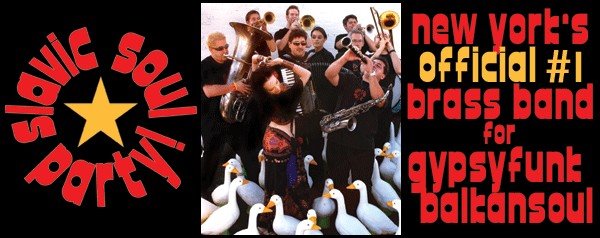
 Various Slavs of New York featured heavily in this week’s New York magazine roundup of lit-bars, “Bookish Boozing.” At the top of the list was Barbes (376 9th Street at Sixth Avenue, Park Slope), not exactly a Slavic spot, but home to Slavic Soul Party each Tuesday evening.
Similarly, number two on the list, Bowery Poetry Club (308 Bowery, between Bleecker and Houston) regularly hosts Slavic readings, particularly the Project Gorod series.
More directly, both KGB Bar (85 East 4th Street between Second and Third Avenues) and the Russian Samovar (256 West 52nd Street between Eighth Avenue and Broadway) fly the Slavic flag proudly.
On KGB Bar, New York writes: “Sundays bring fiction, Mondays poetry, and Tuesdays non-fiction. From Wednesday to Friday, you’ll hear everything from sci-fi to prize-winning journalism. The monthly ‘Drunken! Careening! Writers!’ limits each participating novelist/poet/hack to fifteen minutes and insists each work must have ‘at least one thing that makes people laugh.’”
And on the Samovar, “Sporadic readings take place in the upstairs room, where listeners gather around a large table and knock back exotically infused vodkas.”
Also on the list? Half King (505 West 23rd Street), Happy Ending (302 Broome Street), Mo Pitkin's House of Satisfaction (34 Avenue A), Pete’s Candy Store (709 Lorimer Street), and Rocky Sullivan’s (129 Lexington Avenue).
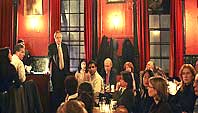
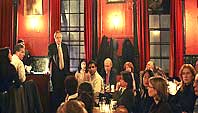
(Photo: UN Secretary of Staff, Mr. Mark Malloch Brown at KGB, by Julia Calfee for New York)
 Last week’s New York Observer featured Michael Calderone’s “Live With Marx And Like It: Lower East Side Gets Ritzy; Hottest Conversion Is Forward,” about the Forward Building on the Lower East Side. The building’s façade features portraits of Karl Marx and Friedrich Engles, making it yet another Soviet-esque landmark in Manhattan.
The building dates from 1912 and sits at 175 East Broadway facing Seward Park. Its name derives from its original owners, the Jewish Daily Forward. It is now being converted into apartments.
Peculiarly, Trotsky also shows up in this week's Observer, in Geoffrey Wheatcroft's "From Trotsky to Midcult: In Search of Dwight Macdonald." The Lower East Side used to be home to Café Trotsky, but it closed in December.
(Photo: Barry Lewis for the New York Observer)
 So here’s the latest: the Slavic Soul Party! gig scheduled for tonight at Mehanata has officially been moved to Maia Meyhane (98 Avenue B between 6th and 7th Streets).
The announcement came together with word that Mehanata is not actually closed for good. Yet. The Ramada is definitely on its way, so the place’s days are most unfortunately numbered.
 Monday’s post on Mehanata certainly stirred up quite a bit of interest, and a few more details have turned. First up, Gawker ran a post called Ariel Kaminer Kills the Bulgarian Bar Monday, alleging dreaded the Sports Illustrated Cover Curse is at play.
And then in Bulgarian Bar closes in yesterday’s Metro, we read that no one bothered to tell Slavic Soul Party that their gig this Friday night at Mehanata is probably not going to happen. Matt Moran told Metro, “What I know at the moment is that it’s closed now, but that they’re trying to open by this weekend.”
The latest rumour is that the bar hasn't actually been shut down yet to make way for the Ramada (though that's definitely in the cards), but that they may just have been shut down now for a fire-code violation or something relatively minor. Slavic Soul Party hasn't cancelled yet, though, so if you were planning on checking out the show, call ahead first: 212-625-0981.
 Just a day after the New York times included Mehanata in 36 Hours: Lower Manhattan on Friday, Slavs of New York received this email from the downtown Bulgarian bar:
As many of you may know, the building where Mehanata is located is going to become a Ramada Hotel. The construction started earlier than we expected and we have to be closed for awhile. However we joined forces with Maia Meyhane located at Avenue B and 6th Street in the East Village and the parties will be held there with the same DJs and staff for the time being. We will inform you when Mehanata reopens and keep you posted with all the developments.
So the party’s over. For now.
Be sure to check out Maia Meyhane, and you can also get a glimpse of the now-defunct favorite in the video accompanying the Times article, around 5:46 minutes into it. In Bulgarian Bar Goes Straight for the Arts & Leisure, Gawker points out that “you’ll have the rare pleasure of watching a Bulgarian Bar waitress berate a Times arts editor. Which is something all of us, every now and then, wish we had the chance to do.”
 New York has been home to a Bulgarian community since at least 1900, according to the Encyclopedia of New York City. The original immigrants settled in today's Alphabet City, around Avenues B and C at 3rd and 4th Streets.
The city was also home to the first Bulgarian association in the country, the Bulgarian American Mutual Aid Society, founded in 1906. Several other organizations aimed at the newly-arrived immigrants followed. Political emigration after World War Two saw the creation of a number of political groups in the city, such as the Bulgarian National Committee (1946-) and the Bulgarian National Front (1947-1968).
As the early immigrants moved up in society, they, like other immigrant groups, moved out of the Lower East Side. Many Bulgarians ended up the Tremont Avenue and Fordham Road sections of the Bronx, as well as in other parts of Manhattan and in the suburbs.
By the end of the 20th century, there were between 1500 and 2000 Bulgarians in New York, according to the Encyclopedia. Religious centers include Ss. Kirill and Methody Cathedral (552 West 50th Street) and St. Andrew in the Bronx.  The Bulgarian community is connected through the weekly newspaper Nedelnik, and many congregate at the city's Bulgarian restaurants, such as Bulgara in Astoria, Tricolorii in Sunnyside and Mehanata in Manhattan.
In large part building on the popularity of Mehanata, the Bulgarian community has stumbled into the cultural spotight in recent years, helping to launch a local Balkan music scene, and a Gypsy music festival.
The Bulgarian community is connected through the weekly newspaper Nedelnik, and many congregate at the city's Bulgarian restaurants, such as Bulgara in Astoria, Tricolorii in Sunnyside and Mehanata in Manhattan.
In large part building on the popularity of Mehanata, the Bulgarian community has stumbled into the cultural spotight in recent years, helping to launch a local Balkan music scene, and a Gypsy music festival.
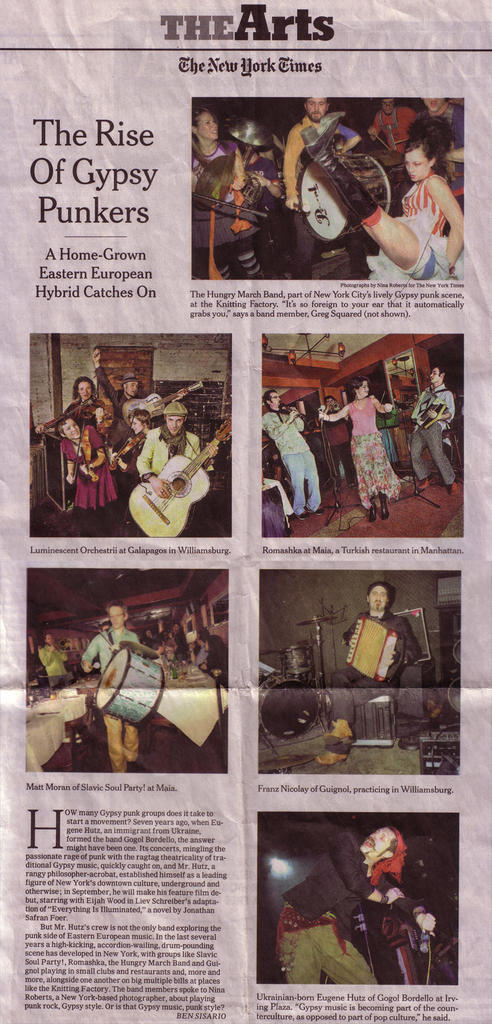
 One of the least-expected waves to hit New York City is the current Balkan gypsy music fad, led by Gogol Bordello and its illuminated frontman Eugene Hütz.
The scene started slowly at Mehanata, on the second floor of an unassuming building on the corner of Broadway and Canal Street in Chinatown. Hütz started out there as a DJ and quickly built a following. Gogol Bordello quickly followed, forming in 2000. The band performs what it calls "punk cabaret" music, influenced by Hutsul, Ukrainian, Romanian and Gypsy music. Hütz's rise recently culminated in a starring role in the movie Everything is Illuminated.
There are easily a dozen bands in the five boroughs playing one sort of Balkan music or another. Among the current favorites are Zagnut Cirkus Orkestar, Romashka, Hungry March Band and Luminescent Orchestrii. The most established are Zlatne Uste and Slavic Soul Party!, and one old favorite we'd love to see make a comeback is Pectopah.
You can catch these bands at shows all over town, particularly at Mehanata, Hungarian House, Barbes and Maia Meyhane. Other venues that frequently feature these bands include the Knitting Factory, Nublu and Satalla.
For anyone interested in learning the traditional dances that accompany the music, there's NYC Folk Dance. Each year, they schedule two seasons of low-key dance lessons as part of their Folk Dance Fridays, Family Dance and Balkan Cafe series at Hungarian House on the Upper East Side. They also run a Wednesday night Balkan dance class in Chelsea.
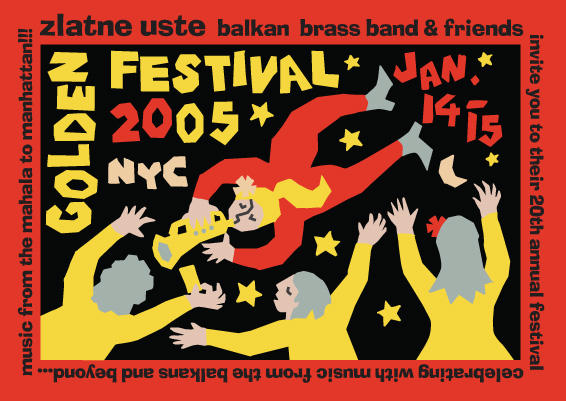
 The high point of the Balkan music year in the city is definitely the Golden Festival, which next takes place on 13 and 14 January 2006. In its 21st year, the annual gathering is organized by Zlatne Uste and features countless performers on multiple stages, Balkan and Middle Eastern delicacies and art vendors.
 But before that comes the first New York Gypsy Festival, which opens on Saturday and runs through 6 November. The festival, like most of the bands and events, does not feature music from Slavic lands exclusively, but covers a wider cultural area that includes Romania, Turkey and the Middle East. The highlight will be an eight-hour marathon of performances on 6 November at the Roxy.
And if you can't attend any of the events, or just want a souvenier, check out the new double CD produced by Mehanata. Tracks were provided by many bands that have performed at Mehanata, including Balkan Beat Box, the Dolomites, Gogol Bordello, Guignol, the Hungry March Band, J.U.F., Luminescent Orchestrii, Romashka, Shaat’nez, Slavic Soul Party!, Yuri Yunakov and Zagnut Cirkus Orkestar.
But why the sudden craze? Inna Barmash, the singer of Romashka, told the Times of London in May that “There is something about gypsy music that people just respond to, whether it’s flamenco, Hungarian gypsy or Russian gypsy — it catches people’s souls in a very immediate way. People seem to know how to dance to it intuitively” (check out The Gypsies pitch up in the New York Times). Matt Moran of Slavic Soul Party! told the Times that he thinks part of the reason is the opening up of the Eastern Bloc and the floods of new immigrants and refugees from Eastern Europe and the Balkans. But the music and the passion behind it are the real pull - who could resist it?
 Until 2003, the Metro New Jersey - New York Chapter of the Carpatho-Rusyn Society (C-RS) existed to provide a social outlet for the city's Carpatho-Rusyn (or Ruthenian, Carpatho-Russian, or Lemko) community. At that time, however, it was expected that a proper New York City Chapter would be created and so the chapter was renamed simply the New Jersey Chapter. The NYC Chapter never materialized, so the NJ Chapter remains the closest link the city's Rusyns have to Rusyn communities throughout the country and around the world.
Carpatho-Rusyns are a small Slavic group found in the Carpathian mountains, along the borders of what is now Poland, Slovakia, Hungary, Ukraine and Romania. Pockets also live along the Serbian-Croatian border.
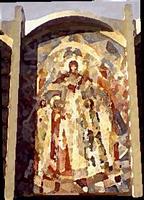 They emmigrated in large numbers to the United States starting in the 1880s, with many settling in New York City - particularly in Lower Manhattan, the Lower East Side and the East Village and in Greenpoint. Major Rusyn landmarks in the city inclulde St. Nicholas Carpatho-Russian Orthodox Church (288 East 10th Street at Avenue A) and St. Mary's Ruthenian Catholic Church (246 Easat 15th Street) in the East Village, and the Russian Orthodox Cathedral of the Transfiguration (228 N. 12th Street) in Greenpoint. The most famous Carpatho-Rusyn New Yorker is by far Andy Warhol.
On Saturday, the C-RS will hold its monthly meeting at the public library in Wayne, NJ, with a presentation entitled A Rusyn World Congress in a Spa Town. Orestes and Katarina Mihaly and Paul Best, three of the North American delegates to the June 2005 World Congress of Rusyns, held in Krynica, Poland, will provide an overview of that important international social and cultural gathering of Rusyns from around the world.
Also on hand will be Maria Silvestri, who headed the North American youth delegation to the World Forum of Rusyn Youth as leader of Rusyn Outpost: North America. She will not only describe the World Forum and its activities, but will also present interviews with young Rusyns from several countries that she recorded while in Krynica.
A Rusyn World Congress in a Spa Town will take place from 2:00 p.m. to 4:00 p.m. at the Wayne Public Library, 461 Valley Road, Wayne, NJ. From Manhattan, take NJ Transit bus 197 from Port Authority to the Valley Road/Preakness Avenue stop in Wayne (the library, in the Wayne Municipal Complex, will be right across the street). The 1:00 p.m. bus departs Port Authority and arrives in Wayne at 1:47 PM.
Meanwhile, the New York Chapter is still in the process of forming. If you would be interested in participating, please email nycslav@yahoo.com for more information.
(Photo: St. Mary's, by Bob Kisch, from http://worldisround.com/articles/17913/index.html)
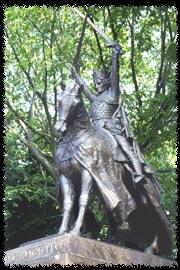
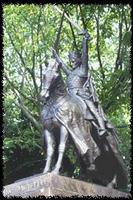 Manhattan is home to several public sculptures and monuments featuring a variety of important Slavs.
One of the easiest to find is the statue of King Ladislas Jagiello of Poland, located at the east shore of Turtle Pond in Central Park near 80th Street. The statue is the work of S.K. Ostrowski and originally featured into the Polish pavilion at the NYC World's Fair. It settled in the park in 1945.
At East 17th Street and N.D. Perlman Place on Stuyvesant Square, you'll also find a monument to Czech composer Anton Dvořák. This one is the work of Yugoslavia's most important sculptor, Ivan Meštrović. The sculpture came to New York more than thirty years ago, originally installed on the roof of Avery Fisher Hall at Lincoln Center.
Manhattan is home to several public sculptures and monuments featuring a variety of important Slavs.
One of the easiest to find is the statue of King Ladislas Jagiello of Poland, located at the east shore of Turtle Pond in Central Park near 80th Street. The statue is the work of S.K. Ostrowski and originally featured into the Polish pavilion at the NYC World's Fair. It settled in the park in 1945.
At East 17th Street and N.D. Perlman Place on Stuyvesant Square, you'll also find a monument to Czech composer Anton Dvořák. This one is the work of Yugoslavia's most important sculptor, Ivan Meštrović. The sculpture came to New York more than thirty years ago, originally installed on the roof of Avery Fisher Hall at Lincoln Center.
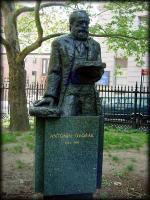
Even though Dvořák's former home at 327 East 17th Street near Stuyvesant Square had been designated a landmark, the City Council overturned the designation in 1991 and the building was destroyed soon after. An AIDS hospice currently sits on the site. The statue was erected nearby in 1997.
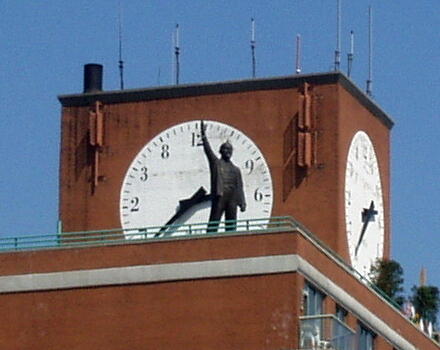
Another public sculpture of interest is that of Vladimir Lenin that sits atop the Red Square building on East Houston Street.
The grounds of the United Nations, on the East Side, are a treasure trove of Slavic-related sculptures and monuments. Most visible is definitely the statue of St. George that sits on First Avenue near 48th Street. This statue, of the patron saint of Moscow, is the work of Zurab Tsereteli, a Georgian sculptor who completed several large-scale projects in Moscow in the 1990s.
Also on the grounds is "Peace," an equestrian statue by Croatian sculptor Antun Augustinčić, originally a gift to the organization from Yugoslavia. Nearby is a Soviet sculpture, "Let Us Beat Swords into Plowshares." It's also worth pointing out that aside from the statues the public can also see a copy of the Vace Situla from Slovenia and an enormous stained-glass window by Marc Chagal in the visitors lobby.
Unaccessible to the general public is a monument to Saints Cyril and Methodius, a gift of Slovakia. The monument sits just outside the delegates' entrace to the General Assembly building. Also unaccessible to the general public is a statue of Kopernicus from Poland, Croatia's Girl with lute by Ivan Meštrović and also a piece of a medieval fresco from Bulgaria.
(Photos from http://www.nycgovparks.org/)
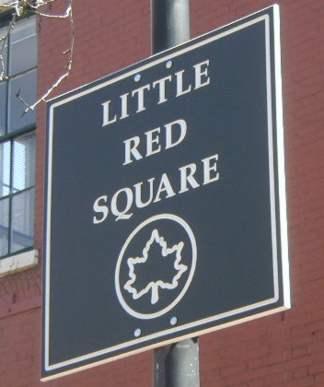
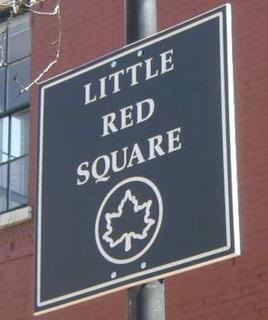 Moscow's Red Square may well be the most famous in the world, but never-to-be-outdone Manhattan boasts not one but two of its own.
The oldest is Little Red Square, located in Greenwich Village at Sixth Avenue and Bleeker Street. However, the site has nothing to do with Russia, but rather commemorates the Little Red Schoolhouse which sits adjacent to the square at 272 Sixth Avenue at Bleeker Street.
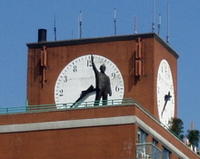 A bit odder is the Red Square, at 250 East Houston Street. The building itself has little to do with anything Russian, other than the roof, which features one of the last publicly-displayed statues of Vladimir Lenin to be found anywhere in the world. The statue is the work of sculptor Yuri Gerasimov, and was moved to the roof of the building in 1994 from its original location somewhere in the Soviet Union.
The statue was voted "Best Homage to a Foreign Despot" by the Village Voice in 2003.
(Top photo from http://en.wikipedia.org/wiki/Image:Lenin-east_village.jpg, below from http://www.forgotten-ny.com/STREET%20SCENES/deepsix/deepsix.html)
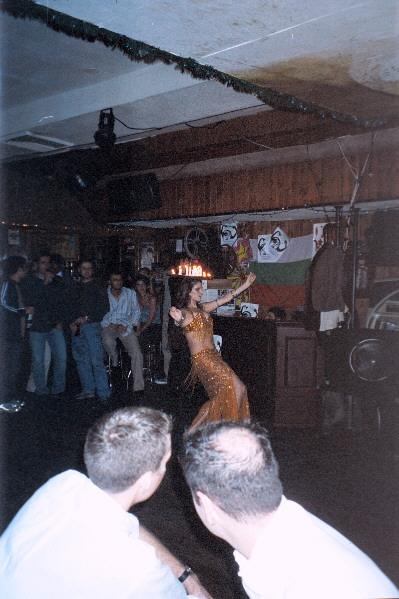
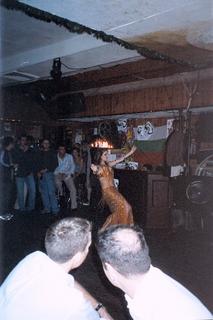 Come before 10 p.m. and it's Manhattan's only Bulgarian restaurant...come later and it's Manhattan's only Balkan dance club!
On the web at http://mehanata.com/ and in person at 416 Broadway, New York on the corner with Canal (second floor, entrance on Broadway). Call 212 625 0981.
Mehanata has also just released a double CD featuring many of its live performers, including Balkan Beat Box, Dolomites, Gogol Bordello, Guignol, Hungry March Band, J.U.F., Luminescent Orchestrii, Romashka, Shaat’nez, Slavic Soul Party!, Yuri Yunakov and Zagnut Cirkus Orkestar. Buy it here: http://www.cdbaby.com/cd/mehanata