Showing posts with label poles. Show all posts

Saturday, January 17, 2009

Walking Tour: Ridgewood

Ridgewood is perhaps a bit out of the way for the average New Yorker, but the effort to get there is well worthwhile. Historically, this is a German neighborhood but today it is as diverse as anywhere else in Queens – and is home to a major Polish enclave (mainly along Fresh Pond Road), and a smattering of former Yugoslavs, among many other groups.

The neighborhood is home to a major historic district, focused on its fantastically preserved early 20th century residential buildings. When the historic district was declared in 1983, it was the largest in the country, with nearly 3000 buildings included. Even beyond the Slavic sites here, the historic architecture makes Ridgewood a nice place to spend an afternoon.

Though there are several transportation options, Slavs of New York came from Manhattan on the L line to Myrtle-Wyckoff Avenue, and walked across Myrtle Avenue (though there is also a connection to the M line that runs straight through Ridgewood).

The Balkan presence is quickly felt on Myrtle Avenue. Walking across, you’ll first hit the Bulgarian grocery Parrot Coffee Grocery (58-22 Myrtle Avenue). Nearby is the Serbian-owned European Music & Video Store (59-13 71st Avenue), then Muncan Meat Market (60-86 Myrtle Avenue).

A bit further down, the deli Balkan Express (64-02 Myrtle Avenue), featuring a Socialist Federative Republic of Yugoslavia flag on its awning has unfortunately closed, though the awning (and the flag) remain for now. From here, it’s a quick walk over to the next neighborhood in Queens, Glendale, home of the Serbian Club (72-65 65th Place).
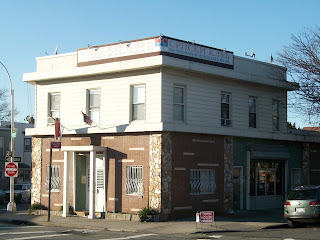


An outpost of the Greenpoint-based Polish & Slavic Federal Credit Union (60-95 Myrtle Avenue) on the corner with Fresh Pond Road is the gateway to a Polish enclave second only to Greenpoint itself. Walking up Fresh Pond Road, you’ll first hit Bona Restaurant (71-24 Fresh Pond Road).

The road has a string of Polish delis, too numerous to list here. They include Teddy's Market Polskie Delikatesy (71-08 Fresh Pond Road), Wawel Meats (68-33 Fresh Pond Road), Pulaski Deli (67-12 Fresh Pond Road) and Okruszek Polish Bakery (67-10 Fresh Pond Road). Just around the corner, down Putnam Road, is a Polish bookstore.
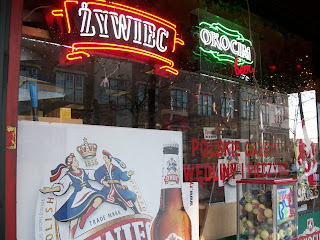


After a couple more delis, including Jantar (66-66 Fresh Pond Road) and Starowiejski (66-51 Fresh Pond Road), there are two excellent Polish restaurants: Kredens (66-36 Fresh Pond Road) and Krolewskie Jadlo (66-21 Fresh Pond Road). Either is a good place for lunch or dinner.

Further up, you’ll find many more Polish delis, as well as Video Random (66-02 Fresh Pond Road) and Aga Book Store (65-18 Fresh Pond Road).

A short walk down Linden Street from Fresh Pond Road will take you to
Gottscheer Hall (657 Fairview Avenue), which is worth poking your head into. The well-preserved deco lobby is impressive, as is the beer-hall on the first floor.


Along with the early German presence came the Gottscheer Germans, a group from what is today Kočevje, in Slovenia. Very few Gottscheer Germans remain in Slovenia because of post-World War II repression of German culture in Yugoslavia, and so their presence in Ridgewood is rather unique. The Gottscheer community here has a number of institutions – most visibly Gotscheer Hall, but also a dance group, a hunting club, a women’s chorus and more.

Down Fairview, the excellent restaurant Bosna Express (7-91 Fairview Avenue) sits next door to the Albanian Café Tirana, a sight possible perhaps only in Queens. Also nearby are even more Polish delis, joined now by a few Balkan ones. Check out Old World Bakery (66-91 Forest Avenue), Europa Grocery (99 Forest Avenue), Korona Deli & Grocery (66-65 Forest Avenue), and Burek's (68-55 Forest Avenue). Also nearby is St. Matthias Roman Catholic Church (58-15 Catalpa Avenue), a German parish that now serves the Polish enclave.

And from here, you will be within striking distance of the Myrtle-Wyckoff Avenue L train.

Thursday, November 27, 2008

Slavs at the 1939 World's Fair in Queens

The other week, Slavs of New York was lucky enough to join the Municipal Arts Society’s walking tour of Bohemian National and the Sokol Halls, led by Joe Svehlak. Everyone is encouraged to visit Bohemian National Hall, but Sokol Hall is a bit less of a public space so getting inside was a treat.

Just inside the door is a small pub, and among the decorations are five large medallions – one each for Bohemia, Moravia, Silesia, Slovakia and Subcarpathian Rus (Ruthenia), the five parts of Czechoslovakia from 1918 to 1939. The guide said they were originally from the Czechoslovak pavilion from the 1939-1940 World’s Fair in Flushing Meadows, Queens.


The Munich Agreement was in September 1938, and Hitler invaded on 14 March 1939. Slovakia declared independence on 14 March, and Ruthenia on 15 March (the latter was then occupied by Hungary just about 24 hours later). The rest of Czechoslovakia was reorganized as the Nazi Protectorate of Bohemia and Moravia. Czechoslovakia would not reemerge until the close of World War II.


So how was there a World’s Fair pavilion for a state that did not exist?

Turns out, the contract with the fair organizers was signed in 1938, and at the time of the Nazi invasion the following March the building was already about half-done.
The plans were scaled down, but preparations went forward.

Mayor Fiorello La Guardia emerged as a leading proponent of Czechoslovak independence, quickly meeting with Czechoslovak representatives and assuring that so long as the United States did not recognize the German moves the Czechoslovak envoys would keep their titles and authority. When Nazi Germany (the only major country not participating in the fair) tried to keep the Czechoslovak pavilion from opening, La Guardia set up a “citizens’ committee” to raise funds to help complete the pavilion and its exhibits.

The pavilion became a
symbol of Czechoslovak resistance to Nazi domination. Former Czechoslovak president Edvard Benes spoke at the dedication of the pavilion on 31 May, highlighting the struggle of the Czechs, Slovaks and Carpatho-Russians (Rusyns) in Europe and thanking La Guardia, noting that “This pavilion, ladies and gentlemen, is the free and independent Czecho-Slovakia of the near past and the free and independent Czecho-Slovakia of the near future.”

The Czechoslovak pavilion stood
between the pavilions of the Soviet Union and Japan. Here’s a description of the finished pavilion from the New York Times on 30 April 1939:

The progress of the country during its twenty-year existence is the central theme, and the products and resources of the land and people are represented and demonstrated – such products as iron, steel, textiles, shoes, beer, hams, Glass blowing and etching are shown. A restaurant and open-air beer garden are included in the project.

Yugoslav pavilion featured a large, illuminated map of the country, as well as a model of the oldest pharmacy in the world, from Dubrovnik. Also highlighted were Yugoslavs who have made contributions to the United States, such as Nikola Tesla and Michael Pupin.

Mayor La Guardia spoke in Croatian, a language he learnt while stationed in the United States Consular Service in Fiume (Rijeka), at the opening of the Yugoslav pavilion in May. Among his comments:

The people of Yugoslavia are generous, kindly and peace-loving. Whenever there is trouble in the Balkans, look for the reason, and it will be found to come from without and not from within. Let the strong and big nations leave the Balkans alone and peace will prevail there.

Among the 60 states participating at the 1939 World’s Fair were three more Slavic states: Yugoslavia, Poland and the Soviet Union.

The

The Polish pavilion was built around the 348th anniversary of the first Polish Constitution, and included – among a wide variety of exhibits – the Jagellonian globe, which is believed to be the first to show the name “America.”


The statue of King Jagiello by Stanisław K. Ostrowski, originally placed in front of the Polish pavilion, is one of the rare artifacts of the 1939-1940 World’s Fair still publicly displayed in New York. The statue now sits in Manhattan’s Central Park, near the Turtle Pond.


The Soviet Pavilion was universally acclaimed as a major highlight of the fair. The building was the tallest on the fairgrounds, other than the iconic Trylon structure. Estimates for its cost ranged from $4 to 6 million, by far the most of any World’s Fair structure. Among the materials used in its construction were nine different sorts of marble brought over specially from the USSR.

The building was topped by a 79-foot-tall worker holding aloft an illuminated red star, nick named Big Joe. After complaints, Fair officials had to put a US flag atop the Parachute Jump (which was later relocated to Coney Island) to ensure it flew higher than the Soviet star.

Exhibits inside included a map of the Soviet Union covered in precious stones, two cinemas, a restaurant, and even a full-scale replica of a portion of Moscow’s Mayakovsky metro station (the station was brand new, having just been completed in 1938).

At the end of the 1939 season, the
Soviet Union pulled out of the fair, and its building was taken apart and shipped back to Moscow.


On 3 January 1940, the New York Times ran a story about the dismantling of Big Joe entitled “Soviet Worker at Fair is ‘Purged’” commenting tongue-in-cheek that “Stalin’s extended his purge to the United States yesterday and ‘Big Joe’… was decapitated by a derrick.”

Initially, there were plans to reassemble the pavilion at
Gorky Park in Moscow, but this was never done and the final fate of Big Joe and the rest of the exhibits remain a mystery.

Sunday, November 09, 2008

Walking Tour: Bedford-Stuyvesant

Bedford-Stuyvesant, in north central Brooklyn, is not an obvious neighborhood to get the Slavs of New York walking tour treatment. While the neighborhood may have been home to some Poles long ago, they did not leave much of a trace. This is the district that elected the first Black woman to Congress – Shirley Chisholm in 1968 – and today it is a major center of African-American life in the city.

Our tour starts at the Classon Avenue G station (this can easily be accomplished together with a visit to
Greenpoint, also serviced by the G train). Coming out of the station, walk up Classon towards Kalb Avenue, turn right onto Taaffe Place and you’ll find Sputnik (262 Taaffe Place).

The place lies slightly out of the area normally though of as Bed-Stuy, but it’s close and the burgers are highly recommended. The restaurant has a 1950s space-age theme that has as much in common with the Jetsons as it does with the Russian space program, but has a great vibe.

After a quick bite (the burgers are highly recommended!) head back down to Kalb and keep walking straight, to Nostrand. From there, two streets up is Pulaski Street, one street down is Kosciusko Street. Between Marcy and Dekalb Avenue is the
Kosciusko Street Pool, a public swimming pool.

Kazimierz Pulaski (1746-1779) was a Polish nobleman who came to the American colonies and rose to the rank of General of the Continental Army during the Revolutionary War. Pulaski does not seem to have been active in New York, but memorials to him abound across the United States. Aside from this street, the Pulaski Bridge between Greenpoint and Long Island City is also named for him.
Pulaski Day is celebrated on the Sunday closest to 11 October with a massive parade down Fifth Avenue in Manhattan.

Kosciusko Street is named for
Thaddeus Kosciuszko (1746-1817), a major figure in the American – and Polish – wars of independence. Though he is not known to have spent much time in New York (he was, however, the chief engineer at West Point, and his one-time home in Philadelphia is a National Memorial), he has also given his name to the Kosciuszko Bridge, over the Newtown Creek between Brooklyn and Queens.

Kosciuszko is also the only Slav honored in the New York City subway system - the
Kosciusko Street J train station. When you’ve finished exploring the neighborhood, walk down to Lafayette Street and hop the #38 bus to catch the train!

Sunday, November 02, 2008

Update: Recent News

As we're catching up on our blogging, here's a selection of recent news:

Stalin on Cooper Square

The Cooper Union's main building on East Seventh Street is displaying a 1952 Picasso portrait of Stalin, part of an exhibit entitled Stalin by Picasso or Portrait of Woman With Mustache by Lene Berg. The exhibit runs through 6 December. The New York Times notes that Stalin joins the statue of Lenin atop the Red Square building on East Houston Street and links to a 1997 note explaining how that statue got there.

And while you're checking out the Cooper Union exhibit, check out the Slavs of New York East Village walking tour as well!

Hot Kielbasa!

Meanwhile, in Greenpoint… Sikorski Meat Market got busted last month for serving up cocaine when customers ordered “hot kielbasa.” The Brooklyn Eagle reports that 26 defendants now face between 10 years and life in prison. And, it turns out the FBI and NYPD have a Eurasian Organized Crime Task Force operating in the city – who knew?

The Mosque?

Another controversy last month concerned an “ironic” hipster bag produced by Brooklyn Novelty that features Greenpoint, and shows the Russian Orthodox Cathedral of the Transfiguration labeled as “The Mosque.” New York Shitty broke the story, and the New York Post followed up with unhappy comments from clerics at the church. The bag remains on sale…

Future of Protection Cathedral

Finally, big changes are afoot at the Russian Orthodox Cathedral of the Holy Virgin Protection (59 East 2nd Street). Curbed reports that the church, currently being considered for landmark designation, is looking to put an eight-storey residential structure above the existing building.

(Cooper Union photo: Gianni Cipriano for The New York Times; Photo of Rev. Wiaczeslaw Krawczuk from the New York Post)

Wednesday, September 24, 2008

Walking Tour: Slavs of Greenpoint

Greenpoint is the preeminent Polish enclave in New York – and one of the largest outside of Poland itself. According to the 2000 Census, New York had the second-largest Polish community in the country after Chicago, and the majority seem to live in Greenpoint.

The Polish presence is so strong that even though you downloaded that
Polish-language primer from GreenPunkt as a joke, it turned out to be pretty useful in the end. Kirk Semple wrote recently in The New York Times that the booming economy in Poland is luring more Poles home and may leave Polish Greenpoint a part of history. But for now, there’s still much to see – even if gentrification is an ever-increasing force in the neighborhood and the promise of a better life now has many local Poles rethinking life in their homeland.

Since they’re close, this walk actually starts in
Williamsburg, at the Bedford Avenue L station. Walk Up Bedford Avenue and you’ll immediately pass both Raymond's Place (124 Bedford Avenue) and Kasia’s Restaurant (146 Bedford Avenue). Turn right along North 12th Street, walk to Driggs Avenue and you cannot miss the landmark Russian Orthodox Cathedral of the Transfiguration of Our Lord (228 N.12th Street at Driggs).

From here, go back out to Bedford Avenue, keep walking north and you’ll hit Father Jerzy Popieluszko Square. Popieluszko was a priest martyred by Poland's Communist government in 1984 for supporting the emergent Solidarity movement. The monument was erected here just six years later, in 1990.

At the fork, keep right and walk along Nassau Avenue (passing the Nassau Avenue G station), and you should see a number of Polish
milkbars and restaurants, including Lomzynianka (646 Manhattan Avenue), Pod Wierchami (119 Nassau Avenue) and Pyza (118 Nassau Avenue).

At Eckford Stret, turn right and walk down to Driggs Avenue to the
Polish National Home (a.k.a. the Warsaw) (261 Driggs Avenue). This former ethnic social club in recent years has recast itself as a major club venue.

From here, walk down Driggs to Humbolt, where you’ll see Walesa-Solidarity Square (a.k.a. Humbolt Street) and Pope John Paul II Plaza (Driggs Street) near the center of Greenpoint’s Polish community,
St. Stanislaus Kostka Church (607 Humboldt Street at Driggs).

Turn right and walk up Humbolt St. back to Nassau Avenue, where you’ll find Old Poland Bakery and Restaurant (192 Nassau Avenue). Have a snack, or continue on to Manhattan Avenue and turn right. Near Norman Avenue is Krolewskie Jadlo (694 Manhattan Ave), guarded over by a Polish knight.
At the next intersection (Manhattan and Meserole), you’ll find Club Europa (98 Meserole Avenue) to the left, and the fantastic Wedel chocolate shop (772 Manhattan Avenue) on corner to the right. If you can, make SURE to check this place out around Christmas time!

Further along Manhattan on the next block is yet another Polish restaurant,
Christina's (853 Manhattan Avenue), and Polonia Bookstore (882 Manhattan Ave) where you can get books in Polish as well as books to learn Polish. If you turn right onto Greenpoint Avenue, Club Exit (149 Greenpoint Avenue, check out Clubbing in Greenpoint) is just off Manhattan Avenue.

The next intersection is with Kent Street, and just past Manhattan Avenue to the left is the former Carpatho-Rusyn
Greek Catholic Church of St. Elias (149 Kent Street (Manhattan Avenue & Franklin Street) and to the right, the Polish and Slavic Center (177 Kent Street and the Polish and Slavic Credit Union (175 Kent Street), two major local institutions.

And at the next intersection, turn right on Kent Street and you’ll find
Ksiegarnia Literacka (161 Java Street). This one is the classiest of Greenpoint's Polish bookstores, and even if you don't read the language it's well worth dropping in just to take a look. It's also the end of the tour - unless you're feeling adventurous and want to check out the Pulaski Bridge (keep waking up Manhattan Avenue to the end and turn right on Ash Street and hike out to McGuiness Boulevard).

When you're done, you can walk back to the Bedford Avenue L train or the Nassau Avenue G, but the closest will be the Greenpoint Avenue G station at the intersection of Greenpoint and Manhattan Avenues.

Sunday, August 10, 2008

Walking Tour: The East Village

Start at Union Square, and walk east along the northern side of 14th Street. You will soon hit a small shop, Russian Souvenirs (227 14th Street), between Second and Third Avenues. The shop has seemingly been there forever, and is a great place for traditional Russian arts and crafts, and Soviet kitsch.

Once you hit Second Avenue, you can walk north one block to Stuyvesant Square (not really part of the East Village, but close enough), where you will find the Byzantine (Ruthenian) Catholic church of
St. Mary (246 East 15th Street), dating from 1964.

Diagonally across the park, at East 17th Street and Nathan D. Perlman Place is a
bust of Czech composer (and Slav of New York, at least for a time in 1892) Anton Dvořák by Yugoslav sculptor Ivan Meštrović

Leaving Stuyvesant Square, the Slavic heart of the East Village unfolds southward down Second Avenue. On the west side of the street, you pass the
Ukrainian Orthodox Federal Credit Union (215 Second Avenue) and then the Ukrainian Congress Committee of America (203 Second Avenue), and across Second Avenue on the east side are the diner Little Poland (200 Second Avenue), and the Jozef Pilsudski Institute of America in the Polish National Home (180 Second Avenue).

One of the most important blocks for our purposes is Second Avenue between St. Mark’s Place and 9th Street. On the northeast corner you’ll find the popular Ukrainian diner
Veselka Restaurant (144 Second Avenue), and right next door is the Ukrainian National Home (142 Second Avenue). Though there are no windows, the food inside is top notch. Also in the building are the Karpaty Pub, and Lys Mykyta bar.

A couple doors down is a building with an impressive medallion of Ukrainian national poet Taras Shevchenko but no other signage (136 Second Avenue). Inside are the Dibrova Social Club (CYM) and the
Ukrainian Free University Foundation Inc. Across the street you’ll find the last of the great Slavic meat markets, Baczynsky’s (139 Second Avenue, note that it is closed until September 2008).

One more block down, you’ll see the small Polish diner Stage Restaurant (128 Second Avenue), and a few doors down the Ukrainian Sports Club (122 Second Avenue).

From here, cross Second Avenue and continue west along East 7th Street to find the cultural center of the local Ukrainian Community. The landmark
St. George Ukrainian Catholic Church (30 East 7th Street) dates from 1977, but a much older structure, St. George Ruthenian Catholic Church, once stood on the same spot. On the north side of the street is the excellent Surma Book & Music Store (11 East 7th Street), well worth a visit.

Take the short side street Taras Shevchenko Place next to the church down to 6th Street. You’ll find
St. George Academy (215 East 6th Street) on the corner, and walking east toward Second Avenue you’ll find the new Ukrainian Museum (222 East 6th Street). Check out the latest exhibits, and make sure to visit the gift shop (though the selection at Surma is much wider).

Now walk back out to Second Avenue, cross to the east side of the street and walk north a few doors. You’ll see a building with a Cyrillic inscription that is the Self Reliance Federal Credit Union (108 Second Avenue). Turn onto 7th Street and walk east towards First Avenue.

A newcomer to the Slavic world of the East Village is the Polish-themed bar
Klimat (77 East 7th Street), with a wide selection of beer and wine from Slavic countries, as well as traditional Polish food. Next door is the stalwart Ukrainian bar Blue and Gold (79 East 7th Street). If you’re interested, you can continue along 7th Street and pick up the Slavs of New York Walking Tour of Alphabet City to venture further.

Otherwise, on First Avenue between 6th and 7th Street you’ll see the restaurant
Polonia (110 First Avenue), and between St. Mark’s Place and 9th Street is First Avenue Pierogie & Deli (130 First Avenue).

Around the corner is the
Slovenian parish of St. Cyril (62 St. Mark's Place), a reminder that the East Village historically was much more than Ukrainians, Rusyns and Poles. Earlier times also saw vibrant Bulgarian, Czech, Slovak, and, yes, Slovene communities (among others).

Walk back to Second Avenue and continue south. An interesting sight is
KGB Bar (85 East 4th Street), just around the corner. The building in a previous life was the home to the Ukrainian Communist Party in the United States, but today is home not only to the bar but also the Kraine Theatre.

Further down Second Avenue is the Russian
Anyway Cafe (34 East 2nd Street), and between First and Second Avenues is the Orthodox Cathedral of the Holy Virgin Protection (59 East 2nd Street). Formerly a Russian-oriented parish, the church today takes in a wider audience. The building was originally the Mt. Olivet Memorial Church, and became an Orthodox church in 1943.

Continuing along East 2nd Street and crossing First Avenue you’ll find the small shop Arka - Ukrainian Arts (26 First Avenue). The store keeps somewhat irregular hours – right now, they’re open from 10:00 a.m. to 5:00 p.m. on Tuesdays, Thursdays and Fridays.

At the end of First Avenue is
Little Veselka, which operates out of a kiosk in First Park, between 1st Street and Houston Street. Seating is available in the park.

And finally, if you’re feeling adventurous, walk down Houston and you’ll find the apartment complex
Red Square (250 East Houston Street) between Avenues A and B. On the roof is a statue of Lenin rescued from the last days of the Soviet Union.

For some good background on the Ukrainians of the East Village, check out "
Ukrainian East Village: A Shortened Oral History of an Immigrant Neighborhood” from the New York Press back in 2001. And for something a bit more substantial, taking in Ukrainians, Poles, Russians and Carpatho-Rusyns (Carpatho-Russians), try Yuri Kapralov’s Once There Was a Village, documenting the author’s time in the neighborhood in the late 1970s.